


Buying Guide
Deep Seat Sofa Guide: 26 vs. 27.5 Inches
Compare 26- and 27.5-inch sofa seats for upright sitting and lounging. Use a fit test for back support, feet, knees and room clearance.
On this page
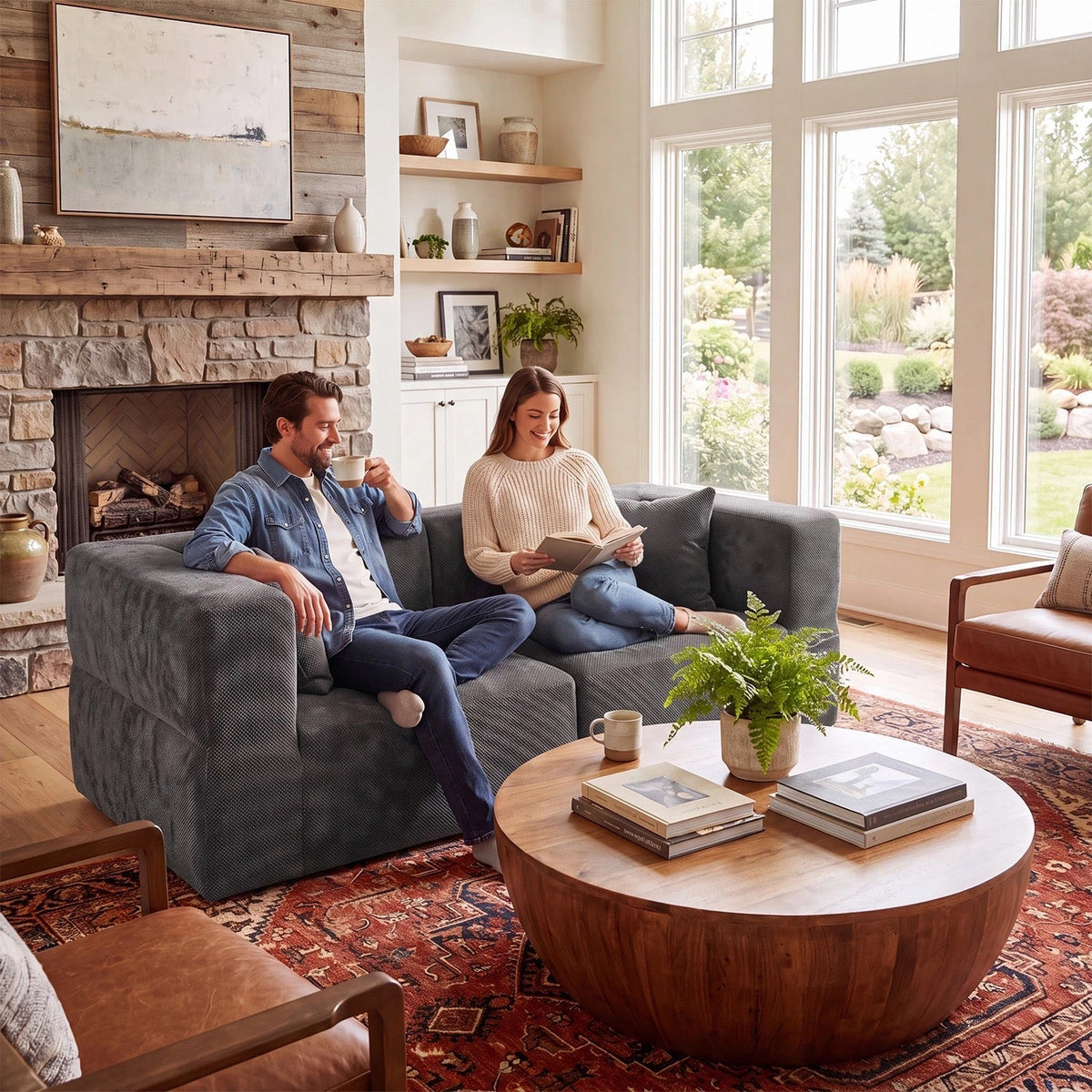
A deep seat can support relaxed sitting, but this image cannot prove upright fit for every body.
This guide is for a shopper who wants one sofa to handle conversation, reading or laptop use as well as movie-night lounging. It compares two current Monvane loveseat examples—26 inches and 27.56 inches of published seat depth—then turns the numbers into a repeatable home test. It does not diagnose posture, promise back support or set an industry-wide definition of a deep seat.
The 1.56-inch difference is real, but it is not the whole comfort story. A thicker back cushion may reduce usable depth; a softer seat may compress; a low seat can change how easily your feet settle; and two people with different leg lengths may experience the same sofa differently. Use the published dimensions to make a shortlist, then let the exact sitting test decide.
What seat depth actually measures
Seat depth is the front-to-back distance across the usable sitting surface, usually measured from the front edge of the seat to the point where the back cushion begins. It is not the same as overall depth. Overall depth measures the complete sofa from its frontmost point to its backmost point and controls how far the piece projects into the room.
Always confirm the measuring points on the exact product page. A loose back pillow, rounded front edge or different retailer convention can make two published numbers less comparable than they appear. Do not subtract the backrest thickness from overall depth and call the remainder seat depth unless the seller explicitly uses those points.

Is 26 inches or 27.56 inches better?
Neither is automatically better. Treat 26 inches as the first comparison when upright sitting is the non-negotiable job. Treat 27.56 inches as the first comparison when relaxed, tucked-leg or curl-up use matters more and the user can still reach support comfortably. Then test both assumptions against the exact back cushion, seat height and body using the sofa.
| Decision point | Start with a 26" seat | Start with a 27.56" seat |
|---|---|---|
| Primary use | Conversation, reading, eating from a tray or other more upright tasks | Relaxed TV use, sitting with legs tucked up or a roomier lounge position |
| Likely trade-off | May feel less expansive for a user who prefers to curl up | May require a lumbar pillow or foot support for some upright sitters |
| Pass condition | Back reaches support, knee crease stays clear and feet or chosen support feel stable | Same upright checks pass, and the added depth is genuinely useful for lounging |
| Reject when | The seat feels restrictive in the household's normal relaxed position | The user must slide forward, perches on the edge or cannot change position easily |
A small university chair study found that subjective comfort changed across seat depths, which supports the general idea that depth and body dimensions interact. It does not establish an ideal sofa depth: the study used task chairs, a limited participant group and conditions that differ from upholstered sofas. The useful lesson is to avoid universal numbers, not to import an office-chair result into a living room.
Research boundary: PubMed · Determining optimum seat depth using comfort and pressure distribution
Run a five-minute upright-sitting fit test
Use the sofa as you intend to use it. Remove only accessories the product allows you to move, wear ordinary indoor clothing and test without forcing a showroom pose. If two people will share the sofa, each person should run the test separately.
- Sit all the way back. Let your pelvis and back meet the normal back cushion instead of hovering forward.
- Check the seat edge. It should not press hard into the knee crease or force you to straighten the legs.
- Check the feet. They should reach the floor or an intentional, stable foot support without making you slide forward.
- Stay for five to ten minutes. Read, talk, use a laptop briefly or watch the screen in your normal upright position.
- Switch to lounge mode. Curl up or recline as you normally would, then decide whether the extra depth solves a real task.

UCLA's office-chair guidance uses firm foot support and space between the seat edge and the back of the knees as practical fit checks. Those principles can help you notice a mismatch, but a sofa has different cushioning, back angles and sitting tasks. Use them as a cross-check, not a prescription or health claim.
Fit-check reference: UCLA Ergonomics · Selecting a Chair
Why the same seat depth can feel different
A published depth number describes geometry before it describes experience. Four other variables can move the result enough that two sofas with similar listings feel different.
- Back-cushion position. A thick or forward-leaning cushion shortens usable depth; a movable lumbar pillow can provide targeted support without changing the sofa shell.
- Seat height. A higher or lower seat changes the relationship among hips, knees and feet. Compare the exact seat height with a sofa or chair you already know.
- Cushion response. Compression, edge shape and surface tension change where the body settles. Published depth alone does not reveal firmness or long-term feel.
- Sitting style. Upright conversation, cross-legged sitting, curled-up reading and reclining use different parts of the seat. Name the primary task before choosing.

Current Monvane 26- and 27.56-inch examples
The current Monvane pages reviewed for this guide provide a useful exact-product comparison. The Chenille and Corduroy Loveseat Sofa variants list the same outside footprint, 26-inch seat depth and 15.75-inch seat height. The Loveseat Sofa (2 Seater) lists a 27.56-inch seat depth and 16.5-inch seat height.
| Current product | Overall W × D × H | Seat depth | Seat height | What it proves |
|---|---|---|---|---|
| Loveseat Sofa · Chenille | 69.3" × 43.3" × 33.5" | 26" | 15.75" | One exact 26-inch example |
| Loveseat Sofa · Corduroy | 69.3" × 43.3" × 33.5" | 26" | 15.75" | Same listed geometry; different upholstery family |
| Loveseat Sofa · 2 Seater | 75" × 37.4" × 30" | 27.56" | 16.5" | One exact 27.56-inch example |
The most important room-fit surprise is that the 75-inch two-seater has the deeper listed seat but the shallower overall depth: 37.4 inches versus 43.3 inches. Product structure, back profile and arm geometry shape the outside footprint. Never use seat depth as a shortcut for how far the entire sofa enters the room.
These specifications do not prove that one model is softer, more supportive or more comfortable. No side-by-side instrumented comfort test was supplied for this rewrite. Use the table to shortlist geometry, then use the fit test and current product details to make the personal decision.

Current product sources: Chenille loveseat · Corduroy loveseat · 2 Seater loveseat

Who should choose which depth?
| Your priority | Compare first | Reason | Stop or adjust when |
|---|---|---|---|
| Mostly upright sitting | 26" example | Shorter starting distance from front edge to back support | The seat still pushes the legs forward or lacks stable support |
| Mostly relaxed lounging | 27.56" example | More published surface for tucked-leg or relaxed positions | The extra depth is unused or makes every upright sit awkward |
| Two users with different leg lengths | Test both | One user's pass can be another user's mismatch | A required pillow or footrest creates instability or daily friction |
| Small room with a tight path | Compare overall depth first | The deeper seat number may sit inside a shallower outside shell | The exact footprint, table gap or main route fails |
For a mixed-height household, a slightly shallower seat plus optional, correctly sized lumbar pillows can be easier to adapt than a seat that is too deep for the shorter user. That is a starting hypothesis, not a universal rule. Confirm that the pillows stay stable, do not crowd the shared seat and are appropriate for the exact model. If both users dislike the same configuration, choose a different seat geometry instead of trying to repair the mismatch with accessories.
Fit the whole sofa into the room
A comfortable seat can still be the wrong product if the complete sofa breaks the room. Tape the exact overall width and depth, add the coffee table and test the route people actually use. Monvane's current room guide uses at least 30 inches for a main walkway, 16–18 inches between the seating edge and a coffee table and 2–6 inches behind the sofa when the layout allows. These are planning references, not building-code or accessibility guarantees.
The 69.3-inch models use less wall width but extend 43.3 inches into the room. The 75-inch model needs 5.7 more inches of wall but is 5.9 inches shallower overall. Start with whichever room dimension cannot move. Only after both candidates pass the floor plan should seat depth and personal fit break the tie.

Room-planning source: Monvane Sofa Sizes & Room Fit Guide
Common deep-seat buying mistakes
- Calling the largest number the most comfortable. Depth supports a task only when the user's body, back support and feet also work.
- Comparing seat depth with overall depth. One describes the sitting surface; the other controls the room footprint.
- Testing only one pose. A sofa for daily life should be checked in the household's real upright and relaxed positions.
- Treating a pillow as proof of fit. A pillow can fine-tune support, but a large permanent correction may signal the wrong geometry.
- Generalizing from one product. The 26- and 27.56-inch figures in this guide belong to named current Monvane examples, not every sofa.
- Ignoring other household users. Each regular sitter should pass the same test before a shared-sofa decision.
Deep seat sofa FAQ
Is a deep seat the same as a low sofa?
No. Seat depth measures front-to-back sitting space; seat height measures the floor-to-seat relationship. A sofa can be deep and relatively high, shallow and low, or another combination. Compare both fields because seat height changes whether your feet reach support and how easily you move between sitting and standing.
Can I compare seat depth across different brands?
Only after checking the measuring points. Sellers may measure to a fixed back, a loose cushion or another contact point. Look for a dimension drawing or written method, and ask the seller when the page is unclear. Do not assume two identical numbers describe identical usable seating space.
Can a lumbar pillow fix a sofa that feels too deep?
A stable lumbar or back pillow can shorten the usable depth for some upright sitters. It should be a small, intentional adjustment rather than a way to rescue a persistent mismatch. If the pillow slides, crowds the seat or is needed for every position, compare another seat geometry.
Should a shorter person avoid every deep-seat sofa?
No. Height alone does not decide fit; leg proportions, back-cushion position, seat height and preferred posture all matter. A shorter user may enjoy a deep seat for lounging and use a stable pillow for occasional upright sitting. The exact sit test is more reliable than a height label.
What if two regular users need different seat depths?
Test both people on the same exact sofa. Favor a configuration that both can use safely and without repeated repositioning, then evaluate optional pillows or foot support for personal fine-tuning. If one person still perches or slides forward, the shared sofa has not passed.
Make the decision with exact evidence
Start with the job the sofa must perform most often. Compare the 26-inch examples first for upright-first use and the 27.56-inch example first for lounge-first use, but approve neither until the exact product passes body fit, room fit and delivery checks. Keep the dimensions beside you, test every regular sitter and pause when a product page does not explain its measuring points.
Compare current Monvane loveseats · Open the room-fit guide · Ask Monvane support
Sources and methodology
Current Monvane dimensions and room-planning figures were checked on August 4, 2026 against the linked first-party pages. Product images come from the Monvane website-writing library and are used only for visible product form and use context. The fit method combines exact product geometry with a qualified upright-sitting cross-check; external chair research is not treated as a sofa standard. No medical benefit, long-term durability result, universal comfort claim or side-by-side instrumented product test is asserted.


