


Delivery & Quality
How Compressed Sofas Are Made: Materials, Packaging, and Quality Checks
See how compressed sofas move from product specification to packaging, what current Monvane facts show, and which quality evidence to verify.
On this page
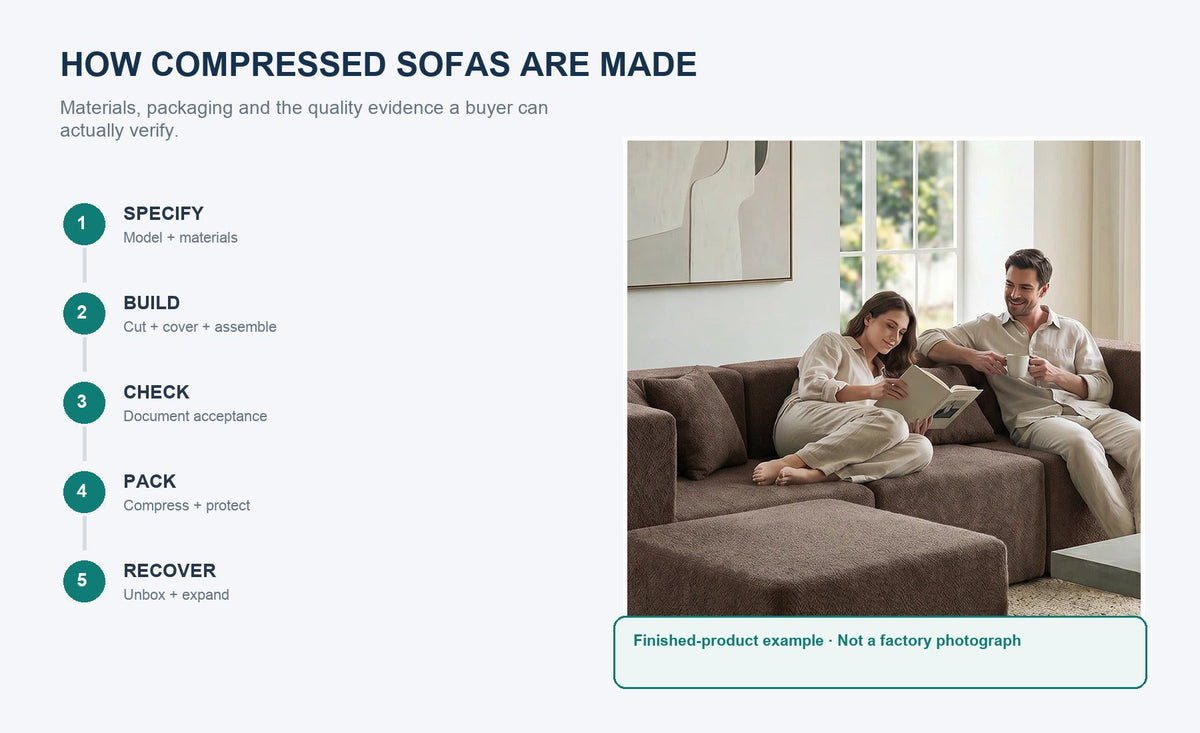
A compressed sofa still begins with an exact product specification. Compression changes the delivery state; it does not replace material, process or test evidence.
Factory access and product evidence answer different questions. A marketing illustration can explain a concept, but it cannot prove what happened at a specific station. A density number, abrasion claim or certification logo also needs a model-level source. This guide keeps the useful buyer question—how a compressed sofa is made and checked—while separating verified product facts from a general process map.
What this guide can—and cannot—show
A finished sofa page can confirm the specifications the seller publishes for that model. A support page can confirm the expected setup and issue-reporting process. Those sources cannot show an undocumented factory station, inspection frequency, rejection threshold or test result. A truthful manufacturing guide therefore labels each type of evidence instead of filling gaps with industry assumptions.
| Evidence available now | What it supports | What it does not support |
|---|---|---|
| Current Monvane product pages | Named model dimensions, foam density, fabric description, construction wording, package count and setup | Universal specifications, factory procedure, lifetime or lab performance |
| Current support / setup pages | 48–72-hour natural recovery guidance, unboxing sequence and damage-reporting steps | A rebound test, structural test or promise that every unit reaches one exact time |
| Editorial process diagrams | A clear checklist of stages and proof buyers should request | A Monvane factory blueprint, work instruction or production audit |
| Certification-program rules | How to verify the certificate holder, material or article scope and validity | That an exact Monvane product is certified without its number and mapping |
The seven-stage compressed-sofa process
The sequence below is a responsible editorial map for a foam-based compressed sofa. It explains what must happen conceptually and what evidence would make each stage publishable. It is not a claim that every manufacturer uses the same machinery, order, inspection frequency or acceptance limits.

| Stage | The job | Evidence that should exist |
|---|---|---|
| 1 · Product specification | Define the exact model, dimensions, materials, unit count and acceptance rules | Approved bill of materials, drawing/spec sheet and revision |
| 2 · Foam preparation | Cut or shape foam parts and identify the correct density/type | Supplier record, part ID, density/tolerance and lot mapping |
| 3 · Upholstery preparation | Cut and sew the cover for the exact parts and finish | Fabric specification, color/lot record, sewing or finish checks |
| 4 · Module assembly | Bring the foam, cover and any supporting components together | Section image, component map, model-specific work instruction |
| 5 · Pre-pack inspection | Check appearance, dimensions, components and any defined functions | Checklist, sampling frequency, pass/fail limits and corrective action |
| 6 · Compression and packing | Reduce volume, protect the product and label the carton | Packing instruction, package dimensions/weight and protection standard |
| 7 · Delivery recovery | Open packaging, position pieces and allow foam to expand | Model setup guide, recovery range and issue-reporting threshold |
What current Monvane product pages actually document
Two current Monvane modular products publish a useful but limited set of construction facts. The L-Shaped Modular Couch lists an outside size of 103 inches wide by 65 inches deep by 30 inches high and two packages. The U-Shaped Modular Couch lists 130 inches wide by 65 inches deep by 30 inches high and three packages. Both pages list 30D high-density foam, shown as 1.87 pounds per cubic foot, short-pile chenille, boneless and glue-free construction, and no-tool setup.

| Current product | Published size | Material / construction facts | Setup / shipping |
|---|---|---|---|
| L-Shaped Modular Couch | 103"W × 65"D × 30"H | 30D foam (1.87 lb/ft³); short-pile chenille; boneless; glue-free | No tools; 2 packages |
| U-Shaped Modular Couch | 130"W × 65"D × 30"H | 30D foam (1.87 lb/ft³); short-pile chenille; boneless; glue-free | No tools; 3 packages |
Exact current product pages: L-Shaped Modular Couch · U-Shaped Modular Couch
“Boneless” and “glue-free” should be repeated only as the current product wording. They do not prove that every Monvane sofa has the same internal structure, that a module contains no support component of any kind or that the product will perform for a stated number of years. A section photograph or component diagram would be the next useful evidence.
Compression is packaging—not proof of quality
Compression changes the product’s shipping state. After the protective bag is opened, foam-based seating needs time to regain shape. Monvane’s current support guidance says compressed foam normally recovers naturally within 48–72 hours; the setup page tells the buyer to open the cartons in the intended room, cut the compression bags and allow the product to expand. That range is a setup expectation, not a laboratory rebound score or a durability forecast.

Current setup references: Monvane Support · Setup & Delivery
If one area remains visibly compressed after the stated range, compare it with the setup instructions and contact support rather than improvising heat, chemicals or aggressive handling. Keep the product and carton photographs, package label and order information because those records help distinguish shipping damage, a missing component and normal early recovery.
Use an evidence ladder for every quality claim
A quality claim becomes stronger as it moves from an adjective to a model-matched record. “High quality” alone is not measurable. A density specification is more useful, but it still does not tell you the foam type, firmness, layer geometry, tolerance or how the complete seat performs. A named test report is stronger only when the tested sample maps to the exact material and current product.

| Evidence level | A useful example | Responsible language |
|---|---|---|
| Marketing description | “Supportive” or “durable” without a defined measure | Treat as a description, not a test result |
| Product specification | 30D / 1.87 lb/ft³ foam on two named pages | State the number and exact products; do not add a lifespan |
| Test report | Named method, laboratory, sample, date and result | State only the measured property and conditions |
| Certificate scope | Number, holder, valid status and certified material/article | Name the certified scope—not the whole sofa by default |
| Model mapping | Supplier/variant or bill-of-material record links evidence to the current item | Publish the strongest exact claim the mapping supports |
Five questions replace five quality shortcuts
A useful quality checklist asks about foam, internal structure, recovery, upholstery and certification. Those are the right fields, but numerical lifespan and abrasion conclusions still need to be traceable to the exact product. Use the questions below to request evidence without inventing a pass mark.

| Field | Ask this | Do not infer |
|---|---|---|
| Foam | What density and foam type does this exact seat use? Are there multiple layers? | That 30D alone guarantees one comfort level or an 8–10-year lifespan |
| Internal structure | What components sit inside the module, and what does “boneless” mean for this model? | That boneless means no support structure, no movement or greater durability |
| Recovery | What range is normal, and when should an uneven area be reported? | That fast visual expansion proves long-term resilience |
| Upholstery | Which test method, lab, sample and result apply to the exact fabric variant? | A 30,000–50,000 Martindale result when no current report is supplied |
| Certification | What is the certificate number, holder, scope, validity and product mapping? | That a logo means the complete sofa is certified, non-toxic or universally safe |
How to check CertiPUR-US and OEKO-TEX claims
Certification language must match the program’s scope. CertiPUR-US states that it certifies flexible polyurethane foam—not furniture, a product line or a company. Its directory and producer certificates help verify participating firms, foam families, report IDs and validity. If a seller uses the name, ask which foam supplier and product family apply to the exact model.
OEKO-TEX STANDARD 100 covers textiles or articles tested for harmful substances within a defined certificate scope and product class. The official Label Check accepts the case-sensitive certificate or label number. Before applying the claim to a sofa, confirm whether the certificate covers the upholstery fabric, another component or the finished article—and whether the exact color, supplier and current variant are included.

Official certification references: CertiPUR-US FAQ · CertiPUR-US Directory · OEKO-TEX STANDARD 100 · OEKO-TEX Label Check
What to check when the sofa arrives
Arrival is the first time a buyer can compare the delivered item with the published model. This is not a factory quality audit, but it creates useful evidence if a package is damaged, a piece is missing or recovery does not match the instructions.
- Match the labels. Confirm the order, model or variant and the number of delivered packages before discarding anything.
- Photograph the cartons. Capture every side, shipping label, puncture, crush or wet area before opening.
- Open in the intended room. Follow the exact setup page, protect the upholstery and keep the packaging while the product is checked.
- Count and inspect the pieces. Compare the delivered units, fabric, visible seams and dimensions with the current product information.
- Allow the stated recovery window. Use 48–72 hours as current site guidance, not as permission to ignore obvious damage or a wrong item.
- Report a documented issue. Send the order information plus product and packaging photos or video through the current support route.
Compressed sofa manufacturing FAQ
How is a compressed sofa made?
At a high level, the model is specified, foam parts are cut or shaped, upholstery is prepared, the modules are assembled and inspected, and the product is protected, compressed and packed. The exact machines, order and checks vary, so factory-specific claims need factory records.
Does compression damage a sofa?
Compression alone does not answer that question. Use the exact manufacturer’s packaging limits, recovery guidance and defect process. Current Monvane support guidance allows 48–72 hours for compressed foam to recover naturally.
What does 30D sofa foam mean?
On the two current Monvane pages used here, 30D is published with a density of 1.87 lb/ft³. Density describes mass per volume; by itself it does not prove firmness, comfort, layer design or lifespan.
Are compressed sofas lower quality than traditionally shipped sofas?
Not automatically. Shipping state is separate from material specification, construction, test results, service and real-use fit. Compare the exact evidence instead of ranking products by carton size.
How can I verify a fabric abrasion claim?
Ask for the named test method, laboratory or report, tested fabric or color, date and measured result. Do not transfer a supplier result to another upholstery variant without product mapping.
What certification proof should a sofa seller provide?
Request the certificate or label number, certificate holder, standard, material or article scope, product class where relevant, validity and the record connecting that scope to the exact model and supplier.
Choose evidence that follows the exact sofa
A useful manufacturing guide does not need to pretend that every production record is public. It needs to show the reader which facts are available, which claim each fact supports and what is still missing. For the current Monvane L- and U-shaped examples, begin with the published foam, fabric, construction, dimensions, package count and setup guidance. Ask for the remaining test or certificate mapping before relying on a stronger quality statement.
Use the exact product page to recheck specifications before ordering, and use the support page for the current setup and issue process. If Monvane later publishes model-specific factory photography, quality-control data or certificate records, add those items with dates and scopes instead of silently broadening this article.
Compare current modular sofas · Review materials and durability · Open support
Sources and methodology
Two legacy compressed-sofa articles were reviewed for useful buyer questions, unsupported claims and image provenance. Product dimensions, foam density, fabric, construction, package count and setup were checked against current Monvane L- and U-shaped product pages on August 4, 2026. Recovery and issue guidance were checked against current first-party support and setup pages. Certification boundaries were checked against official CertiPUR-US and OEKO-TEX program pages. The manufacturing sequence and evidence ladder are editorial frameworks, not factory blueprints, inspection records or engineering drawings. No factory photograph, lab result, certificate number, lifespan, price, promotion, rating, stock claim or unverified sustainability or safety claim is presented as fact.


