


Buying Guides
What Is a Loveseat? Definition, Uses and Who It Fits
A loveseat is a compact two-person sofa, but exact size and features vary. Learn how it differs from other seating, where it works and what to check before buying.
On this page
The loveseat category is built around a two-person seating job; exact width, depth and features still vary by model.
That distinction matters online. A product can be labeled a loveseat and still be wider, deeper or more lounge-oriented than another two-seater. The category tells you the intended seating capacity. It does not tell you whether the piece will fit a six-foot wall, support an upright posture, convert into a bed, resist stains or arrive without assembly.
This guide owns the definition, terminology, use cases and audience-fit decision. For a full measuring workflow, use the separate Monvane size guide rather than turning a definition article into another dimension checklist.
What is a loveseat?
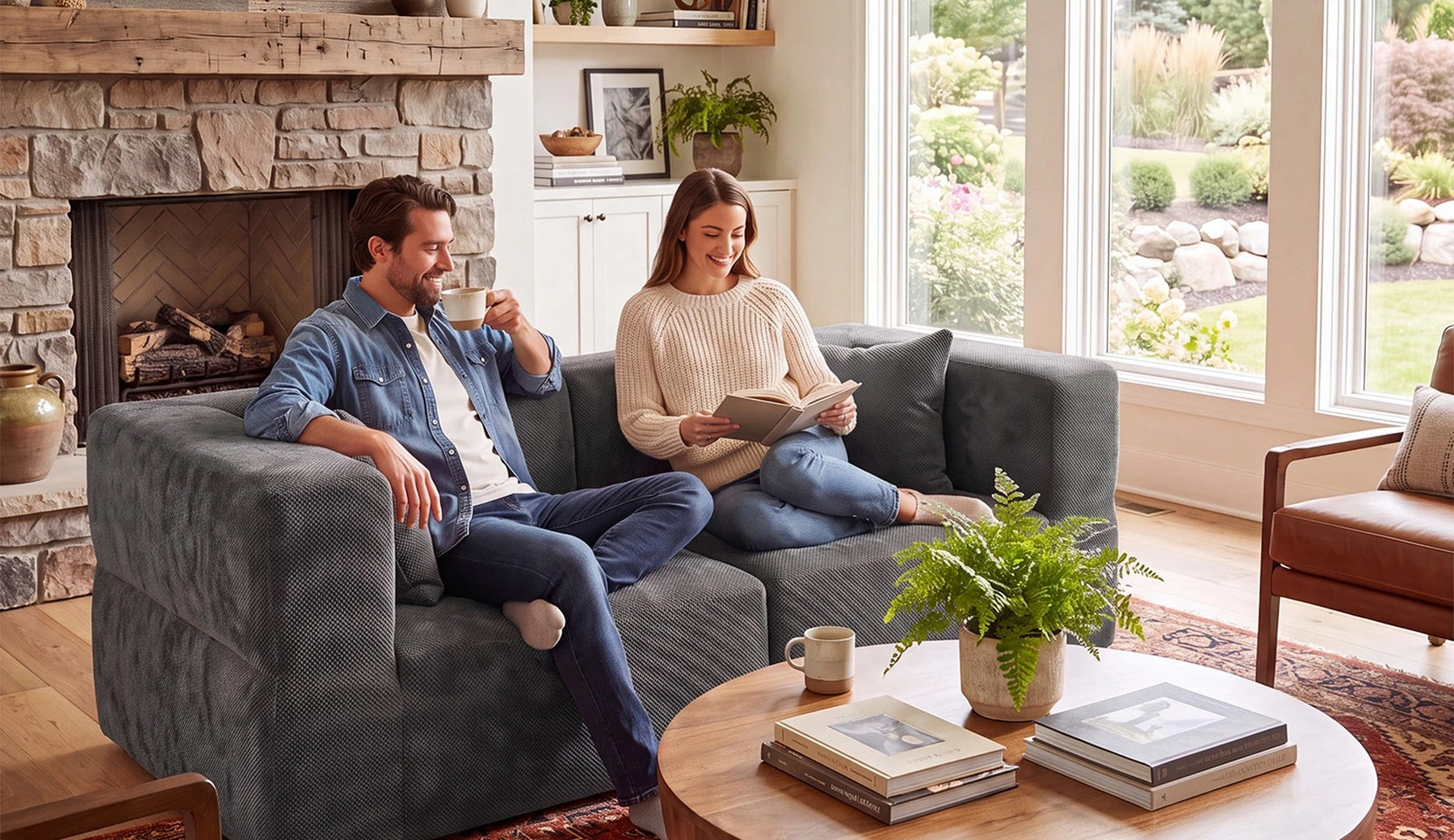
Merriam-Webster defines a love seat as a double chair, sofa or settee for two people. In current retail language, “loveseat” and “two-seater sofa” often overlap. Both usually describe a standalone upholstered seat where two people sit side by side, with a back and some form of arm support.
The important word is “two.” A loveseat is not defined by one official width, cushion count or construction method. Some designs use two distinct seat cushions; others use one continuous seat. Some have fixed arms, while others have movable components. Those details change the experience, but they do not replace the basic two-person category.

Definition reference: Merriam-Webster’s love seat entry
Why is it called a loveseat?
The practical reason is simple: it is a seat for two people, close enough to share one compact piece of furniture. Merriam-Webster records 1847 as the first known use of “love seat” in the modern two-person sense. That gives the term a documented historical anchor without turning a buying guide into folklore.
You may see confident stories claiming that every loveseat began as a chair for large dresses or as a courtship bench. Furniture history includes several wide-chair and two-seat forms, but short retail histories often repeat one neat origin story as if it were settled. For today’s shopper, the reliable takeaway is the current definition: a two-person seat. The exact style must still be identified from the product itself.
Loveseat vs. sofa, chair, settee, sectional and sofa bed
Furniture labels overlap, and retailers do not all draw the boundaries in exactly the same place. Use the intended seating job and structure first, then confirm capacity and dimensions on the current listing.
| Term | Usual seating job | What separates it from a loveseat |
|---|---|---|
| Armchair | One person | A single independent seat rather than a shared two-person seat |
| Loveseat / two-seater | Two people | The reference category: a compact standalone sofa form for two |
| Sofa | Varies; often more seats | A broad category that may be longer or hold more people; some two-seat sofas are sold as loveseats |
| Settee | Varies; often compact | A broad or more traditional term that can overlap with a loveseat, depending on the design |
| Sectional | Multiple seats or modules | Built from connected sections or modules rather than one compact two-seat body |
| Sofa bed | Seating plus sleep | Adds a verified conversion or sleeper function; the word “loveseat” alone does not imply one |
What is a loveseat used for?
A loveseat works best when two-person seating is the actual job—not merely when the room is described as small. These are the most useful roles to consider:
- Main seating for one or two people. In a studio, apartment or smaller living room, a loveseat can replace a larger sofa when the measured footprint keeps the walkway usable.
- Roomy solo seating. One person can sit across a wider surface, curl up with a pillow or use the second seat for a book or blanket.
- A secondary conversation seat. In a larger living room, a loveseat can face or sit perpendicular to a sofa without adding a full sectional.
- A compact seat for a bedroom, home office or reading corner. The piece still needs a clear door swing, chair path and delivery route.
The same loveseat does not need to serve every role. A deep, lounge-oriented design may be a strong movie seat but less suitable for an upright desk-side conversation area. Start with the routine, then select the posture and footprint.

Who is a loveseat best for?
| Household or need | Fit | Reason to choose or compare |
|---|---|---|
| One person who likes room to lounge | Often a strong fit | More shared surface than an armchair without automatically moving to a larger sofa |
| Two-person household | Often a strong fit | Matches the intended seating capacity if both users fit the seat and posture |
| Small room or apartment | Conditional fit | Can work well, but only the exact outside width, depth and traffic path decide |
| Household regularly seating three or more | Usually secondary | A larger sofa or sectional may better match everyday capacity |
| Frequent overnight guest use | Compare sofa beds | A standard loveseat does not include a sleep function unless the listing confirms one |
| Upright or easy-rise preference | Measure and test | Seat depth and height—not the loveseat label—control how low or reclined the position feels |
A loveseat is less automatic when the room must seat a family every day, when the only available wall is shorter than the product, or when a deep seat keeps the intended user from reaching the back support. In those situations, compare an armchair pair, a larger sofa, a sectional or a verified sofa bed instead of forcing the category to solve the wrong problem.
How big is a loveseat?
There is no single loveseat width. Current Monvane examples make the point clearly: the Chenille and Corduroy Loveseat Sofas are listed at 69.3 inches wide, while the Loveseat Sofa (2 Seater) is listed at 75 inches wide. All three are listed for two seats, yet their overall depth, height and seat measurements also differ.
| Current model | Overall D × W × H | Seat depth / height | Fabric |
|---|---|---|---|
| Loveseat Sofa (Chenille) | 43.3" × 69.3" × 33.5" | 26" / 15.75" | Chenille |
| Loveseat Sofa (Corduroy) | 43.3" × 69.3" × 33.5" | 26" / 15.75" | Corduroy |
| Loveseat Sofa (2 Seater) | 37.4" × 75" × 30" | 27.56" / 16.5" | Chenille |
Current product specifications: Chenille loveseat · Corduroy loveseat · 75-inch 2 Seater

For these three Monvane products only, the current pages also list no tool-based assembly and a 48-hour natural-expansion period after unboxing. Do not turn that into a universal loveseat rule. Another brand or model may use legs, frames, connectors or different setup instructions.
For full measuring and clearance guidance, use the Monvane Sofa Size Guide
How to choose a loveseat in six steps
- Define the seating job. Decide whether the piece is the main sofa, a solo lounge seat, a conversation seat or an occasional room seat.
- Count regular users. A two-seat category is a weak main solution when three or more people need seats every day.
- Map the exact footprint. Tape the full outside width and depth, then open doors, pull out nearby chairs and walk the main path.
- Compare posture measurements. Match seat depth and height to a chair or sofa that the intended user already finds workable.
- Choose the actual fabric and care plan. Review visible texture, current upholstery details and product-specific cleaning instructions.
- Check delivery and setup. Measure the package route, confirm assembly requirements and allow the listed recovery time for compressed designs.
The loveseat label does not guarantee these features
Treat the following as product-level claims, never category assumptions:
- A fixed size. Two-seat products can have different outside widths, depths and arm proportions.
- Small-space fit. A loveseat can still block a door, narrow a walkway or project too far into the room.
- A sleeper or convertible function. Only a verified mechanism or flat configuration supports that claim.
- Universal comfort. Body size, posture, seat depth, height, back support and foam response all change the experience.
- No assembly, stain resistance, pet suitability, washable covers or long-term durability. Each needs its own current evidence.

Need a room-specific example? Read How to Plan a Compact Loveseat for a Bedroom, Office or Guest Room
Loveseat FAQ
Is a loveseat for one person or two?
A loveseat is designed as a two-person seat. One person can also use it as a roomier lounge seat, but the category’s basic seating job is two people side by side.
Is a loveseat the same as a two-seater sofa?
Often, yes. Retailers commonly use loveseat and two-seater sofa for overlapping products. Check the listed seating capacity and dimensions because naming conventions vary.
Is a loveseat smaller than a sofa?
A loveseat is usually shorter than a larger multi-seat sofa, but “sofa” is a broad term and there is no universal cutoff. Compare the exact outside width and depth.
Why is a loveseat called a loveseat?
The name reflects a shared seat for two people. Merriam-Webster records 1847 as the first known use in this sense. More specific romantic origin stories should be treated cautiously unless they have a reliable historical source.
Can a loveseat be the main sofa?
Yes, when one or two people are the regular users and the measured footprint, posture and room path work. A larger household may need additional seating.
Is a loveseat good for a small apartment?
It can be, but the label is not proof of fit. Tape the exact width and depth on the floor and keep the main walkway, door swing and nearby furniture usable.
Can you sleep on a loveseat?
A standard loveseat is not automatically a sleeper. Casual napping may be possible for some users, but overnight use requires a product with a verified sleep surface or conversion function.
Do loveseats require assembly?
It depends on the model. The three current Monvane examples in this guide list no tool-based assembly and 48 hours for natural expansion, but that is not a category-wide rule.
Choose the seating job first
A loveseat is a two-person sofa category—not a promise about size, comfort, fabric or function. It is a strong option when one compact piece genuinely serves one or two regular users and the exact footprint preserves the room’s path. Start with the seating job, verify the model, and move to a larger sofa, sectional or sofa bed when the household needs more capacity or a different function.
Compare current Monvane loveseats · Plan the room with the Sofa Size Guide
Sources and methodology
The category definition and first-known-use date were checked against Merriam-Webster on August 3, 2026. Product examples were checked against the three linked Monvane product pages and the current Monvane size guide on the same date. Specifications are model examples, not category standards. Prices, promotions, ratings, reviews and unsupported performance claims were excluded. The category map is an editorial explanation, not a product drawing.


