


Buying Guides
Wood Frame Loveseat: Comfort, Durability, and Care Guide
A wood-frame label is useful only when the material is attached to a specific component. Learn how to compare hidden structure, comfort evidence, durability signals and component-specific care.
On this page
A wood frame loveseat is not automatically more comfortable or more durable than one built with different materials. This guide separates comfort, durability and care instead of treating the wood label as a verdict. Start by identifying which component uses which wood or wood-based product, how that component connects to the suspension and cushions, and what care the exact finish permits. Treat hidden structure, exposed wood and wood-look appearance as three different claims. Then record the back and seat frame, arms, rails or base, legs, suspension, and joints or hardware separately. If the listing cannot attach a material to a component, keep that field unknown. A photograph cannot prove hidden joinery, and a material list cannot predict lifespan.
Start with the frame claim, not the wood adjective
“Wood frame” sounds precise, but a listing may use it at several levels. It can describe the hidden structure under upholstery, one part of a mixed internal build, exposed legs or rails, or a visible finish that resembles wood. Those meanings lead to different buying and care questions.
- Hidden structure: ask which back, seat, arm, rail or blocking components are wood or wood-based and where the seller documents them.
- Exposed finished wood: identify both the substrate and the finish. Solid wood, veneer, stain, clear lacquer, paint and oil do not describe the same care surface.
- Appearance only: visible grain or brown color can prompt a material question, but it cannot prove solid wood, a joint type or frame durability.
Write the component after the material: “solid pine legs,” “plywood back and seat frame,” or “finish not identified.” Avoid a note such as “mostly solid wood” unless the exact record defines the scope. Also keep “wooden frame loveseat” separate from “wood-look loveseat.” A visual style is not a construction record.

Map every structural role before comparing materials
A loveseat can combine several materials because different parts do different jobs. The USDA Forest Products Laboratory classifies plywood, laminated veneer lumber, particleboard, fiberboard and other wood-based composites as distinct material families used in both structural and nonstructural applications, including furniture. That background does not rank one named loveseat. It is a reason to ask what a material does in the exact design.
| Component role | Evidence to capture | Question it answers |
|---|---|---|
| Back and seat frame | Exact material list, product ID and source location | What forms the main upholstered structure? |
| Arm frames | Material by arm component, padding and attachment description if supplied | Are the arms part of the same build or a separate structure? |
| Rails or base | Front, rear and side rail materials; visible or hidden status | What connects or supports the main seating span? |
| Legs | Substrate, finish, attachment and replacement information | What touches the floor, and how is the exposed surface maintained? |
| Suspension | Webbing, springs, deck or other exact seller description | What supports the cushions above the frame? |
| Joints and hardware | Documented corner blocks, connectors, fasteners, assembly manual and service route | How are roles joined, and what can the owner verify or service? |
If a row is missing, mark it unknown. Do not copy a material from the legs into the hidden frame, or a frame material into the suspension. A material name without a role is incomplete evidence. The six-row component record is a Monvane editorial organizer, not an engineering inspection or product standard.
Three current records show three different scopes
Current exact product pages make the disclosure problem concrete. The following examples are not matched candidates and do not represent the whole market. Their job is to show how different records attach construction facts to different components.
Monvane: an exact boneless non-example
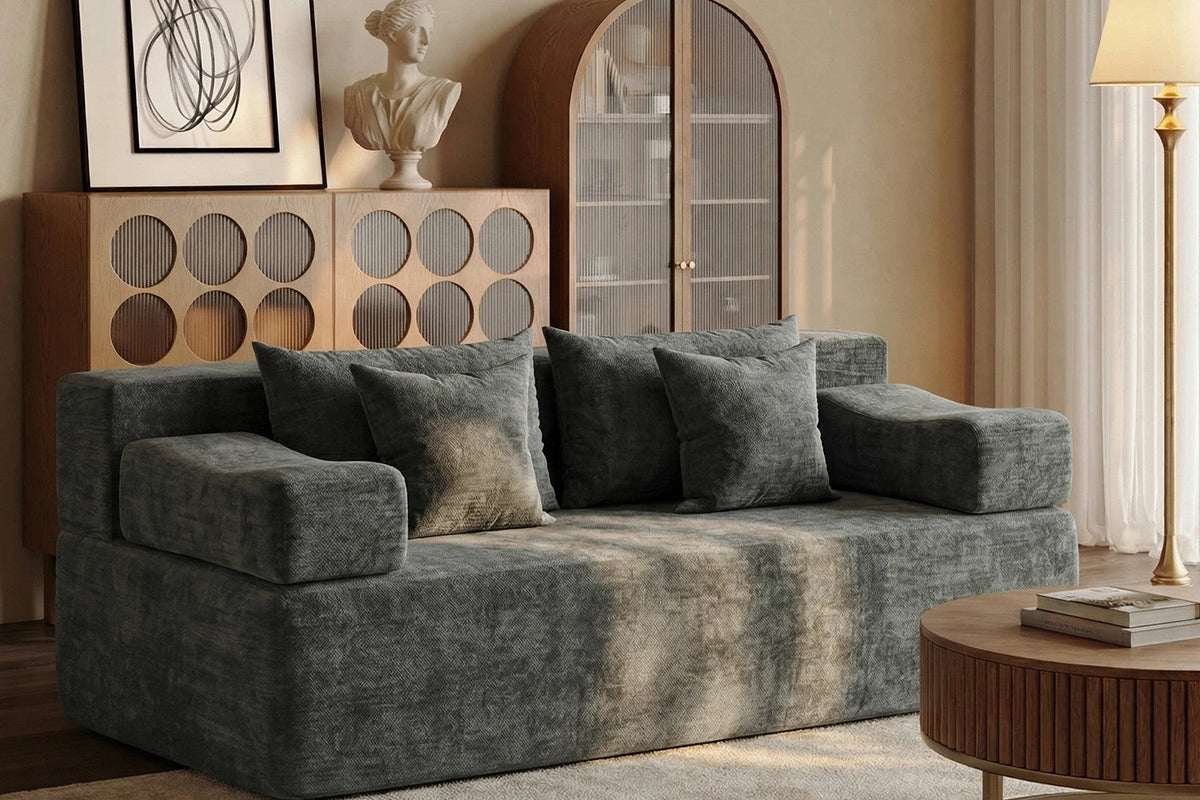
The current Monvane Loveseat Sofa in Chenille identifies its structure as boneless and glue-free. The exact page also names high-density 30D foam, chenille upholstery and a damp-cloth spot-care route. This is useful precisely because it is not evidence of a wood frame. A shopper comparing it with a wood-frame loveseat must compare two different construction approaches by their own records.

IKEA: mixed materials by frame role
The current IKEA MORABO Loveseat frame, Article Number 904.563.35, lists plywood, solid pine, particleboard and fiberboard for the back and seat frame. Its armrest-frame list repeats those wood materials and adds foam. The same exact record separately lists cushion materials and calls the cover stationary and non-removable. This is a component-level mixed-material record, not support for calling the loveseat “all solid wood.”
Article: frame, support and joint wording
The current Article Rhett 63.5-inch Loveseat, SKU25800, states corner-block frame construction, solid pine legs, and a frame list of solid pine, poplar and rubberwood engineered wood with nylon webbing. It separately identifies its cushion filling and fabric care. That record gives more than one structural clue, but it still does not expose every joint or predict how another loveseat is built.
These current records illustrate disclosure scope only; they do not rank the three products or predict how long any loveseat will last. Do not turn “corner-block,” “solid pine,” “engineered wood,” “plywood” or “boneless” into a universal winner without the rest of the product record and the intended household use.
Separate frame evidence from comfort evidence
The frame holds or shapes the seating system; it does not describe the entire sitting response. The current exact records above list cushion or suspension fields separately from the frame materials. Keep those columns separate when comparing candidates.
| Evidence layer | What to record | What to observe |
|---|---|---|
| Frame | Components, materials, joints, hardware and assembly state | Stability and whether the exact product record is complete |
| Suspension | Webbing, springs, deck or other disclosed support | How the seat supports weight across center and edge |
| Cushions | Fill, layers, attachment and cover status | Initial response, recovery and whether users can maintain position |
| Geometry | Seat depth and height, back and arm positions, usable width | Back contact, foot position, reach and ease of standing |
| Surface | Upholstery and exact finish or texture | Touch preference, sliding, heat perception and care burden |
Test the exact loveseat with the people who will use it most. Try the center and front edge, sit upright and in the main lounge position, shift naturally, and stand up. Replace “comfortable” with a specific observation: “my feet rest flat,” “the back cushion loses contact,” or “the edge makes standing difficult.” Two households can accept the same frame record and still choose different loveseats because their bodies, routines and preferred postures differ.
The sitting check compares household preference on the exact loveseat; it is not a medical, ergonomic or durability test. When buying online, use exact dimensions to screen obvious mismatches, but keep cushion response unknown until a legitimate trial or current return route can resolve it.
Judge durability from the load path and service record
Durability is not a synonym for a wood species. A useful record asks how the main seating span, arms, legs, suspension and joints work together, which facts are documented, and what happens when a high-use part changes. A seller’s “durable” statement remains seller wording unless the exact page supplies a defined test, scope and result.
- Preserve exact identity. Save the maker, product name, model or SKU, selected configuration and date.
- Attach materials to load-bearing roles. Record what is known for the back/seat frame, arms, rails or base, legs and suspension.
- Capture only documented connections. Note corner blocks, hardware or assembly details only when the exact page, manual or written seller answer supplies them.
- Record a delivery baseline. On a level floor, photograph accessible legs, visible rails, seams, hardware and the product’s normal unloaded alignment. Do not perform a load test.
- Track a change, not a hunch. If movement, a gap or a sound is new, record where it occurs, when it appears and whether the exact manual identifies that connection.
- Preserve the service path. Keep the assembly manual, parts route, warranty terms, receipt and seller contact with the component record.
This is a non-invasive owner observation, not permission to open upholstery or repair a structural joint. Do not unzip, cut, peel or probe a cover to inspect hidden members. Pause use and contact the exact seller or service path when you see new instability, a widening joint, a split component, protruding hardware, a missing fastener or a change that the manual does not explain. Do not improvise with glue, drilling or substitute hardware.
Match care to the surface you can actually reach
One loveseat may contain four care scopes: upholstery, exposed finished wood, hidden frame, and hardware or joints. One care sentence cannot authorize work on all four scopes. Copy each instruction beside the component it actually covers.

- Upholstery: record whether the cover is removable, the permitted cleaning method, drying limits and the escalation route for persistent stains. The current Monvane example gives a damp-cloth spot-care instruction for its exact chenille loveseat. The MORABO record says to vacuum and wipe its non-removable cover with a damp cloth. The Rhett record gives its own dry-blot, vacuum or non-metallic-brush and professional-cleaning route. None is a universal fabric instruction.
- Exposed finished wood: identify both substrate and finish before applying moisture, cleaner, polish or oil. Visible grain is not permission to sand or refinish. USDA material guidance notes that wood responds to moisture and that dimensional response varies with material and conditions; that is a reason to avoid saturating an unknown finish, not a cleaning recipe.
- Hidden frame: keep it dry through the product’s approved upholstery-care route and inspect only seller-approved access points. Do not transfer an exposed-leg treatment under the upholstery.
- Hardware and joints: record the exact manual and part number. Tighten, replace or adjust something only when the exact instruction authorizes the action and method.
The four-scope care checklist organizes seller instructions; it does not authorize a cleaner, finish, tightening step or repair. If a decisive care field is missing, ask the seller before applying a product. For a Monvane model, use Monvane Support with the exact product name, order details, photos and the unresolved component question.
Make the decision from the component record
| Decision | Use it when | Next action |
|---|---|---|
| Pass | Structural roles are documented well enough for the decision, the full seating system works for frequent users, accessible condition is stable, and the care/service path fits the household. | Save the exact record and selected configuration with the order. |
| Pause | A decisive frame role, joint/support field, finish identity, care instruction, service route or online comfort uncertainty remains open. | Request the missing fact in writing or use a legitimate trial and current terms to resolve it. |
| Reject or escalate | The loveseat fails the intended sitting task, the care burden is unacceptable, or new instability, separation or damage appears. | Choose another exact product or stop use and follow the seller’s service route. |
The final pass, pause or reject record is a shopping aid; the exact seller instructions, warranty and support decision control. Choose the exact loveseat, not the strongest-sounding material adjective. A product with a mixed wood record may fit the household; a solid-wood claim may remain too vague; a boneless design may be the better match for a different routine. The valid conclusion comes from component identity, full-system comfort, observable condition and a care path the household will actually follow.
When reviewing Monvane, start with the current Loveseat Sofa in Chenille as its own documented boneless option rather than forcing it into a wood-frame comparison. If a frame, care or service field is missing on any exact product, keep the decision open until the seller confirms it.
Sources and scope
The current Monvane Loveseat Sofa in Chenille, IKEA MORABO Loveseat frame 904.563.35 and Article Rhett Loveseat SKU25800 records were checked August 19, 2026. Product facts apply only to the named exact pages and checked date. The USDA Wood Handbook chapter on wood-based composites supports material-family boundaries and furniture-use context; its moisture chapter supplies general wood behavior only. Neither source ranks the named loveseats or authorizes product-specific care.
The component record, comfort separation, non-invasive observation, four-scope care checklist and decision table are bounded Monvane editorial tools. They do not certify construction, predict lifespan, replace a current manual or authorize structural repair. The real product and room photographs show visible appearance only; no photograph establishes hidden frame materials or joinery.


