


Buying Guides
Mid Century Style Sofa Bed: Practical Guide
This practical guide shows how to style a mid century sofa bed across closed, lounge and flat states with exact footprints, restrained color and accessory parking.
On this page
This practical mid century style sofa bed guide treats the furniture as a convertible object first and a style anchor second. Verify the exact closed, lounge and fully-flat states; build the room around the largest regular footprint; and give every table, pillow and throw a temporary address before conversion. Then keep one restrained palette through every state. If the seller does not document a mid-century product identity, describe the room as mid-century-leaning rather than relabeling the sofa bed. The result should look coherent when closed, operate without a styling pile when open, and reset predictably the next morning.

Start with the changing furniture state
A room that works only while the sofa is closed has not completed the sofa-bed task. Record the exact model and supported configuration before choosing a rug, table or accent. A seller's closed product dimensions do not establish its fully-flat footprint, movement direction or the space a person needs to operate it. If a lounge position is part of normal use, record that state separately rather than averaging between closed and flat.
| State record | What to obtain for the exact model | What the room must still do |
|---|---|---|
| Closed | Outside width, depth and height; loose objects; daily seat setup | Protect the regular path, table access and intended daytime view |
| Lounge or intermediate | Seller-supported position, movement direction and any required approach space | Keep the operator side and recurring route clear |
| Fully flat | Exact or seller-confirmed open length and width, orientation and removable parts | Fit the largest footprint plus the real occupied approach and exit |
| Reset | Reverse sequence, pillow location and condition that confirms the mechanism is ready | Return the table and accessories without rebuilding the room from memory |
Use the manufacturer's exact instructions for every movement. Tape the largest documented footprint on the floor, then add the objects that stay in place: fixed storage, doors, the rug, a floor lamp, curtains and the access side of the mechanism. If a decisive dimension or operating step is missing, pause the style plan and ask for that exact field. Do not let an attractive closed photograph substitute for the open-state record.
Build a mid-century-leaning room brief
Use mid-century as a bounded room direction, not a label that one orange sofa, tapered leg or wood table can prove. The V&A frames mid-century modern through European and American design from approximately 1940 to 1965 and emphasizes diverse countries, forms and materials. Cooper Hewitt's shop editorial associates it with clean, simple lines, restrained embellishment and function. Those sources support a broad starting point; they do not create a universal shopping checklist.
One documented example makes the boundary concrete. The MoMA Design Store identifies Robin Day's 1964 Forum sofa through clean lines, visible construction, a hardwood frame and chrome-plated legs. It is a non-sleeper example with its own record—not proof that every low, orange, wood-adjacent or metal-accented sofa shares the same pedigree.
| Room-brief layer | Practical direction | Do not infer |
|---|---|---|
| Function | Let conversion, access and reset shape the room instead of hiding the mechanism under decor | That functional operation authenticates a historical style |
| Form | Favor a legible silhouette and fewer competing large objects | That one low or simple form is universally mid-century |
| Material relationship | Test the exact upholstery beside real wood, metal, stone and textile samples | That a material name proves origin, quality or period |
| Decoration | Keep the largest fields quiet enough for the convertible form to remain readable in every state | That a sparse room or vintage-looking prop relabels the product |
Write one sentence before shopping: “The room should feel functional, visually clear and warm in both daytime and fully-flat use.” Then name the fixed cues that can carry that direction—perhaps a warm wood cabinet, a simple lamp and a quiet rug. Keep the product identity tied to its exact seller record. When that record does not say mid-century, the honest description is a mid-century-leaning room with a convertible sofa.
Keep one palette through the changing footprint
The palette should survive the largest state, not merely flatter the closed silhouette. A compact upright object may read as one concentrated accent. Once it lies flat, the same color covers more floor and carries more visual weight. Judge the fully-flat state before increasing the number or size of matching accessories.
Read the upright orange state
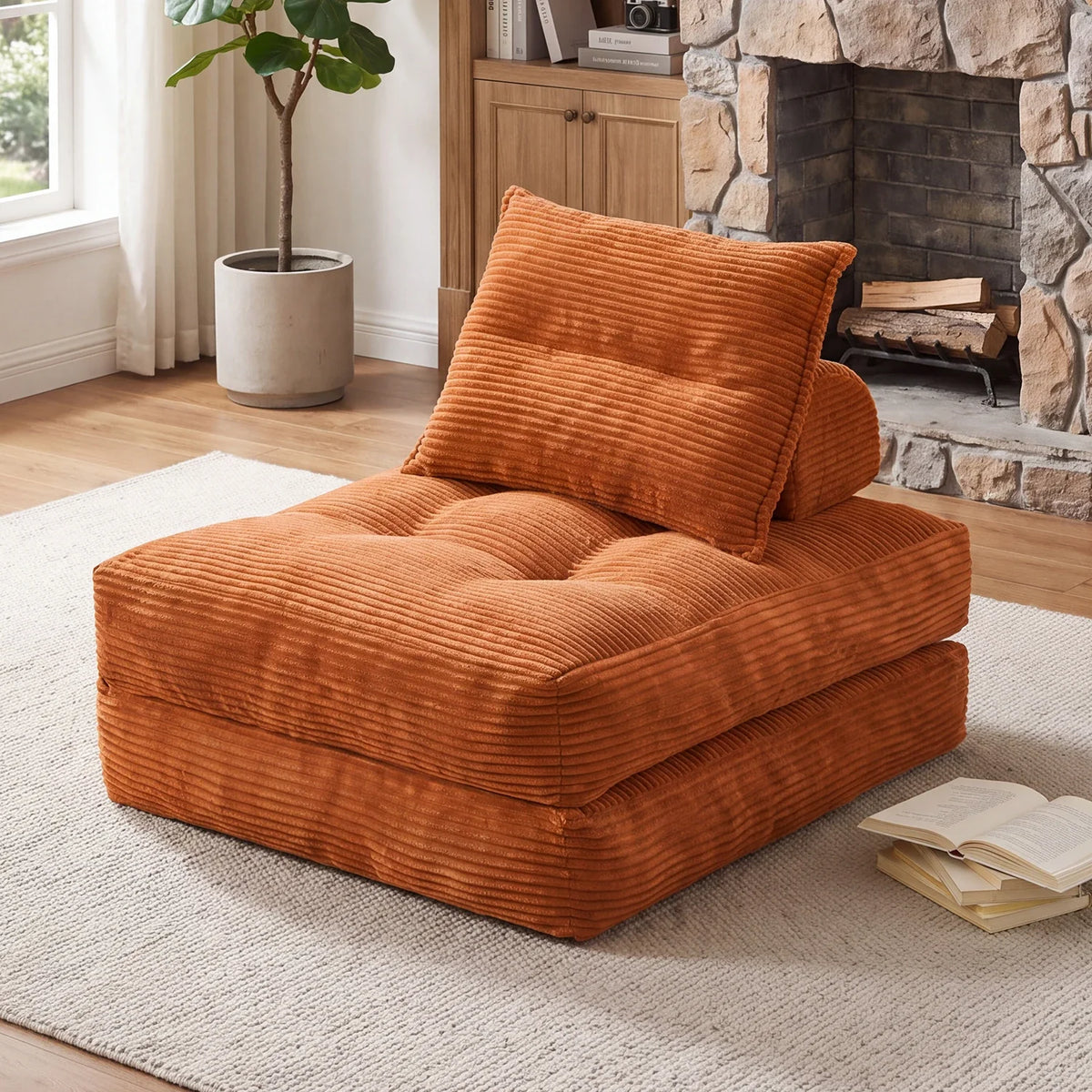
In the featured product-family image, orange is a concentrated foreground field. The warm wood cabinet and floor repeat warmth without copying the upholstery, while the pale rug, curtains and planter leave a quieter surround. Stone and greenery add variation without becoming another saturated orange block. The transferable rule is a hierarchy: one dominant upholstery color, one supporting warm material relationship and one broad neutral field.
Read the fully-flat orange state

The flat image changes the visual balance. Orange becomes a long horizontal field and the low wood table becomes a more direct neighbor. The pale rug still separates both warm objects from the floor, so the relationship stays readable without a large orange repeat on the wall or curtains. If your closed room already contains a strong orange rug, chair or curtain, test the fully-flat view: the expanded sofa may turn a controlled accent into two competing fields.
Use physical samples in the real room. Seller images can show visible relationships and relative mass, but they are not calibrated color records. Keep the fixed palette small—dominant upholstery, supporting wood or metal relationship, broad neutral field—then allow one removable accent only if the fully-flat state remains clear.
Give every movable object a conversion address
A conversion address is a temporary location outside the moving envelope, paired with a reset location after use. It prevents a styled sofa bed from turning into a pile of pillows and a displaced table every time it opens. The address must exist in the measured room; “move it somewhere” is not an address.
| Movable object | Daytime address | Conversion address | Reset evidence |
|---|---|---|---|
| Coffee or side table | Useful reach from the closed seat without blocking the mechanism | A marked wall or corner position outside the full moving envelope and route | Returns to the floor mark without narrowing the daily path |
| Decorative pillows | Only the number that leaves every required seat usable | One basket, shelf or cabinet with enough volume for the entire group | The sofa returns to its saved daytime photo without borrowing storage |
| Throw | Folded where it can be used without hiding controls or joins | The same basket or a dedicated shelf—not the floor or operating side | Dry, accessible and clear of the mechanism |
| Floor lamp | Lights the seat without occupying the opening side | Prefer fixed placement outside all states; if it must move, mark a stable temporary position | Cord and base return clear of the path |
| Rug edge | Supports the daytime grouping without curling under moving parts | Usually fixed; confirm the exact model can operate over or beside it | No bunching, drag or new obstruction after the state cycle |
Choose fewer movable styling objects when the parking zone is small. One useful pillow and one stored throw are often more repeatable than a staged group that consumes a seat and has no home. A low table may look appropriate in a static photograph yet fail if it has to cross the only exit during conversion. Function decides which styling objects survive.
Rehearse closed, lounge, flat and reset states

- Freeze the exact record. Save the model, variant, closed dimensions, fully-open dimensions, seller-supported intermediate states and current instructions. Do not combine fields from similar products.
- Mark the largest state. Tape the exact fully-flat outline and keep the actual operator side, door movement and regular exit visible. Add only the clearance specified for the model or confirmed in writing.
- Place fixed style cues. Set the rug, fixed storage, lighting and dominant wood or metal relationship where they can serve every state. Remove a cue that requires the sofa to remain closed.
- Assign and test addresses. Move the table, pillows and throw from their daytime positions to their conversion positions. Walk the route with those objects parked rather than imagining an empty room.
- Operate all regular states. Follow the exact instructions through closed, lounge and fully flat. Observe whether the palette still reads as one hierarchy and whether a fixed object interferes.
- Reset from the record. Return the mechanism to its ready condition, restore accessories to their marked positions and compare the room with the saved daytime photo. If the reset needs an improvised pile or repeated furniture search, revise the plan.
The three-state brief, conversion-address table and rehearsal are Monvane editorial planning tools, not universal furniture or clearance standards. They organize a room-specific test; they do not replace exact-model instructions or certify mechanism safety, accessibility, code, delivery, comfort or sleep suitability.
Read current and product-family evidence narrowly
Current Oversized Sofa Bed
The current Monvane Oversized Sofa Bed page describes a 3-in-1 convertible and lists product dimensions of 38 inches deep by 33.86 inches wide by 16.54 inches high. Its FAQ says the fully-flat state is approximately 75 inches long by 38 inches wide. Those are separate listed product-dimension and fully-flat records. The reviewed page does not explicitly label the first group as closed or upright, and it does not supply a complete named lounge footprint or a universal operating clearance.
The reviewed product page and current sofa-bed collection do not use mid-century wording. Use the verified geometry for the state rehearsal, but keep the style claim at room level. If the exact movement direction, approach space or current instructions remain unclear, send the precise question through the Monvane Support Center; no answer or response time is assumed here.
Compact Sofa Bed product-family images
The two orange images in this guide belong to the Monvane Compact Sofa Bed product family. They support visible observations about upright versus flat state, orange visual mass, warm wood and a quiet neutral field. They do not establish current collection membership, exact scale, dimensions, materials, comfort, mechanism performance or a documented mid-century identity. Use them as a palette-and-state example, not as a current purchase record.
Sources and scope
The historical boundary was checked August 20, 2026 against the V&A's Mid-Century Modern Design course description, Cooper Hewitt's Mad for Mid-Century editorial and the MoMA Design Store's exact Forum 2-Seater Sofa record. These sources provide a broad period, an institutional summary and one documented 1964 sofa example; they do not authenticate the Monvane products or create a universal style checklist.
Current Monvane collection, product and support fields were checked on the same date. The room brief, palette hierarchy, conversion addresses, three-state rehearsal, image readings and final verdict are Monvane editorial synthesis. They do not authenticate a historical style or certify product identity, comfort, sleep suitability, mechanism safety, accessibility, code, delivery or room fit.
Make the style-and-function decision
| Verdict | Observable result | Next action |
|---|---|---|
| Shortlist | The exact supported states are recorded; the largest footprint and route pass; the restrained palette works open and closed; every movable object has an address; no unsupported product identity is needed | Save the exact model record, floor marks, parking addresses and reset photo together |
| Pause | A decisive state, dimension, movement instruction, sample or product-style claim is missing or unclear | Obtain the exact evidence and repeat the same rehearsal; keep the style claim at room level meanwhile |
| Revise the room | The mechanism and footprint pass, but the expanded color field overwhelms the room or movable objects have no stable address | Remove one competing large field, reduce accessories or create a real parking zone, then rerun every state |
| Reject | The flat state blocks a hard room function, a fixed object enters the moving envelope, or regular reset depends on an improvised pile | Change the exact candidate or layout before returning to style |
Style can choose among functional survivors; it cannot rescue a failed conversion envelope. The practical winner is the exact sofa bed that operates in every regular state, keeps its fixed room cues coherent when fully flat, gives movable objects a repeatable address and does not need an unsupported mid-century product claim. That is a room you can use, reset and explain—not a closed-state photograph that falls apart the first time the bed opens.


