


Bolster Pillows
Sofa Bolster Pillow: Practical Guide
Give one sofa bolster one job, compare finished length with span and diameter with bulk, then run a full-volume towel trial before choosing, moving, or skipping it.
On this page
A sofa bolster pillow works best when it has one job and one bounded sofa zone. Treat its finished length as span and its finished diameter as bulk. Then orient the cylinder for that job, test its full volume with a rolled towel, and keep it only if every required seat still works. There is no single best bolster size or count: one tucked at an outside corner may stay useful, while a longer cylinder across shared seats can become something people remove whenever they sit down.

Define the object before styling it
A sofa bolster is an elongated cylindrical or roll-shaped loose pillow. That shape changes the decision. A square pillow has height and width; a bolster adds a long axis, a finished diameter, and a round surface that may roll or shift.
Record two separate dimensions before comparing colors or fabrics:
- Finished length tells you how far the bolster will span along the back, arm, or occupied seat.
- Finished diameter tells you how much bulk it adds and how much sitting depth it may consume.
This guide uses support only in the everyday sense of where a loose pillow is placed. It does not make medical, therapeutic, posture-correction, or pain-relief claims. Any comfort judgment remains personal and should be made with the actual product in the actual sitting position.
Give one bolster one job
Choose the primary job before choosing the cover. Mixing jobs is what turns a distinctive cylinder into clutter: an accent that also has to serve two users, or a personal prop that has no place when its user leaves.
| Primary job | Axis and contact | Occupied-use requirement | Failure signal |
|---|---|---|---|
| Outside-corner accent | Long axis follows the sofa back; back cushion and arm contain the cylinder | The nearest person can sit, reach the arm, and stand without moving it | It rolls into the seat, blocks the arm, or must be moved for normal sitting |
| Personal prop | Horizontal or slightly angled, but entirely inside one named user's zone | That user chooses the position; adjoining seats remain independent | It crosses a seat boundary or becomes an assumed comfort solution for everyone |
| Display-only piece | Any deliberate display position, with a separate parking place | Removal and reset are quick, repeatable, and accepted by the household | It repeatedly lands on the floor or no one restores it |
Start with one bolster when only one zone has a job. Use a pair only when both sofa ends repeat the same routine and both cylinders pass the occupied-use test. Symmetry in a photograph is not enough reason to double the daily reset work.
Set the axis, contact points, and full-volume trial
Set the long axis
The long axis should follow the job, not the camera angle. For an outside-corner accent, run it along the back so the cylinder ends within that corner. For a personal prop, keep it inside one person's sitting zone. Avoid laying a long bolster across two independent seats unless everyone has agreed that it will be removed before use.
Identify the contact points
A round pillow is easier to contain when two surfaces meet it. At a sofa end, the back cushion can resist rearward movement while the arm resists sideways movement. A cylinder left on an open, sloped, or very shallow surface has fewer restraints and may shift more readily. This is an observation to test, not a promise that any two-surface placement will stay fixed.
Rehearse the full volume
Do not test a cylinder with a flat paper rectangle. Roll a bath towel or small blanket until it matches the proposed finished diameter, then secure the roll at the proposed finished length. The mock-up approximates occupied volume; it does not reproduce the real insert's compression, cover friction, or comfort.
- Place the roll in the intended zone and mark where both ends stop.
- Sit and stand normally in every seat the household needs.
- Reach the sofa arm, side table, controls, and anything stored beside the seat.
- Record one observable result: stays in its zone, intrudes, rolls, falls, blocks access, or needs removal.
- If it moves, name a parking place and reset it three times. If that routine already feels excessive, skip the bolster or choose a smaller one.

Read length and diameter as different decisions
The label bolster does not identify one standard size. Current first-party records illustrate how widely a cylindrical label can vary, but they are not recommendations for your sofa.
| Exact current record | Published size | What the record demonstrates | What it does not establish |
|---|---|---|---|
| The Company Store bolster insert | 6 in. diameter × 15 in. length | A comparatively short, small-diameter current insert record | That this size fits your sofa, cover, body, or preferred use |
| The Company Store bolster insert | 8 in. diameter × 20 in. length | The same page offers a second length-and-diameter combination | That larger is more comfortable or more supportive |
| IKEA BLÅSKATA cylinder-shaped cushion | 10 in. diameter × 31 in. length | A much longer and wider exact current cylinder record | An adult-sofa recommendation; the cited page identifies it as a children's product |
Use the numbers as a warning against size labels, not as a shortlist. First compare length with the intended corner or one-person span. Then compare diameter with the sitting depth you are willing to give up. A short but thick cylinder can consume more depth than expected; a slender but long cylinder can cross a seat boundary. The rolled-towel trial exposes both problems before purchase.

Complete the purchase record
A styled image can show shape and placement, but it cannot complete the purchase decision. Record the selected offer's exact fields in writing. If a decisive field is missing, ask the seller or maker rather than borrowing a detail from a similar image or another size.
| Field to record | Why it changes the decision | Do not assume |
|---|---|---|
| Finished length and diameter | Controls span and occupied bulk in the planned zone | That nominal cover dimensions equal the filled pillow's working volume |
| Insert fill and shell | Identifies the exact object whose care and behavior you will evaluate | Firmness, compression, support, or washability from appearance |
| Cover compatibility and closure | Determines whether the selected cover and insert are documented to work together | That any same-number cover fits any insert, or that every cover is removable |
| Cover care and inner-pillow care | Prevents one care label from being applied to two different components | That a washable cover makes the inner pillow washable |
| Included or sold separately | Prevents a pictured accessory from becoming an unplanned extra purchase | That every object in a styled image comes with the sofa or cover |
The care split is not theoretical. The cited Company Store page publishes one care record for its named insert, while the cited IKEA page publishes separate entries for the removable cover and inner cushion. Follow the exact label for the exact component you own; do not transfer either source's instructions to another product.
Read a tucked Monvane scene narrowly

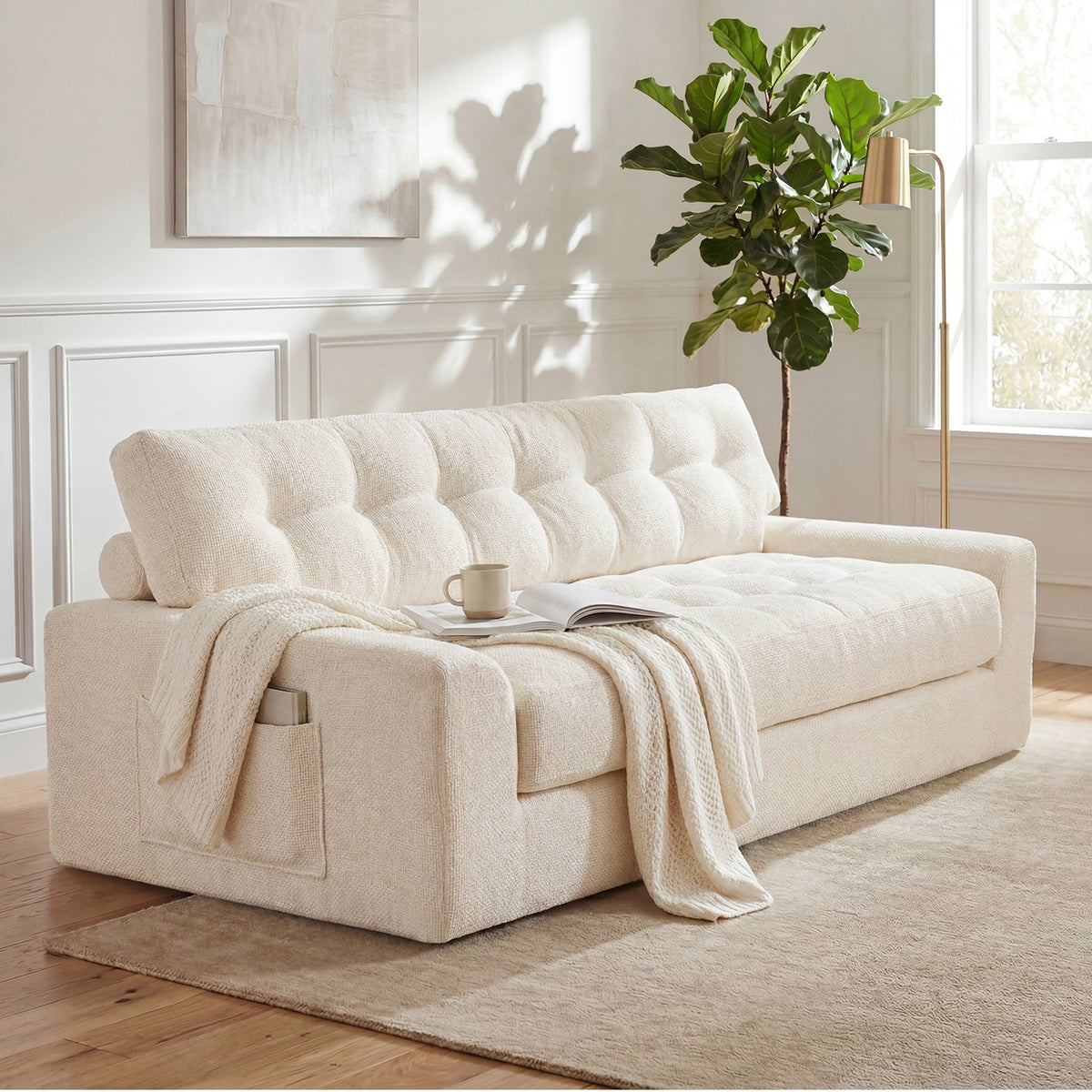
The image offers one useful placement lesson: a small round-ended pillow is visibly nested at the sofa end instead of floating across the middle of the seat. The back cushion and arm visually define its zone, and the long axis follows the back.
Stop there. The image cannot tell you the finished length or diameter, what the pillow contains, whether the cover is removable, whether it is included with a current sofa, or whether it will feel comfortable or stay in place in your home. Use the image to recognize a two-surface tuck, then use the selected product record and the full-volume trial for everything else.
Work three declared sofa routines
These are hypothetical routines, not observed customer homes or product tests. Their purpose is to show how the same cylinder can produce different decisions when the household task changes.
Shared two-seat sofa: skip the center span
Assume two adults use separate seats most evenings. A long mock-up placed across the middle crosses both zones, and either person must move it before sitting. There is no agreed parking place. The decision is skip that length and position. A single shorter bolster may still be tested at one outside corner, but the failed center-spanning layout does not become acceptable because it looks balanced.
Solo reading end: keep one contained bolster
Assume one person consistently reads at the right end. A shorter mock-up stays between the back cushion and arm, leaves the adjacent seat open, and does not block the reader's reach. The reader personally prefers the position, and the bolster remains there when the sofa is occupied. The conditional decision is keep one at that end, subject to the real product's documented size, care, and the reader's own comfort judgment.
Display-first sofa: move it to a named address
Assume the household likes a pair for photographs or daytime display but removes both cylinders for conversation. A basket or shelf beside the sofa can hold them, and one person accepts the reset routine. The decision is display and move. If the cylinders repeatedly end up on the floor or the reset stops happening, the honest revision is to keep one, choose smaller pieces, or remove both.
Make the keep, move, or skip decision
- Keep it in place when it has one named job, stays within one zone, preserves every required seat and access point, and needs no repeated rescue.
- Move it during use only when it has a named parking place and the household accepts the removal-and-reset routine.
- Choose a different size or position when length crosses a seat boundary or diameter consumes too much usable depth.
- Skip it when it rolls into traffic, blocks the arm, repeatedly lands on the floor, or depends on an undocumented comfort, support, care, or included-status assumption.
The practical choice is not the bolster that fills the image. It is the one whose job, dimensions, zone, product record, and reset routine still make sense after people actually sit down.
Sources and scope
- The Company Store: Down Alternative Bolster Pillow Insert — exact current sizes, materials, and care for the named insert, checked September 2, 2026.
- IKEA US: BLÅSKATA cylinder-shaped cushion — exact current dimensions, materials, removable-cover record, care split, and children's-product scope, checked September 2, 2026.
The job/axis/contact method, towel trial, purchase checklist, and three routines are disclosed Monvane editorial tools. They organize observable pre-purchase questions; they are not product tests, safety standards, medical advice, or guarantees. Exact seller and maker documentation for the selected sofa, insert, and cover remains controlling.


