

Living Room Ideas
How to Style a Loveseat: Pillows, Pairing and Current Looks
A practical method for arranging loveseat pillows, pairing nearby furnishings and adapting current looks without crowding everyday seating.
On this page
A useful way to style a loveseat with pillows, room pairing and current looks is to work from the usable seats outward, not from a target pillow count inward. First decide whether two people, one regular reader or occasional guests control the daily setup. Then choose the smallest pillow group that supports that routine, repeat two visible cues from the room, change one quality deliberately, and connect the loveseat to the rug, side furniture and background. Finish by sitting, reaching, walking past and resetting the arrangement.

Step 1: Protect the daily seat
Clear every movable pillow and throw before styling. Sit in the loveseat in its normal room position and name the job that must survive: two people talking, one person reading with occasional company, a guest seat in an office, or a styled bedroom corner that is used briefly. If two people use it together, give each person a position before giving any surface to decor.
- Photograph the fixed room. Include the loveseat, rug or floor, nearest table or lamp and the wall, curtain or artwork behind it. These are the cues the styling should connect.
- Mark the intended positions. Sit normally, place your arms and reach for the table. Do not treat unused space in a photograph as proof that a pillow belongs there.
- Set a removal limit. Decide whether each regular sitter may move no pillow, one pillow or the whole group. An arrangement that exceeds the household's tolerance will not remain the daily arrangement.
Also identify fixed back cushions, bolsters or arms before adding anything. A loose decorative pillow should not be credited with support already supplied by the loveseat, and a fixed cushion should not be counted as removable styling space. If a mobility need, pain condition or required support affects sitting, use appropriate individual guidance; this is a household styling procedure, not an ergonomic assessment.
Step 2: Choose one pillow layout
There is no universal number of pillows for a loveseat. The correct count is the smallest group that performs the intended support and visual jobs while leaving the required positions usable. Start with one of these Monvane editorial layouts, then reduce it if the physical seat says no.
Two outer corners for two daily sitters
Place one pillow at each outer corner and leave the center visually open. Angle or compress each pillow only enough to follow the back-and-arm junction; do not let it roll forward into the sitter's working depth. This is the strongest starting point when two people use the loveseat together because the arrangement is balanced and neither sitter inherits the storage problem.
If both pillows have the same function, they may repeat a color, texture or shape. They do not need to be identical. One can relate to the rug while the other repeats a smaller cue from art or a nearby chair, provided their visual weight remains similar.
One-sided stack for a dominant solo routine
Build from one outer corner: place the larger or quieter support piece behind, then a smaller bridge or accent in front. Keep the other sitting position clear. This works when one person reads or lounges there most days and the second position is still available without rebuilding the entire loveseat.
Reverse the stack if the clear side is the one closest to the main route or table. If the front pillow slides into the working seat, competes with the arm or must be placed on the floor every time, remove it rather than replacing it with another shape.
Three points for an occasional styled state
Use two quieter outer pillows plus one smaller center or off-center accent. The third point should change scale, shape, pattern or value—not all four at once. Treat this as an occasional or guest-ready state unless two regular sitters can remain in place with the center piece present.
Do not add a fourth pillow merely to make the count even. Add only when it performs a named job and passes the daily-use test. A loveseat that requires every loose pillow to be removed before anyone sits has a display arrangement, not an everyday one.
Give every pillow one job
Separate function from appearance before shopping. A pillow can do more than one job, but it should not exist only because an empty area looked available on a screen.
| Pillow job | What it changes | How to choose it | Remove or revise when |
|---|---|---|---|
| Support | Fills a real back-and-arm gap for a named sitter or posture | Test it in use; keep it subordinate to the loveseat's fixed support and within the intended sitting zone | It pushes the person forward, constantly slips or is needed only to correct a deeper fit problem |
| Bridge | Connects the loveseat to the rug, wood, curtain, art or nearby chair | Repeat one existing hue, line, material impression or texture family | It introduces a new palette that appears nowhere else or disappears completely into the upholstery |
| Accent | Creates a focal change in scale, shape, pattern or light/dark value | Change one visible quality while two other cues remain connected | It becomes the only object the eye can see or requires unrelated accessories to justify it |
A useful starting rule is: repeat two cues and change one. For example, repeat the loveseat's ribbed texture and a warm wood tone, then change the pillow shape; or repeat the rug's cream and the artwork's black line, then change the pattern scale. This is an editing method, not a fixed design law.
Judge scale on the physical loveseat. Build from back to front and from visually quieter to more active. A rear pillow should remain inside the support area it occupies; a front pillow should not consume the sitter's working depth. Photograph the group from the entry, then sit in it. The body test can overrule the camera.
Step 3: Pair the loveseat across three room fields
Pairing is a relationship, not a matching order. Do not buy a rug, table, lamp and chair that all imitate the loveseat. Give the lower, side and background fields different jobs, then repeat only enough information to make the seating area read as one group.
| Room field | Objects | Connection to make | Daily-use check |
|---|---|---|---|
| Lower field | Rug, floor and coffee table | Give the loveseat a visible base; repeat a quiet hue or texture while allowing the upholstery outline to remain readable | The table is reachable, the rug does not create a route problem and the lower edge does not visually disappear |
| Side field | Side table, floor lamp, plant or nearby chair | Repeat one material, line or color cue, then let shape or era differ | The intended sitter can reach or use the object and the side grouping does not pinch the path |
| Background field | Wall, curtain, cabinet and art | Frame the loveseat with a quieter large field and one deliberate vertical or graphic relationship | The loveseat remains legible by day and under normal evening lighting without requiring extra decor to hide a mismatch |

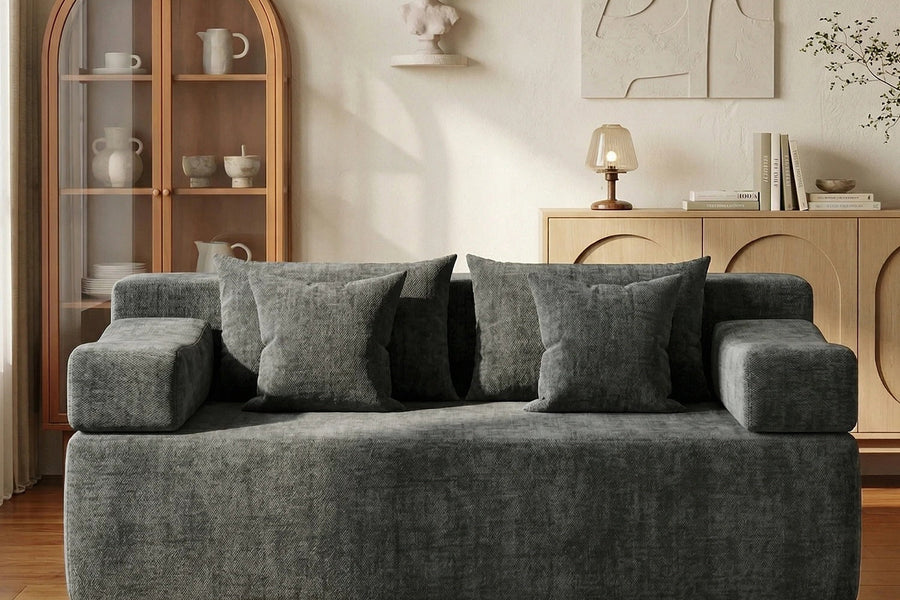
In the green archive scene, the pale rug releases the lower edge, the round wood table and cabinets create a warm side and background bridge, and black lines in the art add a smaller repeated graphic note. The room does not need a green table or green curtains to make the loveseat belong. Use the image for visible relationship logic, not as a calibrated color sample or a spacing plan for another room.
Step 4: Translate current looks into one stable direction
Current evidence supports more than one look. The ninth annual 1stDibs 2026 Interior Designer Trends Survey reports 468 design professionals worldwide; 39% identified maximalism or layering as likely to remain popular, while eclecticism and organic modernism also remained prominent. A separate Houzz most-saved-room feature examines ten living-room photos uploaded from March 15 through June 15, 2026 and highlights layered materials, natural materials, varying scales, functional layouts and focal points among them.
Those are professional and platform samples, not instructions for every household. They show that “current” is not one uniform palette. Trend evidence widens the menu; it does not choose the room. Translate the signals into one of these restrained directions, then keep only what passes the physical setup.
Tonal texture
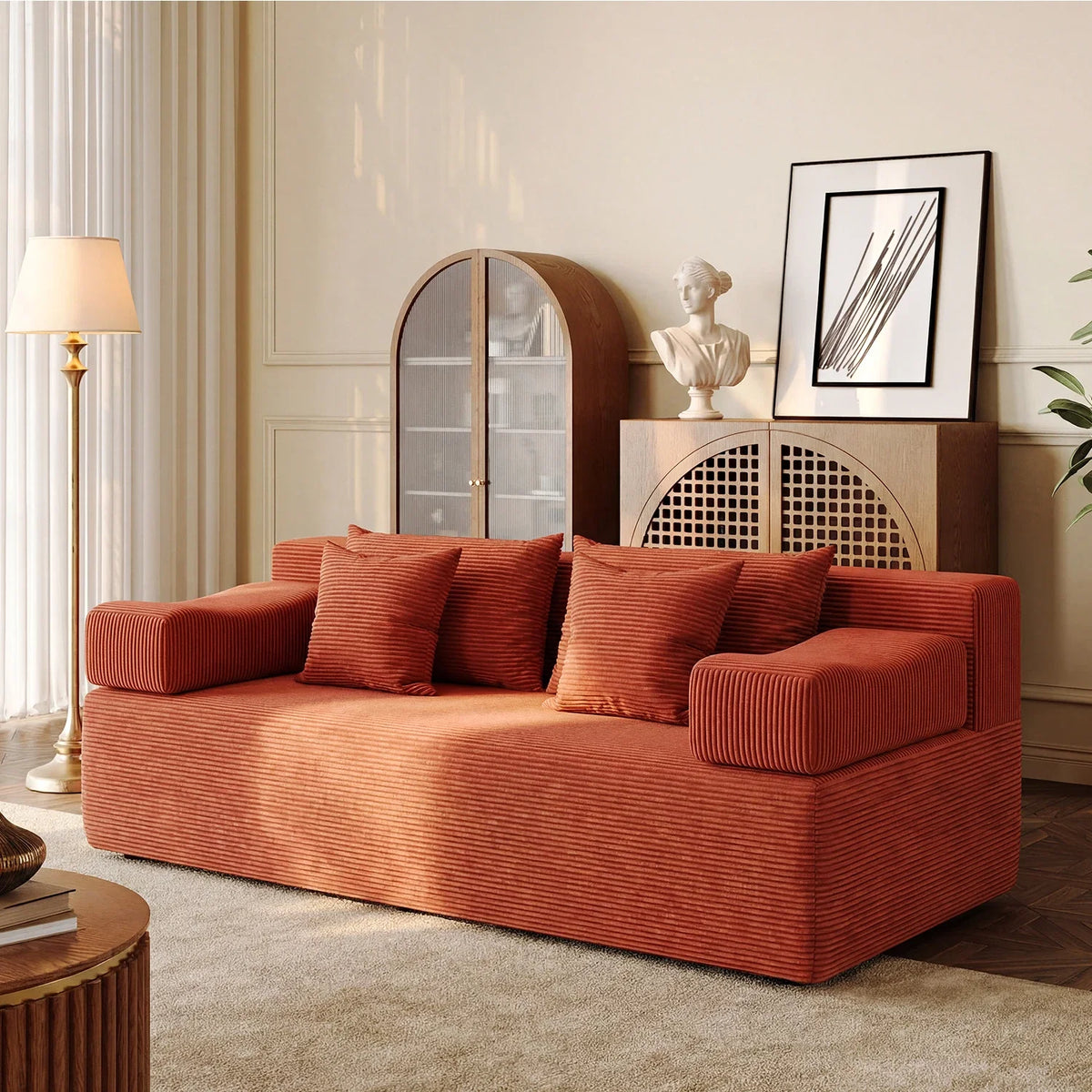
Keep the pillows close to the loveseat's hue, then vary light/dark value, texture direction or shape. This gives a compact piece visual continuity without requiring a loud accent. The featured rust-toned scene demonstrates the strongest version: upholstery and all four loose cushions repeat one ribbed family. For daily use, remove pieces until the intended seats return, then create variation through one smaller shape, a throw with a different weave or a quieter value shift.
Organic warmth
Pair a muted upholstery color with cream, warm wood and a limited natural-looking texture. The green scene demonstrates the room relationship: pale broad fields keep the loveseat readable while wood repeats around it at different heights. A cream or oatmeal bridge pillow can work when it relates to the rug or curtain, but it is unnecessary if the room is already connected.
Collected contrast
Let the loveseat, rug, wood and artwork come from related but not identical visual families. Repeat one dark line and one warm material in separated places, then use a small pillow or textile to bridge the cool and warm fields. The result should feel assembled over time without forcing every trend, pattern and color into the loveseat itself.

In the blue-gray archive scene, the warmer cabinets and table prevent the cool upholstery from controlling the entire room, while the pale rug and wall preserve relief. Dark lines in the art repeat a smaller graphic note above. The cushions remain visually close to the upholstery; a real room could introduce contrast in one piece, but it does not need to.
Edit a staged Monvane loveseat for daily use
The current Monvane Corduroy Loveseat page lists a two-seat product measuring 69.3 inches wide, 43.3 inches deep and 33.5 inches high overall, with a 26-inch listed seat depth. Each of the three selected archive scenes visibly places four loose square cushions across a loveseat-family image. That contrast creates a useful exercise: a two-seat product fact and a four-cushion visual composition answer different questions.
| Read the image for | Do not assume | Daily edit |
|---|---|---|
| Color and texture repetition | Every visible cushion is included, required or available with the current option | Keep the one or two pieces that perform support or bridge work |
| Relationship among rug, wood, lamp and wall | The same objects, color rendering or spacing will transfer to another room | Repeat only the cues already present in the physical room |
| A guest-ready or photographed composition | The arrangement preserves two real sitting positions | Sit both intended users, remove the object that fails and photograph the passing state |
The archive visuals are composition references, not current product instructions or calibrated color records. Verify the exact live option, included items and care information before purchase. If a decorative cover, throw or pillow could contact the upholstery, confirm that its material and care are compatible rather than assuming a styling image authorizes it.
Step 5: Run the sit, reach and reset test
Test the arrangement in the room's normal state, not after moving every competing object out of frame.
- Sit. Put every intended user in the normal position. Record any pillow that pushes a person forward, traps an arm, falls behind the seat or must immediately move.
- Reach. Use the side table, lamp control and other routine objects. A visually balanced side grouping fails if the user cannot reach it or a pillow blocks the movement.
- Walk. Enter, pass and leave while the table, rug and side objects remain in place. Restore the route before adjusting color or pattern.
- View at night. Turn on the lamps normally used in the room. Check whether the loveseat merges with the background, an accent becomes dominant or a bridge color no longer connects the group.
- Reset. Stand up, use the room, then rebuild the arrangement from one reference photo. If the household will not repeat the reset, simplify it now.
Approve the arrangement when the intended positions remain usable, each pillow has a named job, the lower/side/background fields are connected, and one person can restore the daily state without guessing. If it fails, change the object that fails first: remove the obstructing pillow, reassign the side table, restore the route or replace the unsupported accent. Retest before buying anything else.
Save one daylight and one evening reference photo only after the physical room passes. If the current Monvane loveseat is under consideration, compare the exact live option and included items from the product page; otherwise use the same procedure on another loveseat without transferring the named product's dimensions or archive colors.
Sources and scope
The Monvane Corduroy Loveseat page, 1stDibs 2026 Interior Designer Trends report and Houzz March-to-June 2026 most-saved living-room sample were checked August 14, 2026. Product content, availability and trends can change. The three layouts, pillow jobs, pairing fields, current-look translations and five-part test are bounded Monvane editorial starting points—not universal design standards, product instructions, accessibility rules, comfort guarantees or predictions of future taste. The physical loveseat, current seller information, room and household routine control the final arrangement.