

Family Room
Best Sectional Sofa for a Family: Map the Household Load
The best family sectional is the smallest configuration that handles the household’s peak shared routine, preserves routes, supports mixed postures and has a verified recovery path for frequent messes and changes.
On this page
The best sectional sofa for a family is the configuration that handles the household’s busiest shared routine, preserves the room’s routes, and has a verified recovery path for frequent messes and changes. Do not size it from family headcount alone. Map who sits at the same time, how they sit, what enters the seating zone and who resets it afterward.
Fast shortlist: prove the room envelope, assign every module a family job, test incompatible postures together, request exact surface and care evidence, and reject any high-impact failure that the household cannot recover from.
Count simultaneous jobs, not family members
A household of five does not automatically need five identical seats. On a weekday, two adults may sit while children cross the room. On movie night, everyone may lounge. When guests arrive, upright positions and clear exits may matter more than deep seats. The design target is the peak routine that occurs often enough to justify the footprint.
Write four snapshots: ordinary evening, longest shared session, visitor peak and quiet solo use. For each, list people, postures, objects, routes and reset work. A sectional earns its size by solving these states without making normal days harder.

Give every seating zone one primary job
| Zone | Possible family job | Evidence to collect |
|---|---|---|
| Upright seat | Conversation, homework, short visits | Seat height/depth, back reach, table relationship |
| Deep seat | Long viewing or curl-up posture | Usable depth, pillow plan, shared knee room |
| Chaise/return | Leg support or child-and-adult shared zone | Orientation, access side, route impact |
| Corner | Lean-back nest or transition seat | Usable posture, cushion junctions, exit path |
| Ottoman | Footrest, movable seat or surface with tray | Movement control, storage position, permitted use |
Label secondary jobs only after the primary one works. An ottoman advertised as flexible may become a daily obstacle if it has no parking place. A large corner may add seat count on paper while serving only one repeatable posture.
Resolve family conflicts before comparing styles
List pairs of needs that occur together: one upright sitter and one lounger; a sleeping pet and a child crossing the room; a person leaving early while others remain seated; a snack table beside a blanket zone. Test the pair, not each need in isolation.
- Posture conflict: provide different zones instead of forcing one average depth.
- Route conflict: keep the main exit independent from the preferred lounge position.
- surface conflict: separate food/drink access from the hardest-to-clean area.
- Noise conflict: prevent movable modules or tables from becoming a repeated reset problem.
- ownership conflict: decide whether a favored corner is acceptable or creates permanent displacement.
Build a family failure budget

Rank each likely failure by frequency and household impact. Add the verified recovery method, person responsible and time the room can tolerate being out of service. A low-frequency cosmetic change may sit below a daily route blockage; a common spill with no approved care path may sit above both.
| Family event | Failure question | Proof before purchase |
|---|---|---|
| Food or drink | Can the exact surface be treated as instructed? | Current care guide and hidden-area test plan |
| Pet use | Where do hair, claws or dirt concentrate? | Material sample, seam map and cleaning access |
| Child movement | Does play collide with hard tables or blocked routes? | Taped plan and activity rehearsal |
| Sleepover | Is sleeping an approved use or only an imagined one? | Exact function, dimensions and support instructions |
| Reconfiguration | Can the household repeat and stabilize the layout? | Module identity, connectors and parking plan |
Ask for material evidence in layers
Start with exact fiber or surface identification, construction, care instructions and sample availability. Then ask for applicable test methods and results rather than accepting “family friendly.” The Association for Contract Textiles performance guidelines separate abrasion, wet/dry crocking, lightfastness and physical properties, and they also make clear that application and construction determine which guideline applies. This commercial-textile framework is useful as a question map, not proof that a residential sofa meets a contract standard.
Abrasion is one input, not a lifespan forecast. Seams, cushions, support, care, sunlight, pet behavior and household maintenance all affect appearance and use. Keep every performance number attached to its test method, specimen and intended application.
Prove the room at family speed
Tape the complete sectional, tables and ottoman. Add door arcs and the most-used route. Then run the room at a busy-hour pace: one person sits, another crosses, someone reaches the table, a pet occupies its normal location, and a regular user exits. This reveals conflicts a static floor plan hides.
Measure delivery openings separately from final fit. Large configurations may arrive as multiple modules, but only the exact package and current instructions prove what separates and how it stabilizes.
Compare three configuration patterns
L-shaped family sectional
Useful when one long run and one return can divide upright and lounge jobs while leaving one side open. Watch the return orientation and the exit from the inner seat.
U-shaped family sectional
Useful when face-to-face or high-capacity seating justifies two returns. It consumes more room and can turn the center into an isolated island unless routes and table access are deliberate.
Linear modular sofa plus ottoman
Useful when the family needs a stable everyday line and occasional leg support. The ottoman needs a safe, repeatable parking position.
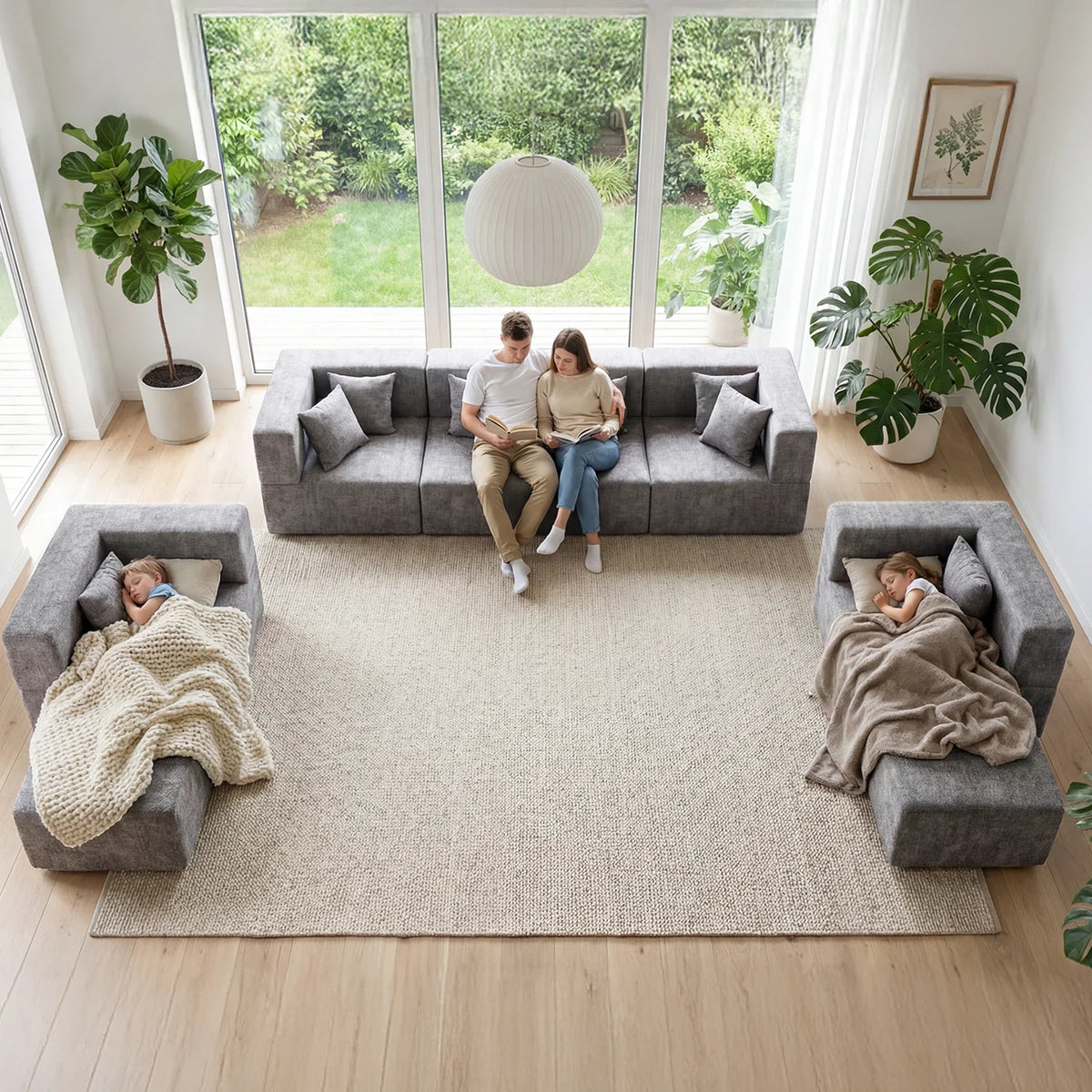
The supplied featured image is filed with Monvane’s 8 Seat U-Shaped Couch (Chenille) materials and visibly presents two adults on the center run with two children lying on the side returns. It is a helpful illustration of simultaneous family zones, not proof of sleeping suitability, child safety or fit in another room. Verify the current named configuration on the 8-seat U-shaped product page.
Use a weighted family shortlist
Give 100 points before shopping: peak-routine fit 25, route and room fit 20, mixed-posture range 15, material/care evidence 15, configuration stability 10, delivery proof 10 and budget/warranty clarity 5. Change the weights only to reflect a documented household priority.
Score an unknown as zero until the seller answers. A beautiful candidate should not win because missing evidence received an optimistic score. Require all hard gates—delivery, room envelope, primary routine and acceptable recovery path—to pass regardless of total.
Family sectional questions
How many sectional seats does a family need?
Count people who sit simultaneously in the peak repeatable routine, then verify the usable positions and postures. Advertised seat count alone is not enough.
Is a U-shaped sectional good for a family room?
It can separate multiple zones and support conversation, but both returns must earn their footprint and the center route and table access must work.
What fabric is best for children and pets?
No material wins universally. Identify the dominant household failure, then compare exact care, surface, seam and relevant test evidence.
Should every module be movable?
Only if reconfiguration is a real routine and the household can move, stabilize and store every state. Unused flexibility can become reset work.
How do we test comfort for different family members?
Test incompatible postures simultaneously and record which zones work for whom. A single average sitter cannot represent a family.
Choose the sectional the household can operate
The winning sectional is not the largest affordable shape. It is the smallest configuration that handles the peak routine, resolves the important conflicts, survives the family failure budget and returns to an orderly daily state. Keep the load map and scorecard with the purchase record.
After the hard gates pass, compare current configurations in Monvane’s Family Living collection using the same household evidence—not the collection order—as the decision rule.