

Best Sofa
What Is the Best Sofa for You? Use Five Buying Gates
The best sofa is the one that passes your room, delivery, body-use, build-evidence and ownership-risk requirements. Eliminate any candidate that fails a non-negotiable gate, then compare only the survivors with dated evidence instead of product-page adjectives.
On this page
There is no single best sofa for every home. The best sofa for you is the candidate that fits the finished room and delivery route, supports the people and activities you named, provides enough construction and care evidence, and leaves an acceptable ownership risk. Treat those as pass-or-stop gates. Compare value only after a sofa survives all five.
Fast decision: write three non-negotiables and three preferences. Reject any sofa that misses a non-negotiable. For the survivors, score each decision field 0 for unavailable evidence, 1 for a seller statement, or 2 for exact, dated documentation. A high total never cancels a blocked doorway, unsuitable seat or unresolved material conflict.
Define the job before asking where to buy a couch
A store cannot identify your best sofa until you define the job. Write a one-sentence mission brief: “This sofa must seat two adults upright on weekdays, let one person lounge in the evening, fit through the apartment stair turn, and remain practical with a shedding dog.” Replace that example with your users, postures, frequency, room and expected ownership period.
Separate constraints from preferences. A 92-inch wall or a narrow stair turn is a constraint. Navy upholstery is usually a preference. If you mix them, an attractive product can distract you from a physical failure. Also decide what the sofa does not need to do. A dedicated guest bed, formal reception seat and sprawling movie-night couch can require different trade-offs.
Run five buying gates in order

Gate 1: Can the sofa reach and work in the finished room?
Record the finished outside width, depth and height for the exact configuration—not a family-level or approximate measurement. Tape the footprint where the sofa will sit. Open doors, drawers and recliners; walk the normal route; check vents, outlets, windows and sightlines. For a sectional, map each return or chaise instead of marking only a rectangle.
Then measure the delivery chain: building entrance, elevator, hall, doorway, stairs, landings and tight turns. Obtain the number and dimensions of packages. “No assembly” may reduce setup work, but it does not prove that a compressed box or a full module can negotiate your route. If you need a detailed footprint worksheet, use Monvane’s sectional measuring guide, then return here with the pass or stop result.
Gate 2: Does it support the bodies and activities you named?
Do not substitute “soft,” “plush” or a star rating for body fit. Compare seat height, usable seat depth, back support position and arm height with a seat each regular user already understands. Test the primary posture for the expected duration: upright conversation, feet-up lounging, reading, napping or frequent standing.
Record disagreements between users. A deep seat may help one person curl up and leave another without back support. Loose pillows may adapt the fit, but they are a planned adjustment—not proof that the base seat suits everyone. Monvane’s live deep-seat comfort guide provides a narrower home comparison; this buying guide only needs the resulting body-fit decision.
Gate 3: Is the construction evidence specific enough?
Ask for the exact upholstery, frame or structural system, cushion layers, support system, attachment method, care instructions and any test or certification that matters to you. “Premium,” “durable” and “high density” are incomplete without a named material, test scope or measurable specification. A certificate should identify what component it covers; it should not be stretched into a guarantee for the whole sofa.
Check the exact selected variant across the title, selector, specifications, images, care guide and downloadable documents. If two fields disagree, pause and request a written answer. Do not silently choose the version you prefer.
Gate 4: Can you live with the ownership terms?
Save the current return policy, warranty, delivery terms and care instructions before checkout. Read eligibility, time windows, exclusions, fees, condition requirements and who pays for return transport. Ask whether covers, connectors, legs or modules can be replaced and how a claim begins. A long warranty headline is not enough if the failure you care about is excluded.
Consider maintenance in the room where the sofa will live. Light upholstery, directional pile, non-removable covers, pets, food and children create different care workloads. Reject the sofa if the documented care method is unrealistic for the household—even when its appearance and dimensions pass.
Gate 5: Is the total risk acceptable?
Compare more than the displayed price. Include delivery or room-of-choice charges, protection plans you genuinely need, expected care supplies, accessories required for fit, return exposure and the cost of replacing an unsuitable piece. Do not invent a future resale value or service life. Instead, write the intended ownership horizon and mark which evidence reduces risk over that period.
An unknown is not automatically a failure. Label it, estimate its consequence and decide whether a written answer is required. A missing decorative detail may be acceptable; missing box dimensions for a difficult stair route may be a stop.
Choose the form factor by its primary job
| Form | Strongest starting use | Reconsider when |
|---|---|---|
| Straight sofa | A simple conversation or media line with flexible side furniture | You need a built-in feet-up position or to define a large open zone |
| Loveseat | Two-person seating where outside width is the controlling limit | Household seating regularly exceeds two or lounge width is essential |
| L-shaped sectional | Corner use, room zoning or one directional chaise | The return blocks the main route or fixes the wrong orientation |
| U-shaped sectional | A large gathering zone with inward-facing seating | Depth crowds circulation or some seats miss the focal point |
| Modular sofa | Layouts expected to change, when exact modules and connectors are documented | Modules slide, replacement options are unclear or alternate layouts do not fit |
| Sofa bed | A verified sleep surface is a real recurring requirement | Sitting quality is compromised or the open-bed footprint blocks the room |
This table chooses a direction, not a winner. A form that matches the job must still pass the five gates in its exact size and configuration.
Score evidence only after the gates pass

Use 0–2 as an evidence-strength score, not a claim that one sofa is objectively twice as good. Zero means the information is unavailable. One means a seller makes a relevant statement. Two means you have an exact, dated specification, manual, policy or applicable test record. Write a short citation or screenshot name beside every two.
Weight only fields that matter to the mission brief. If two people must move the sofa upstairs later, package size and modular separability deserve more attention. If a household member needs easy standing, seat fit remains a gate and cannot be diluted by attractive fabric or a lower price.
A real page check: resolve contradictions before comparing
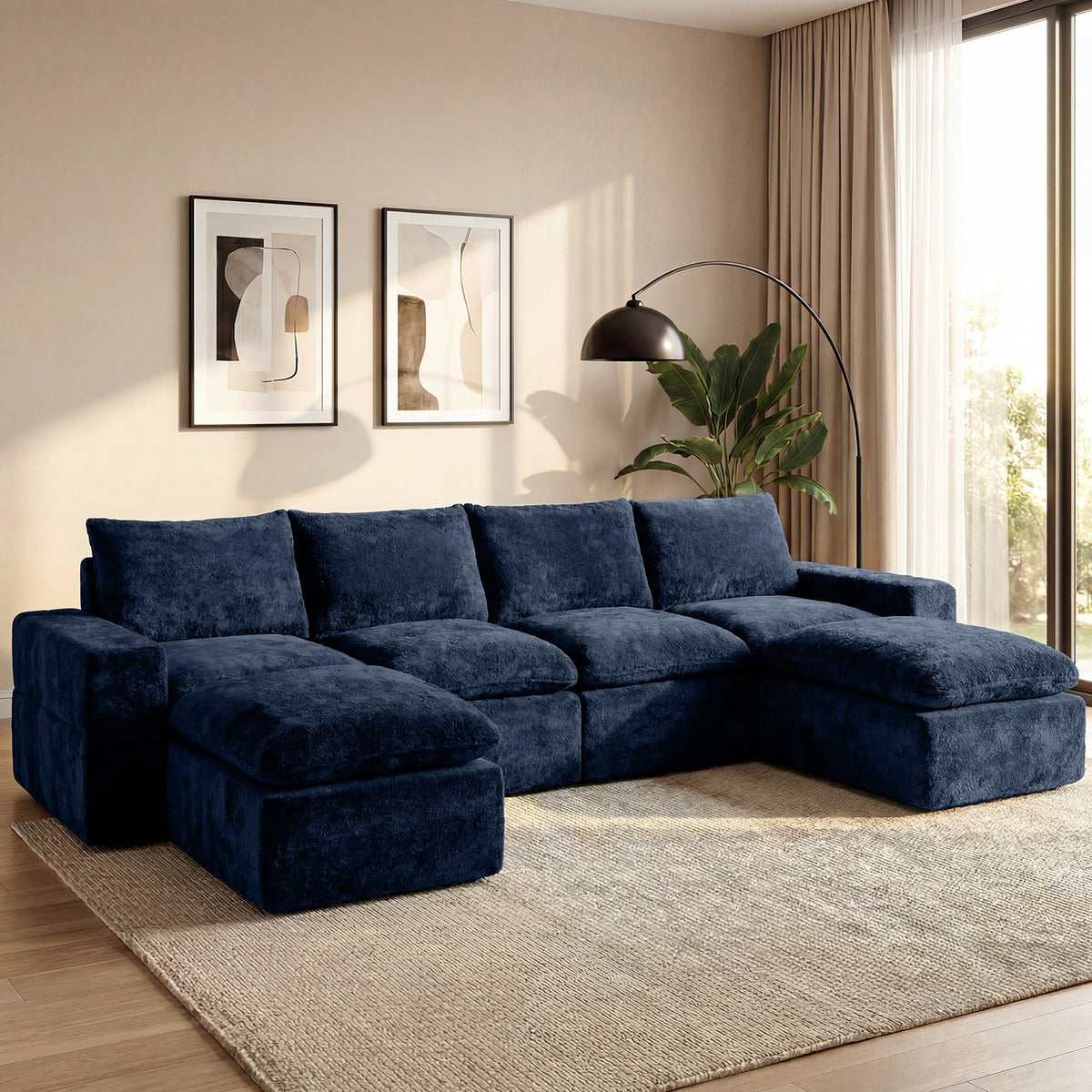
The supplied Monvane asset shows an unoccupied navy modular sofa in a living room and is filed under “Cushioned Modular Sofa (6 Seats).” On the current product page, the specifications list an overall size of 65 inches deep by 103 inches wide by 30 inches high and two packages. Those facts can enter a room and delivery worksheet, subject to rechecking the selected option.
The same page currently presents conflicting upholstery information: the material selector displays “Crushed Velvet,” while description and specification text refer to chenille. The image alone cannot resolve the material. In the decision passport, mark upholstery as STOP—clarification required. Save a dated seller answer tied to the exact color and variant before awarding an evidence score. This example does not label the product good or bad; it demonstrates why page consistency belongs in the buying process.
Add a safety and identity check
Before buying new or used furniture, record the manufacturer or importer, exact product or model name and date information available. Search those identifiers in the U.S. Consumer Product Safety Commission’s Recalls & Product Safety Warnings database. CPSC says its displayed recall data updates weekly and remedy information may change daily, so save the search date and revisit it when relevant.
Not finding a result is not proof that a product is safe, authentic or suitable. It is one due-diligence check. For a used sofa, also inspect identity labels, condition, odors, moisture history, pests, missing connectors and structural damage in person.
Questions to answer before buying a sofa
What is the best sofa material?
No material is best for every household. Choose from the exact care method, texture, exposure to pets or spills, desired appearance and documented construction. Reject vague or conflicting material descriptions until the exact option is confirmed.
Should I buy a sofa online or in a store?
Either route can work. A store may allow body testing; online shopping can make specifications and policies easier to compare. In both cases, save exact measurements, test your primary posture when possible, and obtain written terms. A brief showroom sit does not replace delivery-route planning.
How much should I spend on a sofa?
Set a household ceiling that includes delivery, required accessories, care and return exposure. Do not use a generic price band as a quality guarantee. Spend against the evidence and time horizon in your mission brief.
What information is a deal breaker when missing?
It depends on the consequence. Exact outside and package dimensions are deal breakers when access is tight. Seat measurements matter when body fit is uncertain. Care, returns and warranty scope matter when an expensive mismatch would be difficult to reverse.
Where should I buy a couch?
Buy from a seller that identifies the exact product and variant, supplies the evidence required by your five gates, answers conflicts in writing and provides terms you accept. The method is more reliable than choosing a retailer from a generic “best” label.
Make the decision auditable
For each finalist, keep one folder with the mission brief, taped-room plan, route measurements, dated product page, option name, policies, care guide, seller answers and recall-search date. Mark every gate pass or stop. If two sofas survive, compare evidence scores and choose the one whose documented trade-offs better match the primary job.
When reviewing Monvane, start with the current sofa comparison page, open the exact product page and apply the same five gates. Do not let a collection badge, sale label or the word “best” override a failed constraint. The best sofa is the one you can explain—and live with—after the adjectives are removed.