

Buying Guides
Dog Proof Couch: Practical Guide
A practical guide to matching a couch with a dog’s real contact zones, evidence needs, cleaning routine and household layout.
On this page
A dog proof couch is not one fabric or a promise that claws, teeth, hair and mud can never cause damage. It is an exact couch whose surface, seams, exposed details, care route and room position match what your dog actually does—and whose inevitable mess or wear your household can recover from. This practical guide starts with the dog’s contact zones, then helps you approve, pause or reject the exact model. No “pet-friendly,” “microfiber,” “performance” or high-abrasion label completes that decision by itself.

Start with the dog, not a fabric name
Observe one representative household routine before comparing couches: the dog’s entry route, where it jumps up, how it turns or nests, what it mouths when unsupervised, and where hair, drool or outdoor soil collect. Record what actually happens, not what a product label assumes. The ASPCA notes that chewing is normal canine behavior and recommends management, supervision, appropriate chew options and physical and mental stimulation; buying tougher upholstery does not replace those controls.
| Observed behavior | Likely couch zone | What the couch decision needs |
|---|---|---|
| Jumps up or launches down | Front rail, seat edge, cushion seam and floor-facing module edge | Inspect the exact edge construction, cushion movement and landing route; a flat fabric swatch is incomplete evidence |
| Turns, digs or nests | Assigned seat, back cushion and joins between cushions | Check exposed seams, piping, tufting and whether the reset routine is acceptable |
| Chews or sucks fabric | Arms, corners, zipper pulls, loose trim and any exposed cushion edge | Prevent access and address the behavior; do not rely on a “durable” textile claim |
| Sheds, drools or arrives muddy | Entry-side seat, dog bed or mat, front edge and floor around the couch | Verify the exact permitted cleaning method, dry state and removable or replaceable parts |
Make a separate row for every dog whose routine differs. A calm senior dog that uses a step and sleeps in one place creates a different problem from a young dog that launches onto an arm and chews when alone. Size and breed can inform the questions, but observed behavior and the exact contact path control the couch brief.

Check the exact couch in four layers
Keep the model, upholstery variant and complete configuration fixed while you audit it. Evidence from another color, collection or module set may describe a different surface or construction. Photograph the same four layers on every finalist so marketing language cannot hide an unknown.
Surface evidence
Record the exact fiber and surface description, finish, sample identity and any published test method, result and tested specimen. Treat microfiber, chenille, velvet and other fabric names as starting points, not winners. A couch sold as microfiber can still differ in surface construction, finish, seams, backing and permitted care.
Do not turn an abrasion number into claw proof. The Association for Contract Textiles explains that Wyzenbeek and Martindale tests measure flat abrasion, not edge abrasion or every kind of real upholstered wear, and that higher numbers do not automatically predict longer service life. Ask whether a seller has evidence for the failure mode you actually observed—snagging, seam damage, puncture, staining or cleaning—not merely a large rub count.
Edges and exposed details
Inspect the front rail, arm corners, cushion joins, piping, buttons, zipper pulls and gaps that sit at mouth or paw height. Note whether cushions migrate when the dog lands, whether a module edge becomes exposed, and whether a loose detail invites chewing. A strong center panel does not protect a vulnerable seam or pull.
Care and recovery
Get the exact care label before purchase. Record what may be vacuumed, spot cleaned or removed; the permitted solution and tool; which covers, if any, are washable; how parts dry; and whether replacement covers or modules are available for the selected variant. “Easy care” is not a completed recovery path. The household must be willing to perform the stated process at the frequency the real dog creates.
Stability and access
Test the complete configuration, not one isolated module. Watch what happens when the dog approaches, turns and leaves: modules should not create a new gap, the dog should not need to launch over a table, and people should retain their normal route. If the dog targets furniture when alone, supervision and access management belong in the plan; a couch purchase cannot certify that behavior as resolved.
Give the dog one repeatable place and route
Choose the dog’s normal place before choosing the final layout. It can be an approved seat protected according to the couch maker’s care guidance, a compatible dedicated module, or a dog bed next to the couch. The useful rule is simple: one clear approach, one predictable resting zone, no mouth-level temptations in that zone, and a cleaning route that does not block the household.

Run the routine while the room is occupied. Bring the dog in from its usual door, let it approach under normal supervision, sit in the human seats, use the coffee table and walk the main path. Then perform the reset you intend to maintain: remove hair, address soil under the exact care instructions, straighten the assigned zone and return toys or chews to their approved place. A layout passes only when both the dog route and the human routine work.
Worked shared-room example
Consider a hypothetical household with one medium dog that enters from a patio, jumps onto the nearest seat, sheds heavily and mouths a zipper when left alone. Place the assigned dog zone at the patio-side end so the route does not cross the coffee table. Reject exposed pulls in that zone, keep the approved chew routine away from upholstery, and require written care instructions plus a realistic hair-and-soil reset. If the exact couch lacks edge evidence or cover scope, mark those fields unresolved rather than assuming a fabric name solves them.
This example is a planning method, not a claim that one arrangement trains every dog. If the dog changes behavior, the contact map and layout must be repeated. A couch that works for supervised lounging may still fail when unsupervised access is part of the household’s normal use.
Read a “pet-friendly” label correctly
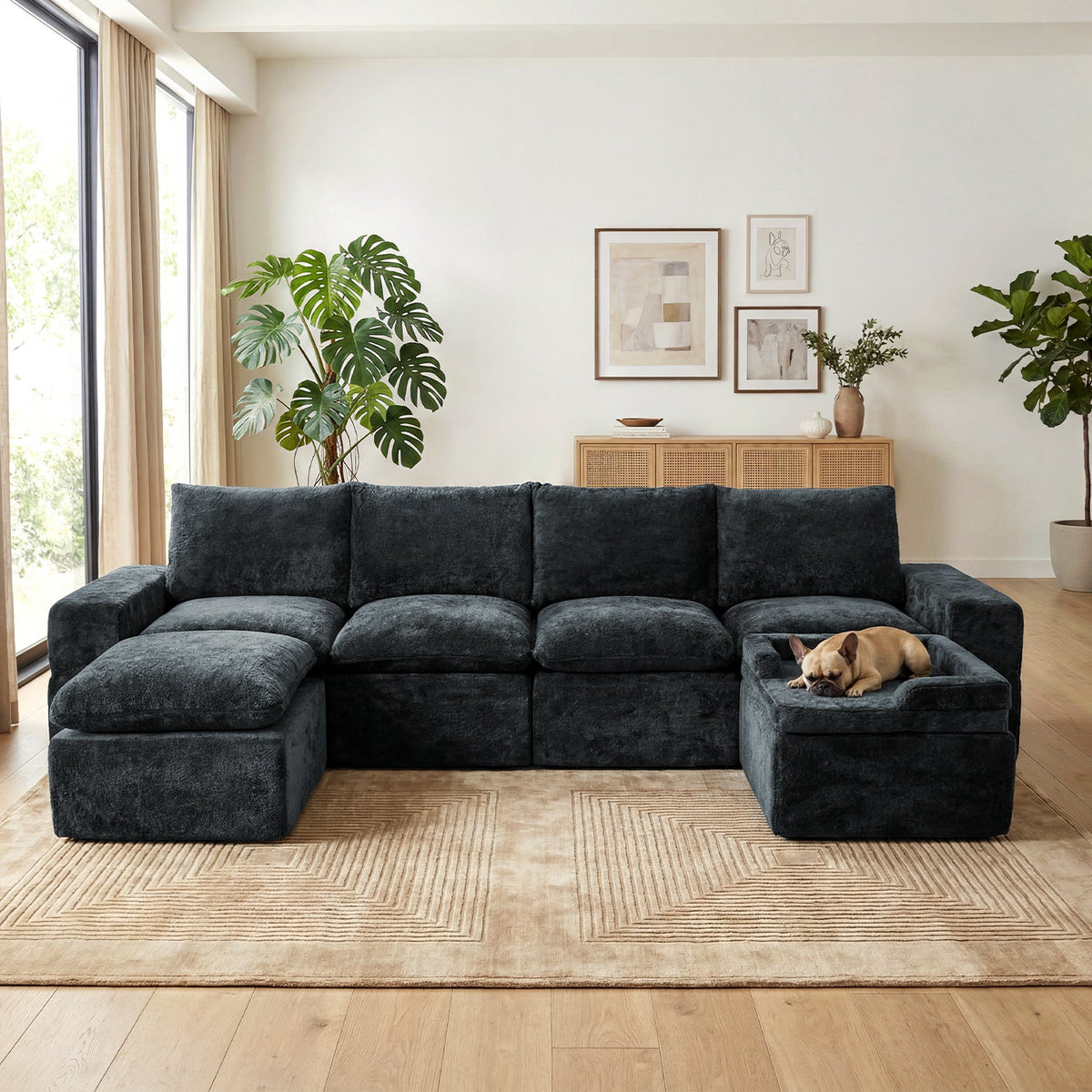
Monvane currently groups two products in its Pet-Friendly Modular Sofas collection, including the Human & Pet Modular Sofa (6 Seats). The product page shows shared-living imagery, an adaptable modular layout, an anti-slip base and copy about spot cleaning or removable-cover washing. Those fields can support a household audit, but the current pages reviewed provide no dog-specific scratch, claw, chew, puncture, stain or waterproof test.
The same current product page also conflicts on upholstery identity: its selector displays “Crushed Velvet,” while a later feature block says “Short-Pile Chenille.” Do not choose between those labels or use either one as pet-performance evidence. Ask Monvane to confirm the selected variant, exact cover scope, care instructions and any relevant test in writing before making a surface or recovery claim.
Know when the couch is the wrong match
Do not shortlist a couch when your dog regularly tears and swallows upholstery or foam, the behavior is not controlled, and unsupervised access cannot be prevented. Furniture specifications do not solve an ingestion risk. If a dog may have swallowed fabric, foam, a zipper or another furniture part, remove access and contact a veterinarian promptly; the Merck Veterinary Manual treats gastrointestinal obstruction as an emergency and identifies foreign-body ingestion as a common cause in dogs and cats.
Also reject the exact couch when a known contact zone depends on undisclosed construction, the seller’s evidence covers only a different specimen, the care method conflicts with the household’s routine, or the only recovery plan is to hide damage with an unapproved cover. Pause instead of reject when a decisive field can still be confirmed in writing.
Make the dog-proof couch decision
| Decision | Observable condition | Next action |
|---|---|---|
| Shortlist | Exact variant is fixed; surface evidence matches the actual failure modes; edges and details pass inspection; permitted care and replacement paths are usable; dog and human routes pass | Keep the completed contact map and care record with the product page and return terms |
| Pause | Material identity, tested specimen, seam construction, cover scope, cleaning permission or selected configuration is missing or conflicting | Request written clarification and repeat the affected part of the audit |
| Reject | A known hard failure remains: accessible chew target, ingestion exposure, incompatible care, unstable route or evidence from the wrong variant | Change the exact couch, layout or access plan; do not rename the risk “pet-friendly” |
The best couch for dogs is therefore conditional, not universal. It is the finalist that survives your dog’s real behavior map and gives the household an evidence-backed, repeatable recovery routine. Use the Monvane pet-friendly collection as one place to compare shared-living layouts, then verify the exact variant instead of treating the collection name as proof.
Sources and scope
The current Monvane pet-friendly collection and Human & Pet Modular Sofa (6 Seats) page were checked August 14, 2026. General behavior boundaries come from the ASPCA’s Destructive Chewing guidance; abrasion-test limits come from the Association for Contract Textiles’ Abrasion Disclaimer; and the ingestion escalation boundary comes from the Merck Veterinary Manual. The contact map, four-layer couch audit, shared-room example and decision table are Monvane editorial shopping tools—not animal-behavior treatment, veterinary advice, textile certification or a product guarantee.