

Buying Guide
What Is a Modular Corner Sofa? Verify the Layout Before Buying
A modular corner sofa is a set of separate seating units that can form a corner-turning layout and at least one other documented arrangement. Before buying, verify the module inventory, connection method and valid configuration diagrams; then plot both legs of the exact setup in your room.
On this page
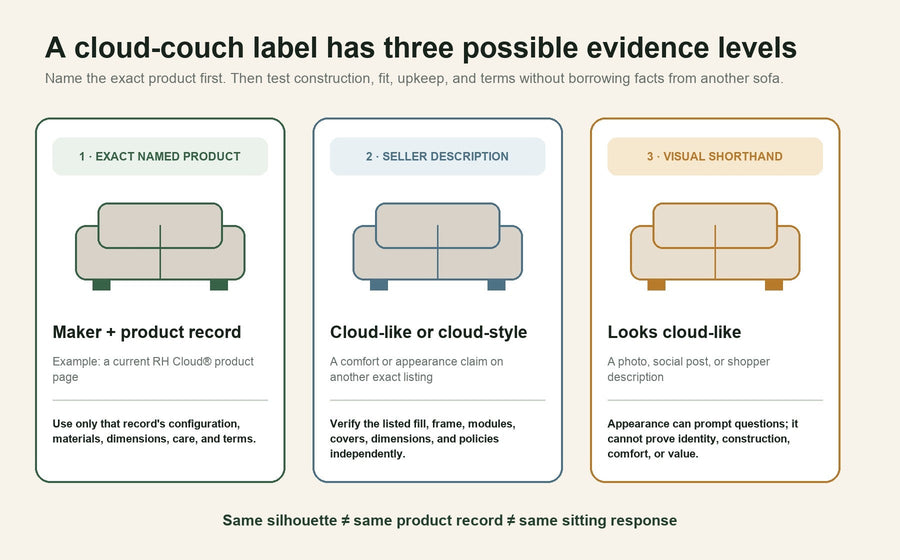
A modular corner sofa makes two promises: it turns a corner, and its separate units can be recombined. Do not accept either promise from the silhouette or product name alone. The useful buying evidence is a module inventory, a connection method and diagrams for every layout you expect to use.
Quick recognition rule: if the seller cannot show what each piece is, how adjacent pieces stay together and what the exact pieces become in a second layout, treat the sofa as a fixed corner sectional with unverified modularity.
A modular corner sofa is two claims, not one style
Merriam-Webster defines modular in terms of modules or standardized units. For sofa shopping, an operational definition is more useful: a modular corner sofa is made from separately identifiable seating units that form a corner configuration and can be moved into another manufacturer-supported arrangement.
The “corner” may be a true inside-turn seat, a terminal chaise, a movable ottoman that builds the short leg, or an angled wedge. Those arrangements do not behave the same. The word “modular” also varies in degree. Some systems let you move only an ottoman; others let you change seats, sides and backs. Record exactly what the product supports instead of grading it by the most flexible system on the market.
What is not enough
- A fixed L-shaped sectional is a corner sofa, but it is not necessarily modular.
- A sofa plus a loose ottoman is not automatically a documented corner system.
- Separate delivery boxes do not prove that the finished units are meant to be rearranged.
- A mirrored lifestyle photo does not prove that left and right configurations are both allowed.
- “Expandable” does not prove that the exact module, connector and cover will remain available later.
Require three proofs before you pay for flexibility

Proof 1: a complete module inventory
The product page, manual or order summary should let you reconstruct the sofa on the floor. List each seat, corner, arm or side, ottoman, cushion and connector by quantity. If a “four-piece” name includes an ottoman but the diagram shows five seating surfaces, resolve the difference before ordering.
Modular architectures differ. The official Lovesac Sactionals page, for example, describes Seats and Sides as separate components, while other products use finished seat modules with integrated backs. That example establishes a category possibility, not a requirement for every brand. Your job is to identify the architecture of the exact sofa you are considering.
Proof 2: a connection and release method
Ask how modules resist spreading during normal use. The answer may be clamps, brackets, shoes, latches, hook-and-loop zones, an anti-slip base or a combination. Then ask how you release and reset the connection when changing the layout. “No assembly” can mean no tool-based frame assembly; it does not explain whether modules connect or simply sit next to one another.
Connection evidence matters at the corner because two seating runs can push in different directions. It also affects cleaning under the sofa, moving one unit and correcting gaps. Check the instructions for the selected flooring and setup; do not invent a connector or add hardware that the manufacturer has not approved.
Proof 3: valid configuration diagrams
For every promised layout, require a plan that uses the exact purchased pieces. The plan should show orientation, overall footprint and any leftover module. A second arrangement is not useful if the spare ottoman blocks the only route or the corner unit has no valid role.
First-party listings illustrate why exact plans matter. Burrow’s current Nomad Plus corner sectional page publishes an 88-by-88-inch general footprint and describes a universal modular design. Lovesac publishes configuration guides built from its own Seats and Sides. Those systems cannot be used as measurement or assembly evidence for one another—or for Monvane.
Identify what the “corner” actually does

Inside-turn corner
Two upholstered runs meet at a dedicated corner or corner-capable unit. This can create a continuous back around the turn, but the inside seat may be used differently from the straight seats. Confirm whether the corner unit can move elsewhere or whether its back and side geometry lock it into one role.
Chaise terminal
A chaise extends forward from one end of a sofa run. It creates an L-shaped footprint but not a second row of upright seats. Verify whether the chaise is left-only, right-only or reversible, and whether “reversible” means moving a cushion, moving an ottoman or rebuilding multiple modules.
Ottoman-built L
A separate ottoman aligned with a seat can create a lounge leg. This is often the easiest geometry to move, but the ottoman may drift, interrupt a walkway or become a coffee-table substitute in the alternative layout. Include its complete floor position in every plan.
Wedge turn
An angled piece softens the inside turn and changes the direction of the next run. It can use a corner differently from a square module. Because the wedge changes both footprint and connection angles, use the manufacturer’s plan rather than approximating it with a square on graph paper.
Build an order record you can reconstruct
| Evidence to save | Question it must answer | Failure it prevents |
|---|---|---|
| Exact product and variant name | Which material, depth and component family did you choose? | Mixing specifications from another variant |
| Module list with quantities | What physical units will arrive? | A missing corner, side or ottoman role |
| Connection instructions | How do units secure, release and reconnect? | Gaps, improvised hardware or an unusable floor setup |
| Plan for Layout A | What is the complete first-day footprint? | Buying from width alone |
| Plan for Layout B | Where does every piece go after reconfiguration? | Paying for flexibility that has no valid second use |
| Replacement path | How are covers, connectors or modules identified later? | Assuming future compatibility without evidence |
Save screenshots or PDFs with the order. Product pages change. Your record should show what was represented for the exact configuration when you made the decision, while your order confirmation and manufacturer instructions remain the controlling documents.
Measure both legs and the space the corner controls
A corner sofa occupies more than its longest published width. Plot the complete footprint of Layout A: wall run one, wall run two, maximum depth, open ends and every movable ottoman. Then mark doors, vents, floor registers, outlets, window operation, tables and the route people actually walk.
Do the same for Layout B. The second plan is where the value of modularity becomes visible. If both plans put the same large unit in the same corner and only move a loose ottoman, decide whether that limited change is worth paying for.
For a detailed measurement sequence, use Monvane’s existing sectional measuring guide. This article’s additional rule is module accountability: every purchased piece needs a legal, useful position in every layout you count as a benefit.
Run a two-layout floor trial
- Tape Layout A. Mark each module separately, not one large rectangle. Label the corner role and all open ends.
- Place temporary objects. Use boxes or chairs to represent backs and arms so the plan has height and visual mass.
- Live with it for an evening. Open doors, reach tables, use the main route and sit in the inside corner.
- Rebuild Layout B. Use only purchased modules. Mark any leftover piece and where it will be stored or used.
- Compare the jobs. Layout B should solve a real future scenario—moving, hosting, changing TV direction or freeing a route—not merely look different on paper.
If one plan fails, change the module count or select a different corner role before buying. Do not assume a more expensive or larger set creates more useful configurations.
Check the daily operations behind the layout
Reconfiguration is not the only ownership task. Ask how heavy the largest module is, whether one person can release the connectors, whether the back is finished for floating placement, and how you clean seams and gaps. Confirm whether covers are removable and whether care instructions differ by fabric.
Also test the corner seat itself. Inside corners can become a favorite curl-up spot or an awkward seat depending on back geometry, cushion placement and household posture. Use the exact cushion arrangement shown in the manual, then test any alternate arrangement separately.
Worked example: interpret Monvane’s listing at the right scope
The current Monvane L-Shaped Modular Couch page describes flexible sections, a modular layout and overall dimensions of 65 inches deep by 103 inches wide by 30 inches high for the displayed product setup. It also lists two packages and offers chenille and Teddy Velvet material choices. These are useful first-party facts for the current listing.
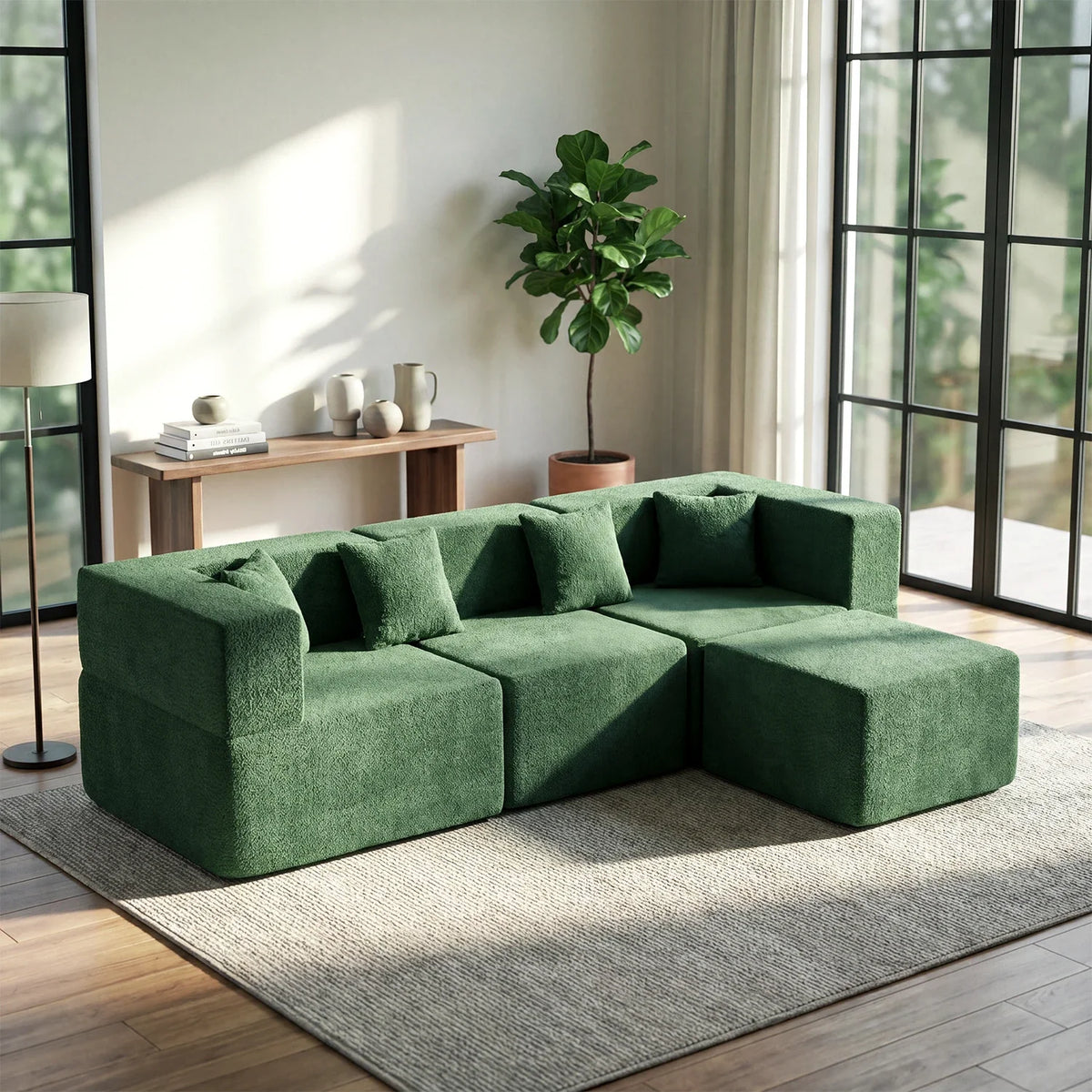
They do not authorize a shopper to invent the footprint of an unshown arrangement. Before choosing this as a modular corner sofa, match the selected material and color to the current product page, record the exact module inventory, identify how the units stay in place and obtain the layouts you plan to use. The green Teddy-style room image supplied to Monvane shows an L-shaped arrangement with a forward lounge unit; it is visual context, not dimensional proof.
Choose the category only when flexibility has a job
A modular corner sofa is a strong candidate when you can name at least two plausible layouts, expect the room or household to change, and are willing to reconnect and maintain multiple units. A fixed sectional may be simpler when one layout will remain for years and a continuous frame is more important than rearrangement. A sofa plus ottoman may be enough when you only need a movable footrest.
Reject a configuration when a frequent route fails, the second layout strands a module, the connection method is unclear, the corner seat does not work for its intended user or future compatibility is only assumed.
Questions shoppers ask about modular corner sofas
Is every L-shaped sofa modular?
No. L describes the footprint. Modular describes identifiable units designed to separate and form supported arrangements. A fixed sectional can be L-shaped without being modular.
Does reversible mean fully modular?
Not necessarily. Reversible may describe only a chaise cushion or movable ottoman. Ask which components move and request diagrams for both orientations.
Do I need a dedicated corner seat?
No. Some systems create a turn with seat and side components, while others use a corner module, chaise or ottoman. The correct answer comes from the selected system’s inventory and instructions.
Can I add modules later?
Only treat future expansion as a benefit when the seller documents compatible part identifiers and a purchase or support path. Product lines, connectors, fabrics and colors can change.
How do I choose left or right orientation?
Use the seller’s configuration diagram, mark the room entry and windows on the same viewpoint, and confirm whether the exact set can reverse. Do not rely on a lifestyle photo or an unlabeled “left” alone.
Finish with an evidence packet, not a product adjective
The purchase gate is complete when you can reconstruct the order, connect it safely according to its instructions, place every piece in two useful room plans and verify current product and return details. If Monvane’s corner-capable format matches that evidence packet, compare the exact options in the current L-shaped modular couch collection. If any proof is missing, resolve it before checkout.