

Furniture Care
Pet Cover for a Sectional Couch: A Practical Guide
Choose sectional pet covers around the places your pet actually uses. Compare seat pads, chaise pieces and larger overlays, then check coverage in use and during laundry.

On this page
Choose a pet cover for a sectional couch by the places your pet touches, then match the cover pieces to the straight seats, chaise and inside corner. A pad may be enough for one reliable resting spot; a pet that crosses the corner needs a different coverage plan. The useful size is the area that stays covered when the sofa is occupied, not the biggest rectangle you can drape over it.
This guide is for covers laid over existing upholstery on stationary seating. It is not a replacement-upholstery guide. Recliners, sleepers and powered sections need covers confirmed for their moving parts, not just a similar seat width.
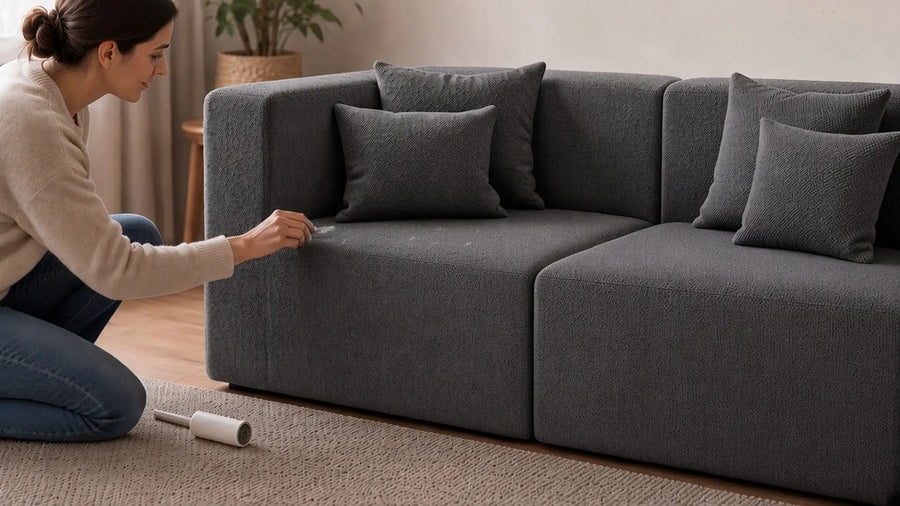
Cover photo: Alex Harwood / Unsplash.
Choose the pet cover by the part of the sectional that gets used
Watch an ordinary lounging session before shopping. Where does your pet climb up, turn around and settle? Does its head rest on the next cushion? Do its paws reach the arm or back? Cover the route onto the sofa as well as the resting spot.
Our recommendation: choose the smallest set of pieces that covers your pet's real routine without constant rescue. That may be one piece, several separately removable pieces or a shaped overlay—not necessarily a full sectional set.
| Where your pet makes contact | A useful starting choice | Check what stays exposed |
|---|---|---|
| Stays on one seat or one end of the chaise | A seat pad or small washable throw, if its own care instructions suit your routine | The climb-up edge, the neighboring cushion and any arm used as a headrest |
| Stretches along the chaise | A long rectangular protector or a chaise-shaped piece with enough usable seat length | The projecting front corners and the junction with the straight seats |
| Crosses the inside corner to reach a second seating run | Separate pieces measured for both runs, or an overlay shaped for the actual corner | A gap or raised fold at the turn; any overlap that shifts under the pet |
| Regularly leans on the back or arms | A protector with those panels, or a confirmed compatible fitted overlay | Arm tops, outer edges and back areas beyond the seat pad |
If your pet roams across the whole sectional, a small pad leaves contact areas exposed. If it stays in one spot, a full set adds fabric to straighten and launder that you may not need.

Measure the seat panels, chaise and inside corner separately
Measure the intended covered surface for each piece, then compare it with the matching panel in the seller's diagram. A cover's overall dimensions may include back and arm flaps. Those inches are not all available for the seat.
- Straight seating run: measure the usable seat width between its boundaries and the seat depth from the back junction to the front edge. Record back and arm coverage separately if you need it.
- Chaise: measure its usable width and the full length from the back junction to the projecting front edge. If the cover is meant to fall over that edge, measure the desired drop too; do not spend the same fabric length twice.
- Inside corner: record both adjoining runs and the corner's actual contour. For a draped piece, let a flexible tape follow the surfaces the fabric must touch. A diagonal line across the hollow skips the material needed to settle into it.
- Piece junctions: ask how the selected design handles the corner—separate edges, a shaped panel or an intended overlap. Check that arrangement where someone will actually sit.
For a hypothetical chaise contact area 30 inches wide and 64 inches long, a protector with a 30-by-60-inch usable seat panel is four inches short in length before any front drop. Calling it a “large sofa cover” does not fix that mismatch. A larger overall size works only if the relevant panel grows enough.
Keep a photo of the sectional with the pieces labeled. For a side-specific chaise cover, have the seller confirm the side on that photo. If you decide on a fitted kit rather than loose protectors, use the separate sectional slipcover installation guide after compatibility is confirmed.
Check coverage after sitting and after your pet settles
The question is not whether the empty sofa looks neat. It is whether your chosen pet-contact areas remain covered during the household's normal use. Our practical check uses ordinary movement, not a stress test.
- Place the pieces using only their intended tucks or supplied attachments. Note the starting position of the corner join, chaise front and pet's entry edge.
- Have the regular users sit down, lean back and get up from their usual seats. Look at the inside turn, chaise front and entry edge again.
- During an ordinary supervised visit, let the pet approach and settle as it normally would. Do not encourage digging, jumping or chewing to test the fabric. Check where the cover ends up after the pet turns or leaves.
- Adjust within the cover's directions, then repeat the ordinary-use check. Decide whether the amount of straightening is something you will actually maintain.
If the chaise front pulls bare, check usable length and whether a tight tuck is using up the fabric. If the corner opens, revisit the piece shapes and their intended meeting point. If an arm flap repeatedly falls away, a seat-only solution is not covering that contact area. More pulling does not add missing coverage.
Remove a cover that keeps sliding out of the needed position, bunches under the sitter or leaves loose parts the pet catches or chews. Do not rescue it with improvised pins, adhesive or ties. Also distinguish cover movement from furniture movement: a protector is not a fix for separating sectional bases or sliding cushions.
Choose the backing and protection claim, not just the fabric name
Start with the mess you need to manage. For routine hair and dry soil, consider how readily you can remove and clean the piece. If liquid protection is essential, ask exactly which surfaces and layers the claim includes, along with its care limits. An overlap between two covers is not automatically a sealed joint. Exposed seams, arms and neighboring seats remain outside a panel's protection.
Check the underside as carefully as the face fabric. Ask whether its backing and supplied anchors are suitable for your exact upholstery, including any leather finish, and whether the sofa maker permits that contact. “Non-slip” is not a fit guarantee for every surface. Avoid a backing or attachment method that conflicts with either product's instructions.
A close-up can show texture, not establish scratch resistance. Do not treat “pet-friendly” as a promise against claws or teeth, and do not buy a thicker throw as a solution to active chewing. Choose another resting arrangement if the cover itself becomes something the pet pulls apart.
Make the wash-and-dry gap part of the purchase
A cover that is easy to remove can still leave the pet's favorite seat uncovered all evening. Our recommendation is to compare the full routine, not just the word washable.
- Get the exact washing and drying instructions before ordering. Machine-washable does not mean tumble-dryable.
- Check that the complete piece fits the intended washer under the machine's loading instructions. A very large cover may call for a different machine or care service.
- Allow space and time for the permitted drying method. Do not put a damp overlay back on the couch simply to restore coverage.
- Choose a clean, dry replacement if the pet will need that place before the washed piece is ready. Otherwise, plan an alternative resting place while the cover is off.

A hypothetical two-piece choice
Suppose your dog sleeps on the chaise and sometimes rests its head on the next seat. A chaise protector plus a neighboring seat piece could cover that routine, provided their dimensions and junction work in use. If the pieces can be cleaned independently and only the chaise piece is soiled, you can leave the clean, dry seat piece in place.
Keep a dry spare for the chaise piece if that is the one that regularly needs washing and you want uninterrupted coverage. You do not automatically need a duplicate set for the whole sectional. But if wet paws travel across the corner and soil both pieces, the one-spare plan no longer covers the whole job: clean both as directed and use suitable replacements or keep the pet off those seats until they are ready.
Choose the set that covers the real contact areas, stays usefully positioned and fits your laundry routine. If none does all three, change the shape, piece count or resting arrangement before accepting a cover you will need to fix every time someone gets up.
FAQ: Pet covers for sectional couches
Can two pets share one small cover?
Only if it covers the places both actually use at the same time. Watch a shared lounging session: one pet may take the chaise while the other moves to an uncovered corner. Choose coverage for that combined routine rather than assuming each will use the same spot in turn. Separate pieces can also let you clean one pet's usual area without stripping the other.
What should I check before putting a pet cover on a leather sectional?
Identify the leather or coated upholstery and the protector's exact backing. Ask both makers about that combination, including any grip dots or anchors. Do not add a generic rug pad or adhesive layer to overcome slipping. If compatibility is confirmed but the intended protector still migrates in normal use, choose a different cover rather than tightening improvised restraints.
Will a chaise cover still fit if I move the chaise to the other side?
A plain rectangle may be reusable if the covered surfaces and intended placement remain the same. A shaped piece can have a side-specific arm flap, corner or attachment. Check the cover's diagram before rearranging, and repeat the measurements and ordinary-use check afterward. A sofa that can change sides does not necessarily have a reversible cover.
Should a pet protector go under the original cushions?
Only its designated anchors or panels should go where the cover instructions place them, and only when that is compatible with the sofa. Do not wrap an ordinary throw beneath fixed cushions or push it into hidden gaps. If you cannot reach the intended attachment without dismantling furniture or forcing a part, stop and confirm that the design is suitable.