

Comfortable Loveseat
Most Comfortable Loveseats for Small Living Rooms: Two Budgets
The most comfortable loveseat for a small living room is the one that passes two budgets at once: enough usable seat space for the intended people and enough surrounding room for routes, tables and everyday movement. Test the exact dimensions with a two-person routine before choosing.
On this page
The most comfortable loveseat for a small living room is not automatically the smallest or deepest one. It is the exact model that gives the intended people acceptable usable seat width, depth, back reach, height and arm positions while preserving the room’s main route and nearby surfaces. Compare body comfort and room comfort as two budgets, then test both people’s real movements.
Fast decision: measure the outside loveseat and the inside usable seat, compare seat depth and height with a familiar chair, tape the complete room footprint, and act out sitting, relaxing, reaching and standing with two people. Reject a model when one person must sacrifice posture or the room must sacrifice its daily route.
Define the comfort job before comparing loveseats
Write the primary routine in one sentence: two people watching a movie, one person curling up to read, a couple talking upright, or occasional guests using short visits. A loveseat optimized for a solo curl-up posture may be too deep for two upright sitters. A compact upright loveseat may save floor area and fail the household’s evening lounge job.
List the regular users and the longest realistic session. Include who sits next to whom, whether pets join, which side each person prefers, and whether one person needs to stand more often. “Comfortable for two” is a hypothesis until that choreography works.
Balance two comfort budgets

The body budget
Start with usable seat width—the distance available between arms or other boundaries—not the outside width alone. Divide it by the real seating positions, then account for a center seam, loose cushions or a gap. Compare seat depth, compressed sitting height, back-cushion thickness and arm height with a seat each person already understands.
Outside width can grow while usable width changes less because arms consume the difference. Deep seats can help relaxed lounging and require a pillow or a different model for someone who wants upright back contact and feet on the floor. No single dimension earns the word “most comfortable.”
The room budget
Tape the full outside width and maximum depth, then add the coffee table, side surface, door arcs and the narrowest daily route. Include the space used when a person sits down, stands or walks past someone already seated. A loveseat that forces the table away from both users may lose practical comfort even when the cushion feels good.
Keep the room test separate from a complete dimension tutorial. Monvane’s current Sofa Size Guide provides named product footprints; use those exact values for tape, then return here to judge how much comfort each footprint buys.
Translate product dimensions into posture questions
| Product fact | Comfort question | Small-room question |
|---|---|---|
| Outside width | How much becomes usable seat after arms? | Does the route remain continuous? |
| Seat depth | Can both users sit upright or lounge as intended? | Does extra depth consume table or passage space? |
| Seat height | Can each user sit and stand acceptably? | Does the low profile solve a visual need only? |
| Arm width/height | Is it a real support or merely lost seat width? | Could a slimmer arm free a side-table zone? |
| Back height/shape | Where does each user receive support? | Does it affect a window or room sightline? |
| Cushion boundaries | Does each person receive a stable zone? | Can cushions be maintained in the space? |
Run the two-person comfort choreography

Use the intended pair of users or comparable body sizes. Run all six actions in the same session. Each person enters, sits upright, moves into the preferred relaxed posture, reaches a safe surface, exits while the other remains seated, and restores the daily arrangement.
Mark pass, adjust or reject for each action. An adjustment may be an approved lumbar pillow or a different table position. Reject when success requires one person to perch, twist repeatedly, block the path or surrender the only useful arm every time.
Test five sitting positions, not one showroom pose
- Left upright: feet, back and arm in the normal conversation posture.
- Right upright: repeat because wall, table or cushion asymmetry can change the result.
- Two-person relaxed: both users settle without overlapping knees or forcing one person outward.
- Solo curl-up: only if this is a real primary routine; note whether cushions and arms support it.
- Edge and stand: each user moves forward and rises without pulling on unstable furniture.
This is a preference and household-fit exercise, not a medical assessment. A person with pain or mobility needs should use appropriate individual guidance rather than a generic sofa recommendation.
Compare surface, support and recovery separately
Upholstery changes touch, temperature impression and friction. Foam and internal construction affect support and compression. Compressed delivery adds a recovery period before the final height and shape can be judged. Keep those observations in separate columns so a soft fabric does not mask an unsuitable posture and early packaging impressions are not treated as final.
Ask for the exact upholstery care instructions, foam information, finished dimensions and model-specific recovery window. Re-run the choreography after recovery. Record whether the center, edges and two sitting positions respond consistently during the intended session.
Two current Monvane size patterns
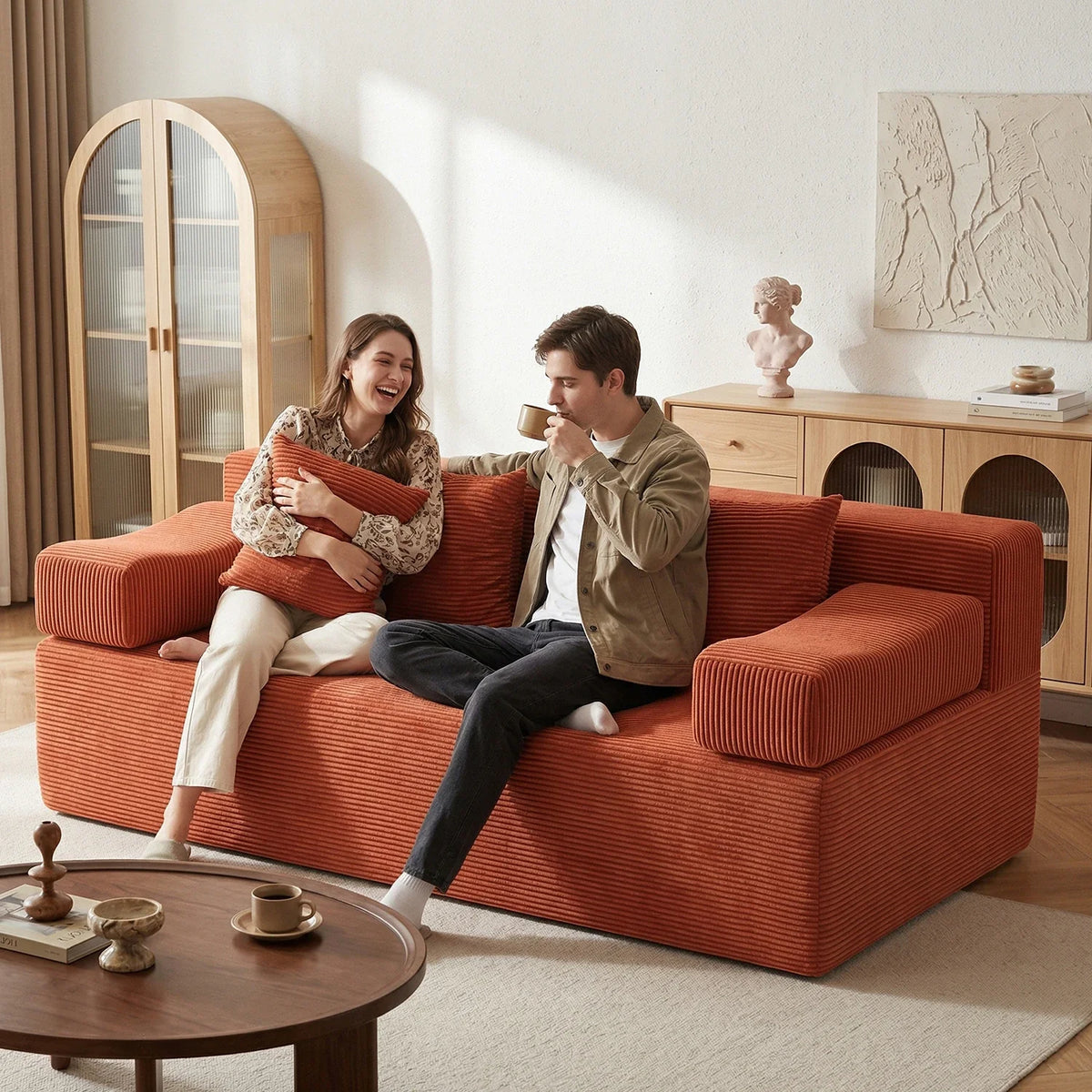
The supplied featured image belongs to the Loveseat Sofa (Corduroy) archive folder. It visibly shows two adults sharing a red ribbed loveseat, with independent back cushions, broad arms and a coffee table in front. The image demonstrates a two-person routine; it does not prove dimensions, long-session comfort or how the same loveseat fits a smaller room.
The current Monvane Corduroy Loveseat page lists 69.3 inches wide by 43.3 inches deep by 33.5 inches high, a 26-inch seat depth and 15.75-inch seat height. A separate current 75-inch Chenille Loveseat page lists 75 inches wide by 37.4 inches deep by 30 inches high, a 27.56-inch seat depth and 16.5-inch seat height.
Neither pattern wins from numbers alone. The 69.3-inch model is narrower outside but deeper overall; the 75-inch model is wider but shallower overall while listing a deeper seat. Verify how each page defines its measurements, tape the exact footprint, and test the familiar-seat comparison before choosing.
Shortlist by routine
| Primary routine | Prioritize | Watch for |
|---|---|---|
| Two-person conversation | Usable width, upright back reach, independent exit | Deep seat requiring both users to add pillows |
| Two-person movie night | Relaxed depth, repeatable arm positions, shared table reach | One preferred side and one compromise side |
| Solo reading | Curl-up length, arm support, lamp and table relationship | Paying for a second seat that blocks the room |
| Occasional guests | Neutral posture range, simple care, clear entry/exit | Optimizing for rare lounging at daily room cost |
| Pet-sharing | Planned human and pet zones, care access, surface evidence | Assuming two advertised seats remain for two adults |
When a loveseat is not the comfortable answer
- Two regular users cannot maintain acceptable postures at the same time.
- The exact footprint blocks the only useful route or table position.
- A small sofa with slimmer arms provides materially more usable seat width.
- One chair plus an ottoman better supports unequal posture preferences.
- The room primarily needs solo seating and a movable second seat.
Questions about comfortable loveseats
What seat depth is most comfortable for a loveseat?
There is no universal best. Compare the stated depth with a familiar seat and test upright and relaxed postures for both regular users.
Can two adults sit comfortably on a loveseat?
Yes, when the usable seat width, cushion boundaries, arms and postures work for that pair. Outside width or a two-seat label does not prove the result.
Is a loveseat always better for a small living room?
No. It must preserve the route and support the intended routine. Two chairs, a compact sofa or one chair and ottoman may use the room better.
Are deep loveseats comfortable?
They can suit relaxed lounging. People who prefer upright sitting may need a different depth or approved back support, and the extra outside depth still has to fit the room.
How do I compare loveseat comfort online?
Collect usable and outside dimensions, compare with a known seat, request current material and recovery details, tape the footprint and complete the two-person choreography during any permitted trial.
Choose from evidence, not a comfort superlative
Keep one scorecard with the routine, regular users, exact footprint, usable seat, five positions, six movements, surface/support notes and unresolved facts. The best loveseat is conditional on that record.
After both comfort budgets pass, compare current options in Monvane’s loveseat collection. A small-room loveseat earns the title “comfortable” when two people and the room can all keep doing their jobs.