

Boneless Sofa
Modular Floor Sofa: Audit the Floor Interface First
A modular floor sofa is practical only when its low profile, bottom construction and floor conditions work as one system. Verify seat height, contact materials, cleaning access, moisture response and module stability before treating a floor-level silhouette as proof of easy ownership.
On this page
A modular floor sofa is a good choice when you can stand comfortably from its verified seat height, identify what touches the floor, clean and inspect every contact zone, and keep the modules stable on your actual surface. A low silhouette or the word “boneless” does not prove those conditions. Treat the sofa, its base, the rug or floor and the room’s moisture history as one interface.
Fast decision: mock the stated seat height, obtain a bottom-view photo and care instructions, test the intended floor surface, and write a realistic cleaning and spill plan. Reconsider the format if any person struggles to rise, the underside cannot be inspected, the floor manufacturer excludes that contact, or the modules migrate during normal use.
First define what “floor sofa” means in this listing
The search term can describe several different products: a cushion placed directly on the floor, a very low framed sofa, or an upholstered foam body with no visible legs. Those are not interchangeable. Ask the seller to identify the exact internal structure, finished seat height, bottom material, ventilation or clearance requirement and connection method for the selected configuration.
Keep three labels separate in your notes:
- Low profile describes the visual or measured height.
- Boneless or frameless describes a construction claim that still needs exact material and support details.
- Floor-contact base identifies the surface that actually meets the rug or finished floor.
A product can satisfy one label without satisfying the others. This distinction prevents a useful keyword from turning into an unsupported product promise.
Audit five proofs at the bottom edge

1. Prove the seat height with your body
Use the seller’s finished seat height, measured at the stated location and condition. Build a firm mock-up at that height or compare it with a chair you use every day. Sit down and stand up several times without pulling on an unstable table. Repeat with the people who will use the sofa most often.
This is a household fit test, not a medical conclusion. Leg length, strength, joint comfort, cushion compression and arm support all change the experience. If rising is difficult, move to a higher seat or seek individual guidance rather than assuming that a soft floor-level body will adapt.
2. Identify the exact bottom assembly
Request a clear underside or bottom-edge image and a written description. Record the fabric, mesh, anti-slip layer, feet, glides, hook-and-loop strips or connectors that touch the room. Ask whether any part can transfer color, trap grit, mark a finish or react with a floor coating. A generic “non-slip” phrase does not answer those questions.
Also determine how a module may be moved. Dragging can grind debris into a finished floor; lifting can be unsafe if there is no approved grip point. Follow the product and flooring instructions for the exact materials.
3. Match the base to the floor system
Name the actual surface: sealed wood, laminate, vinyl, tile, low-pile rug, thick rug or a transition between surfaces. Check the floor or rug maker’s guidance for pads, rubberized backings, ventilation, radiant heat and long-term covering. If no guidance exists, obtain it before approving permanent contact.
A rug may change traction and level the modules unevenly when only part of the sofa sits on it. A hard floor may reveal slow migration that a product photo cannot show. Test the complete arrangement with normal sitting, standing, reclining and pet movement.
4. Design cleaning access before purchase
Map where crumbs, hair and dust will collect: module joins, front edges, wall side and any recess under loose components. Confirm which covers are removable, what “spot clean” means for the exact upholstery and whether modules can be separated without damaging connectors. Choose tools that fit the gaps; do not assume the whole sofa can be flipped or washed.
The easiest floor sofa to own is not necessarily the lightest-looking one. It is the one whose high-contact boundaries can be reached on your actual schedule.
5. Write a moisture-event response
A floor-contact sofa sits close to leaks, wet cleaning, pet accidents and condensation at exterior walls. Keep the floor dry before placement and inspect after any event. The U.S. Environmental Protection Agency’s water-damage guidance treats upholstered furniture as a material that requires prompt water removal and drying assessment. That guidance is not a product warranty or a promise that a soaked sofa can be saved.
For a significant leak, contaminated water, persistent odor or material that remains damp, stop normal use and follow the manufacturer, flooring supplier, insurer or qualified remediation professional as appropriate. Do not hide a wet boundary under a rug or reconnect modules before the area is dry and cleared for use.
Use a recovery checkpoint for compressed modules
Compressed delivery adds a time dimension to the floor interface. Count the packages on arrival, photograph shipping damage, open them in the clean and dry destination, and follow model-specific unboxing instructions. Leave room around each module so it can recover without leaning against a damp wall or blocking a required route.
Do not judge final height, join alignment or firmness immediately after opening. Monvane’s current Support Center says compressed foam should be allowed 48–72 hours to recover and directs shoppers to model-specific instructions. Record the product’s stated window, then photograph the same measurement points at opening and after that window. Escalate discrepancies through the seller’s documented process rather than inventing a recovery method.
Test module stability after recovery
Place the recovered modules in the approved layout and mark their edges with removable floor-safe tape. Use the sofa normally for several days. Check whether joins open when someone stands, a pet jumps down or a lounger changes position. Record movement rather than describing it as “a little” or “a lot.”
If the system uses connectors, verify their direction and limits. If it relies on an anti-slip base, test that exact base on the actual rug or floor. Do not add third-party grippers or adhesives until both the sofa and floor instructions allow them.
Inspect the five zones for 30 days

Inspect at the end of the recovery window, after the first full clean, after any spill or leak and near day 30. Look at the same five zones: module joins, wall side, front edge, underside boundary and rug transition. Note migration, trapped debris, marks, staining, odor or persistent dampness. Photographs taken from the same angle are more useful than memory.
This is an ownership record, not a diagnosis. Follow the warranty and return process while the event and condition are well documented.
A Monvane product as a scoped example
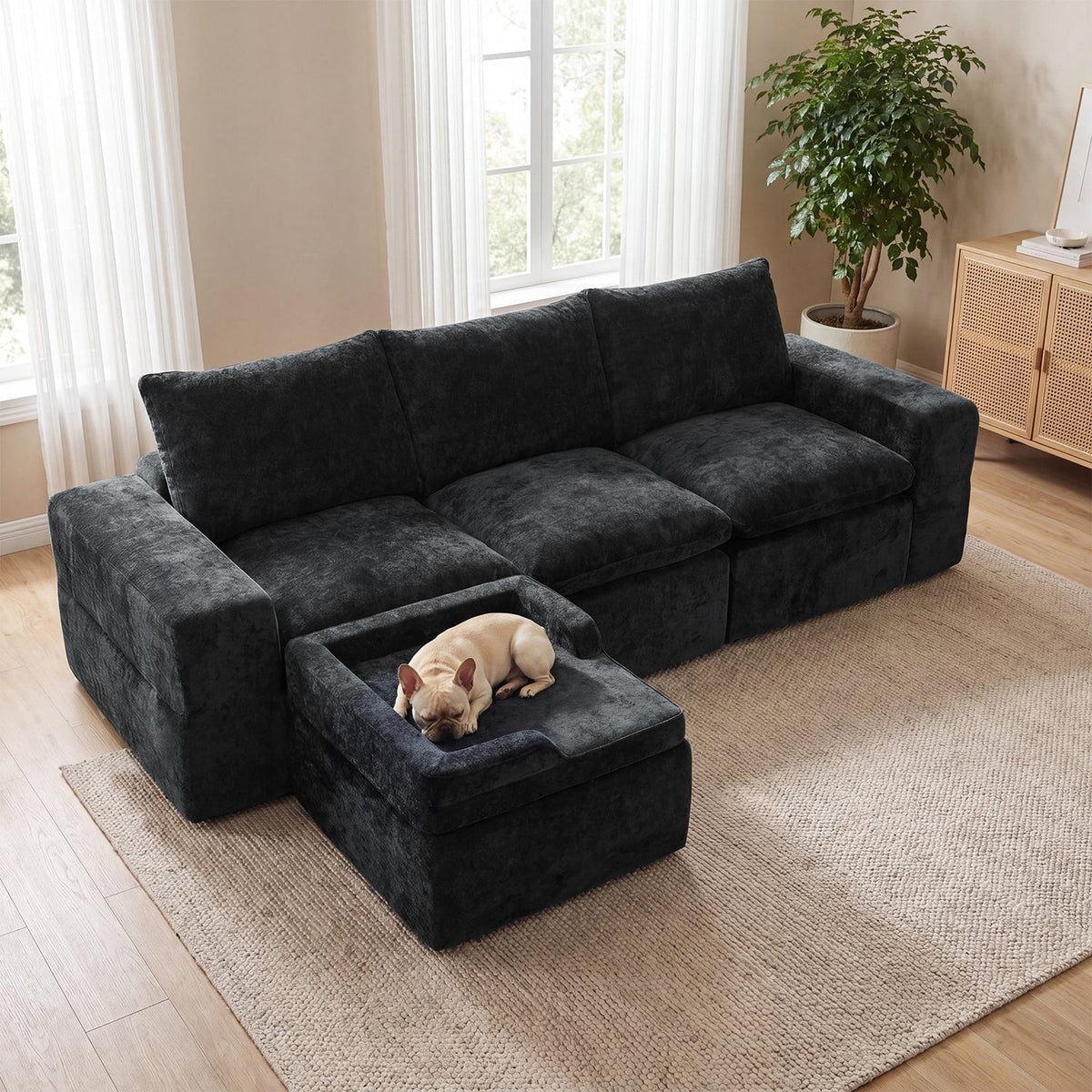
The supplied featured image belongs to Monvane’s Human & Pet Modular Sofa (4 Seats) archive folder. It visibly shows four upholstered units close to a rug and hard-floor boundary, including joins and a forward pet seat. Those visible facts make it useful for a floor-interface exercise; the image does not prove underside materials, dimensions, cleanability or compatibility with every floor.
For a current specification example, the Monvane L-Shaped Modular Couch page describes a boneless, no-assembly design, a 16.5-inch seat height, two packages and an anti-slip base. That is enough to start the five-proof worksheet. It is not enough to rename the model a “floor sofa” or guarantee easy standing, ventilation, floor safety or module stability in a different home.
Who should keep this format on the shortlist?
- A household that prefers a low visual line and has tested the finished seat height.
- A renter or frequent mover who has verified package handling and supported configurations.
- A pet household with a reachable cleaning plan for joins and contact edges.
- A room where the exact base is permitted on the selected rug or floor.
- An owner willing to inspect after recovery, cleaning and moisture events.
Who should reconsider it?
- Anyone who cannot rise comfortably from the mocked seat height.
- A damp-prone room where the contact boundary cannot be monitored.
- A floor finish whose maker excludes the stated backing or long-term coverage.
- A cleaning routine that depends on open under-sofa clearance.
- A household that needs locked connections but the exact product relies only on friction.
Questions about modular floor sofas
Is a modular floor sofa the same as a boneless sofa?
No. “Floor sofa” can describe a low or floor-contact format; “boneless” describes a construction claim. Verify the exact structure, finished seat height and bottom interface instead of treating the words as synonyms.
Are floor sofas hard to get up from?
They can be for some users, but the result depends on finished seat height, cushion compression, arm support and the individual. Mock the height and run a safe sit-to-stand test with each regular user.
Can a floor sofa sit on hardwood?
Only after the sofa’s bottom material and the flooring manufacturer’s requirements are compatible. Check for grit, color transfer, excluded rubberized backings, ventilation and approved movement methods.
How do I clean under a floor sofa?
Follow the model instructions. Plan access through removable or separable modules and use tools that reach the approved boundary. Do not drag, flip or detach the sofa unless the product instructions support it.
How long should compressed modules expand?
Use the model-specific instruction. Monvane’s current support page gives a general 48–72-hour recovery window for compressed foam and says to check the product page or setup guide for exact notes.
Approve the interface in one record
Save the definition used by the seller, finished seat-height test, bottom-view evidence, floor guidance, cleaning map, moisture plan, delivery package count, recovery photos and movement record. If one proof is missing, keep the product as a candidate rather than filling the gap with a category assumption.
After the interface passes, compare current configurations in Monvane’s modular couch collection. The low profile earns its place only when the contact boundary remains usable, inspectable and compatible with the room.