


Bed Bugs
How to Get Rid of Bed Bugs From Sofa? Step-by-Step Care Guide
Confirm the pest before moving anything, treat the sofa as one part of a whole-room plan, use only methods allowed for both the pest-control task and the upholstery, then monitor and escalate when evidence continues.
On this page
To get rid of bed bugs from a sofa, first confirm the pest, stop moving cushions or throws through the home, inspect and vacuum every accessible hiding zone, and then follow this step-by-step care process using only treatment methods allowed for both bed bugs and that sofa surface. Bag removable, dryer-safe items before carrying them to the dryer. Steam or pesticides require exact compatibility and directions; when either is uncertain, use a pest management professional. Treating one sofa is not proof that the dwelling is clear. Bed bug control is a room- or home-wide process that requires repeated inspection and monitoring.

Confirm bed bugs before treating the sofa
Do not diagnose an infestation from bites alone. The US Environmental Protection Agency says bites are a poor indicator because they can resemble other bites, rashes or hives, and some people do not react. Look instead for a live bug, rusty or reddish stains, dark spotting, pale shed skins, or eggs and eggshells. The EPA's identification guide notes that couches can harbor bed bugs in seams and between cushions.
Collect a suspected insect in a secure container or sealed bag and have it identified by a local extension agent, qualified pest professional or other insect expert. Photograph the exact location before cleaning and start a dated record. If an expert confirms bed bugs in an apartment or other multi-family property, notify the landlord or building manager promptly so adjoining units and the building plan are not ignored.
Stop before treatment when identification is uncertain. Random pesticide, heat or disposal can create exposure, damage the sofa or spread an unrelated pest without solving the cause. If suspected bites trigger an allergic reaction, contact a healthcare provider; the CDC notes that such reactions are possible, although rare.
Contain the area before moving a cushion
Keep the sofa and its loose items in the affected room until the handling route is planned. The EPA advises against moving items from an infested area to a non-infested area. Stage sealable bags, a flashlight, a crevice tool, labels and an outdoor-waste route before lifting anything. Keep clean and untreated items in clearly separate containers.
- Pause routine use. Keep people, pets, blankets and laundry off the sofa while it is being assessed.
- Record the starting state. Note every confirmed sign and its precise location rather than using one general “sofa” entry.
- Bag before transport. Put removable textiles directly into a sealed bag before carrying them to another room or shared laundry area.
- Protect the clean route. Decide where treated items will go before opening the first bag.
- Coordinate the larger plan. Inspect the surrounding living space and, in multi-family housing, follow the professional or building instructions instead of treating the sofa as an isolated object.
Do not drag the sofa into a hallway, garage or curbside collection area as a containment step. If the sofa truly cannot be treated, follow local disposal requirements and the EPA's advice to render it unusable and mark it clearly; disposal is not the default when treatment is feasible.
Inspect the sofa as a map, not one surface
Start with upholstery edges and removable pieces
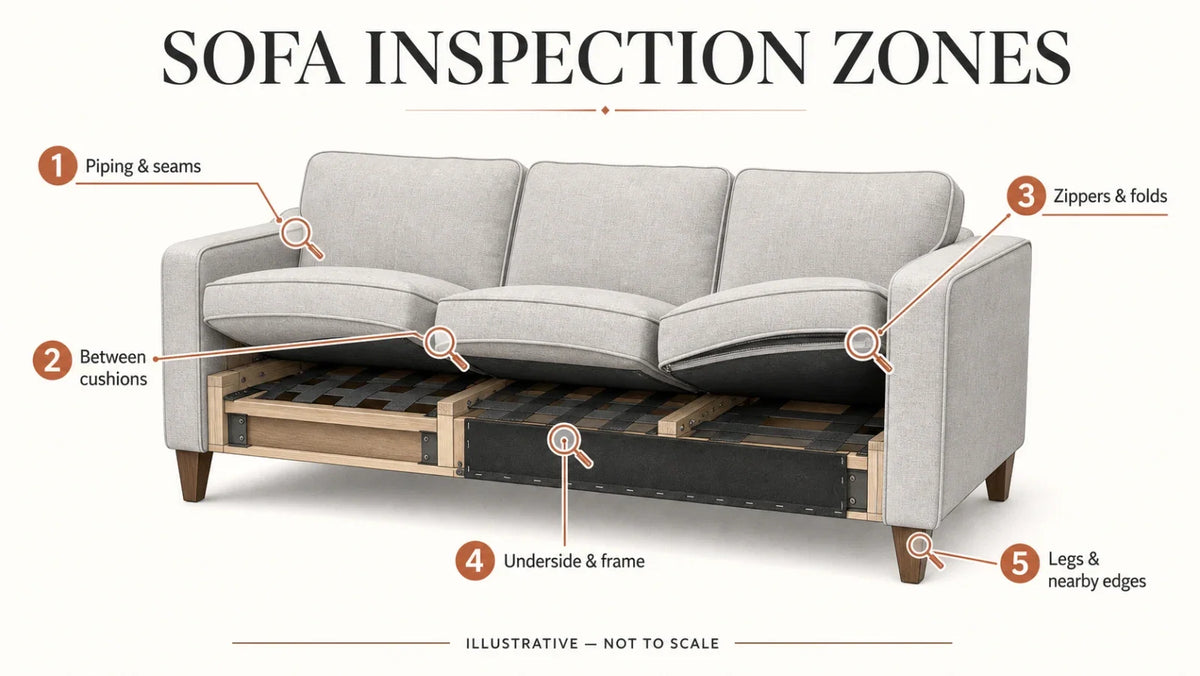
With a flashlight, work systematically across piping, stitched seams, tufts, cushion gaps, zipper folds and tags. Lift a cushion only when you can control where it goes and seal it if necessary. Do not unzip, remove or wash a cover merely because a zipper is visible; a zipper can be an assembly opening rather than proof that the cover is washable.

Continue below the cushions and around the room edge
Inspect accessible seat platforms, the underside edge, dust-cover seams, frame joints, feet and connector areas. Then look at the wall-floor junction, baseboard, nearby curtain folds and adjacent furniture. The illustrated zones are a search map, not permission to cut a dust cover, separate modules, reach into electrical components or disassemble a mechanism. Stop at inaccessible construction and give that location to a professional.
A finished map should distinguish confirmed evidence, inspected with no evidence found and not safely accessible. That three-state map prevents an uninspected void from being mistaken for a clean zone.
Use the two-permission rule for every method
A method belongs on the sofa only when two independent conditions are true: the pest-control directions permit that exact surface and the sofa's care information permits the heat, moisture, tool or product involved. Passing only one condition is a stop signal.

Compare the available treatment branches
| Method | Bed bug requirement | Sofa requirement | Boundary |
|---|---|---|---|
| Inspection and vacuuming | Cover the mapped hiding zones and contain collected debris immediately | The nozzle and suction must not tear fabric, pull trim or disturb hidden components | Physical removal reduces accessible evidence; it does not prove eggs or hidden bugs are gone |
| High-heat clothes dryer | EPA guidance uses a household dryer on high heat for 30 minutes for items that can withstand it | The exact loose cover, throw or textile must be removable and rated for that dryer treatment | Washing alone may not work; fixed upholstery and unknown covers do not enter this branch |
| Steam | EPA guidance calls for steam of at least 130°F, without forceful airflow, and a diffuser to avoid scattering bugs | The exact upholstery, foam, adhesive and finish must tolerate the approved heat and moisture method | Unknown compatibility, inaccessible depth or unsafe equipment moves the task to a professional |
| Pesticide | Use only an EPA-registered product whose label lists bed bugs and permits the exact intended site and surface | Confirm the product will not violate the sofa instructions or damage the intended surface | Follow the label exactly; do not improvise dose, placement, combinations or reapplication |
| Professional furniture or room heat | Use a qualified provider's controlled treatment plan | The provider must assess the sofa's materials and hidden construction | Do not heat the home with a thermostat, propane heater or fireplace; EPA calls that dangerous and ineffective |
| Interceptor monitor | Use and maintain the device according to its directions | The sofa must have stable, accessible legs that fit the device | Not applicable to a floor sofa or a base without discrete legs; monitoring is not treatment by itself |
For a Monvane sofa, use the exact product page, care label and any model-specific instructions available with the order. If the heat, moisture or chemical boundary is missing, contact the Monvane Support Center with the product name, order information and clear photos. Product support can clarify the sofa; a qualified pest professional controls the infestation plan.
Treat the accessible sofa zones in eight steps
The order below combines EPA preparation and control guidance with the two-permission rule. A pest professional's written preparation and treatment sequence takes priority for the property and product involved.
- Confirm the scope and treatment owner. Record the identification, affected rooms, building contact and whether a professional is directing the work.
- Stage containment. Prepare sealed bags, labels, the approved vacuum setup and the route to an outside trash bin before opening sofa zones.
- Bag compatible removable items. Enclose throws and verified removable covers at the sofa. Do not carry them loose.
- Vacuum accessible hiding points. Work through the inspection map, including seams, cushion gaps, platform edges, underside seams, joints and feet that can be reached without damaging or dismantling the sofa.
- Seal the vacuum waste. The EPA instructs users to seal a removed vacuum bag in plastic and place it in outdoor trash. If the equipment cannot be emptied and contained safely, stop and get method-specific advice.
- Process removable textiles. Use the high-dryer route only for items verified to withstand it, then transfer treated items into clean sealed bags. Otherwise keep them sealed for the professional plan.
- Apply the selected sofa treatment. Use steam, a labeled pesticide or professional treatment only after both permissions pass. Follow the exact sequence; do not stack methods or reapply because the surface “looks untreated.”
- Reset for observation. Return only treated items, keep the sofa separated from avoidable wall or textile bridges when the plan calls for it, install compatible monitors and update the location record.
Know what a completed first pass looks like
The first pass is complete when all safely accessible zones have a recorded status, vacuum waste is sealed outside, every removed item is either treated and clean-bagged or still contained, only compatible methods were used, and the monitoring route is active. It is not complete merely because no bug is visible after vacuuming.
Recover when the sofa cannot follow a step
If a cover is not confirmed removable, leave it attached. If the fabric cannot tolerate dryer heat or steam, omit that branch. If a pesticide label does not expressly permit the intended sofa surface, do not apply it there. Mark the untreated or inaccessible zone and give the exact limitation to the pest professional instead of silently skipping it.
Monitor the sofa and the surrounding room
The EPA advises checking for evidence every few days after the initial cleanup and at least every seven days because missed bugs or newly hatched eggs can appear. Keep the same location log so a new finding can be distinguished from an old stain or discarded skin. For sofas with discrete legs, appropriately sized interceptors can help monitor movement when installed and maintained as directed; a floor-level sofa needs another professional monitoring strategy.
A returned live bug, fresh spotting or another confirmed sign means the process has not reached a clear endpoint. Reinspect the mapped locations and nearby room, review whether a zone was inaccessible or a treatment branch was incompatible, and follow the label or professional retreatment plan. Do not shorten a label interval or switch products at random.
No single waiting period in this guide declares eradication. The EPA says DIY control may take weeks to months, steps may need to be repeated, and ongoing records and checks matter. A credible endpoint comes from the full treatment and monitoring plan—not from one clean-looking sofa.
Avoid shortcuts that spread risk
- Do not use bites as the only diagnosis. Confirm the insect or physical evidence before treatment.
- Do not carry loose cushions or laundry to another room. Bag affected items at the source.
- Do not use a fogger as the only control. EPA guidance says foggers do not reach the cracks and crevices where bed bugs hide and can create health, fire or explosion hazards if misused.
- Do not spread pool- or food-grade diatomaceous earth. The EPA warns against these products because of inhalation risk; any desiccant used as a pesticide must be EPA-registered and label-authorized.
- Do not create DIY whole-room heat. Raising the thermostat or using a propane heater or fireplace is not an acceptable treatment.
- Do not assume more product means more control. The pesticide label, not visible residue or anxiety, controls where, how and when a product may be used.
Escalate before the gap becomes the method
Contact a qualified pest management professional when identification remains uncertain, more than one room has evidence, the sofa contains inaccessible voids, the required method is not compatible with the upholstery, a pesticide or heat procedure is outside your training, evidence continues after the directed cycle, or anyone may be unable to follow the containment plan. Multi-family housing also requires prompt building coordination because treating one unit or sofa without the larger plan can leave the source unresolved.
Your next action should match the evidence you have now: secure a specimen if the pest is unconfirmed; contain and map the sofa if it is confirmed; follow only the compatible steps in the coordinated plan; or escalate a method or construction gap rather than improvising. That is how a sofa treatment contributes to getting rid of bed bugs without pretending the sofa is the whole infestation.
Sources and scope
The current EPA pages on finding bed bugs, preparing for treatment, DIY control and integrated pest management, plus the CDC's bed bug overview, were checked August 13, 2026. This guide supplies a bounded sofa-care workflow, not pest identification, a pesticide label, a product-specific upholstery clearance, medical advice or a professional eradication guarantee. Local pesticide rules, housing duties and waste requirements can differ.