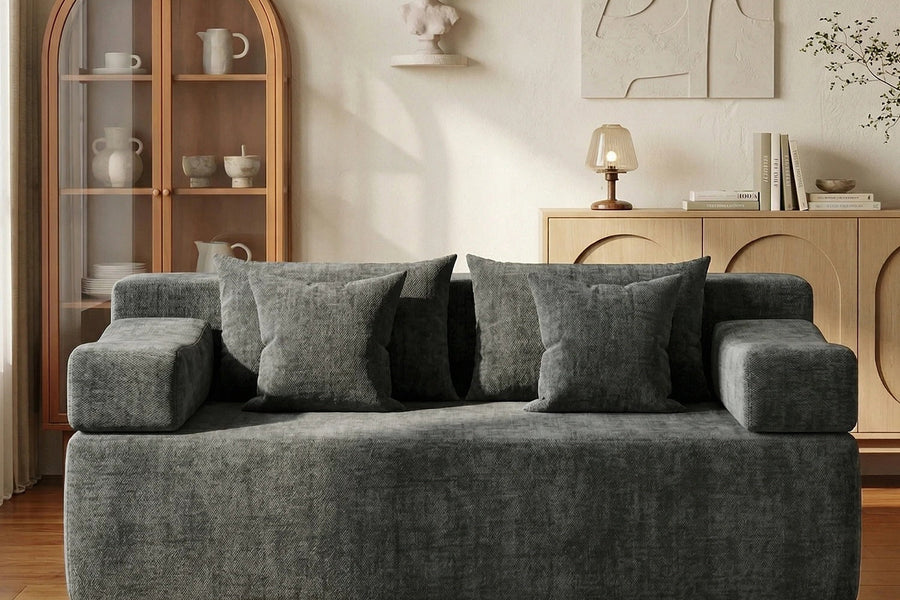


Black Sofa
Living Room Color With Black Sofa: Practical Guide
Pair a black sofa with a light or muted background, a distinct rug field, one middle-value material and controlled black repetition. Then test every sofa edge in normal day and evening light.
On this page
The most reliable living room colors with a black sofa are warm white or ivory, oatmeal or light greige, natural wood, and one muted color such as olive, clay or blue. The exact group should change with the room's daylight, floor and fixed finishes. Keep the sofa readable against the wall and rug, add a middle value between black and the lightest surfaces, and repeat black only in a few separated details. A black sofa does not require a white room; it requires a clear outline and a connected palette.

Protect the sofa outline at four adjoining fields
Black creates a large dark shape before it reads as a style. The room needs separation where the sofa touches its surroundings and continuity elsewhere. Evaluate four fields before shopping for accent pillows.
| Field | Job | Visible failure | Targeted correction |
|---|---|---|---|
| Wall or window field behind | Reveal the back and arm outline | The top edge disappears, or the sofa becomes one severe black bar on a stark white wall | Lighten or warm the background, or add a quieter middle-value textile or artwork field above |
| Rug or floor beneath | Separate the lower edge and define the seating zone | Black upholstery merges with a very dark floor or rug | Use a visibly lighter rug field that relates to the wall, floor or wood already present |
| Wood, leather or textile alongside | Bridge the darkest and lightest surfaces | The room jumps directly from black to white and feels disconnected | Add a middle value such as oak, walnut, camel, oatmeal or muted color |
| Small dark notes elsewhere | Connect the sofa to the whole room | The sofa is the only black object, or every accessory has been turned black | Repeat a few slim lines or small shapes in separated locations, then stop |
Fix the field that loses an edge; do not add unrelated accent colors elsewhere. A disappearing lower edge is a rug or floor problem. A sofa that looks isolated against the wall needs a bridge beside or above it, not five new pillow colors.
Decide how much contrast the room can carry
Bright rooms can support two directions
A room with broad daylight can use a light background for crisp separation or a muted darker wall for a softer envelope. The first route is easier: ivory wall, light rug and warm wood keep the black sofa legible. A dark wall can also work when window light is reliable and the lower edge remains distinct through a lighter rug, floor or baseboard. If the wall and sofa merge by evening, the dramatic daytime image has not solved the everyday room.
Low-light or compact rooms need protected relief
A black sofa does not automatically make a small room feel smaller, but its size and surroundings matter. In a low-light room, keep at least two large adjoining fields visibly lighter—for example, wall plus rug, or window curtain plus floor—and supply a middle value through wood, camel or oatmeal. Do not make every surface pale; that can turn the sofa into one isolated block. The goal is a sequence from light to middle to black.
Judge the black field from the normal doorway and seating position. A loveseat occupies less of the view than a large U-shaped sectional, so the larger configuration generally needs more visible light area inside and around its footprint. That is a room observation, not a universal percentage.
Choose one palette route
These are Monvane editorial starting points, not exact paint or textile matches. Pick the route that solves the room's actual constraint, then edit it with physical samples.
| Route | Background and rug | Middle materials | Muted color | Reject when |
|---|---|---|---|---|
| Warm natural | Ivory or warm white wall; oatmeal or flax rug | Light or medium oak, tan pottery, woven fiber | Olive or clay | The whites turn cold beside the floor, or the tan family becomes orange under evening lamps |
| Soft tailored | Light greige wall; cream-and-taupe rug | Walnut, camel leather or warm bronze | Dusty blue or restrained burgundy | The greige is nearly as dark as the sofa at night, or black-and-white contrast still dominates every view |
| Muted color-rich | Soft sage, blue-green or clay-toned wall; quiet cream rug | Walnut or oak, off-white curtains | One related deeper shade in art or textiles | The wall swallows the sofa outline, or the added colors do not repeat an existing room material |
A black-and-white palette is possible, but it needs material and value changes: woven cream rather than only optic white, warm stone rather than another black slab, or pale wood between the two extremes. A dark-wall palette is also possible, but it must pass the silhouette check later in this guide. Neither option is a default winner.
Give soft furnishings different jobs
Use the rug to release the lower edge
The rug is the broadest editable field directly below the sofa. Choose its background before choosing its small motifs. An oatmeal, ivory, light taupe or softly patterned rug can reveal the sofa base while relating to a warm wall or floor. A black pattern is useful only when the background still provides relief. Color does not rescue a rug that blocks a route or is wrong for the measured furniture plan; preserve the layout first.
Use curtains to shape the vertical field
Curtains sit beside the sofa and window light, so compare them open, backlit and closed. Off-white, flax and warm greige can soften a bright wall without becoming a second dark mass. A colored curtain can work when it relates to the wall or rug, but avoid using one saturated panel as the room's only color. The curtain should connect two existing surfaces rather than begin a separate palette.
Use wood, leather and metal as the middle step
Wood and camel leather are effective because they sit visually between black upholstery and pale walls. Repeat the wood already present in flooring, built-ins or a table before introducing another species or stain. Metal should be controlled: one black lamp, narrow frame or table base can echo the sofa, while warm bronze or brushed metal can supply a quieter transition. Large glossy black tables often enlarge the dark field instead of bridging it.
Let texture and lighting change the final choice

Black chenille, velvet, leather and a smooth woven fabric do not present one identical black surface. Yarn direction, pile, sheen and room light create visible highlights and dark pockets. A pillow that looks charcoal beside a phone image may disappear against the real upholstery; a warm wall may look cooler when the evening lamps turn on.
NIST describes object color appearance under artificial lighting as an important characteristic of the light source and calls the appearance of colors under a particular light color rendering. The practical boundary is narrow: judge physical samples under the daylight and lamps you actually use. A screen image is useful for placement ideas, not an exact purchase match.
Put the sofa fabric or the closest removable piece beside the wall board, rug sample, curtain and wood. Touching samples reveal edge relationships; spreading them across a table can hide a mismatch that becomes obvious in the room.
Read two black-sofa rooms for placement clues
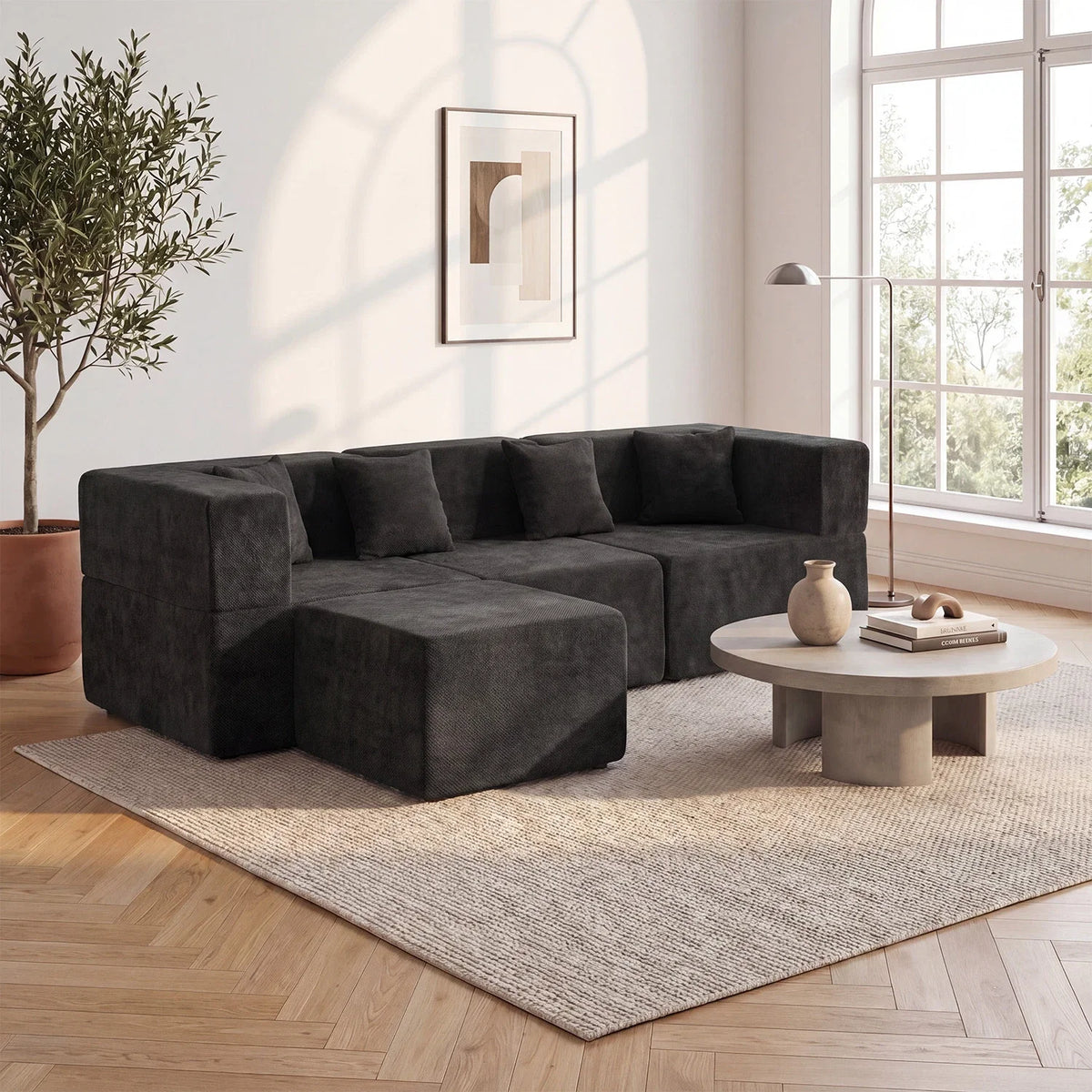
A compact L uses warm middle values
The featured L-shaped room shows black textured upholstery against a warm light wall and pale rug. The oak floor, terracotta planter, gray-beige table and greenery occupy the visual middle. Only a slim floor lamp and picture frame repeat dark lines away from the sofa. This is why the room does not require bright pillows to feel connected.
The current Monvane L-Shaped Modular Couch page offers Black and Chenille options. The archived room image is useful for visible placement logic; it is not a calibrated color sample or proof that every current screen, fabric batch or room will look identical.
A large U needs more open light area

In the U-shaped scene, black upholstery occupies much more of the view. The broad light rug remains visible inside the U and beneath its front edges; white walls and glazing create relief above; plants place muted green around the perimeter. Thin black window and picture-frame lines repeat the sofa without forming another heavy block.
The current Monvane 8 Seat U-Shaped Couch in Chenille page includes a Black option. Use the scene to see how a larger dark field changes the surrounding color job, not as a promise that the same palette will fit a different room or configuration.
Run an edge-by-edge silhouette check
Do this after narrowing the palette but before buying full quantities. The check diagnoses where a scheme fails instead of declaring the whole room “too dark.”
- Place samples where they will live. Put the wall board behind the sofa, rug sample under the front edge, curtain at the window and wood or metal beside the seating area.
- Use normal daytime conditions. Stand at the main entry and sit at the usual viewing position; do not turn on extra lights only for the test.
- Trace four sofa edges. Check the top against the wall or window field, the outer side against the adjoining furniture or open room, the lower edge against rug/floor and the chaise or return against the room center.
- Repeat in normal evening lighting. Observe whether a wall, curtain or rug shifts enough to lose an important edge.
- Change the adjacent field first. If the base disappears, change the rug field. If the back becomes one flat mass, change the wall or vertical textile field. Retest before adding another color.
A palette passes when the important edges remain readable in both conditions without making every neighboring surface high contrast. Save one daylight and one evening reference photo only after making the decision in person; camera processing is not the color standard.
Make the final room-color decision
Place the sofa fabric, wall board, rug, curtain, main wood and one muted color together in their real positions. Approve the scheme only when the sofa remains defined, the room contains a usable middle value, repeated black is controlled and the samples still belong together under normal evening light. Reject a route that works only in a product photo, loses a decisive edge or requires unrelated accessories to disguise the problem.
If you are comparing a current Monvane black sofa, open the exact product page, select the intended color and material, and recheck those options before ordering. Then apply the same physical-sample and silhouette process rather than treating the online gallery as an exact room match. The practical answer is not one universal color: it is a palette in which the wall, floor, furnishings and black sofa each perform a visible job.
Sources and scope
Current NIST color-rendering guidance and the Monvane L-Shaped Modular Couch and 8 Seat U-Shaped Couch in Chenille pages were checked August 13, 2026. Product options and page content can change; the exact selected page controls. The palette routes and edge checks are Monvane editorial starting points—not fixed decorating laws, calibrated color specifications or guarantees of individual preference.