


Cleaning and Maintenance
Stain Resistant Sectional Sofa: Safe Cleaning and Maintenance Guide
Treat stain resistance as a scoped performance claim, then use the exact upholstery care route to triage spills, clean minimally, inspect the dry result and maintain every high-contact sectional zone.
On this page
A stain resistant sectional sofa needs a safe cleaning and maintenance plan. It can make some spills easier to manage, but the phrase is useful only when the seller identifies the exact fabric, the liquids or soils covered, the test method and result, the treated panels, and the care limits. It does not mean stain-proof, waterproof, oil-proof, or safe with every cleaner. Before buying, build that claim record. After a spill, use the exact upholstery instructions, remove excess material without rubbing, apply only an approved method, and judge the result after the area is fully dry.

Read “stain resistant” as a scoped performance claim
Start by asking what performance the words describe. The American Association of Textile Chemists and Colorists maintains separate methods for water repellency, oil repellency and oily-soil release. For example, AATCC TM22 measures resistance to wetting by sprayed water, while AATCC TM118 evaluates wetting by a series of liquid hydrocarbons. AATCC TM130 evaluates release of an oily stain after home laundering, so it is not automatically a fit for attached sofa upholstery.
| Claim or result | What it can support | What it does not establish by itself |
|---|---|---|
| Water repellency | Resistance to surface wetting under the named water test | Oil repellency, dye removal, leak-proof seams, or easy cleanup after absorption |
| Oil repellency | Resistance to wetting by the named oil-test liquids and conditions | Removal of food color, ink, makeup, or a dried stain |
| Oily-soil release after laundering | Residual-stain rating after the specified stain and home-laundering procedure | Performance on a fixed cushion, arm, frame panel, or non-washable cover |
| Spot-cleanable | A stated maintenance route for the exact upholstery | A resistance rating or proof that the stain will disappear |
| Broad “stain resistant” wording | A question that needs a claim record | Universal protection across liquids, soils, panels, age, or cleaning history |
Build the claim record before you buy
Save the product page, care information and the seller's written response for the exact configuration. A useful record answers all seven fields below; a marketing adjective alone does not.
| Record field | What to obtain | Pause when |
|---|---|---|
| Identity | Exact SKU, fabric name, color and any applied finish | The evidence belongs to another fabric or color |
| Contaminant | Water, aqueous liquid, oil, food soil, dye, or a named stain set | The claim says only “everyday stains” |
| Method and result | Named test, protocol, score, grade, or pass criterion | “Tested” appears without a method or result |
| Condition | New fabric, after cleaning, after abrasion, or another stated conditioning step | Long-term performance is implied from new-fabric data |
| Coverage | Seats, backs, arms, front rails, sides, seams, welting and ottoman | A fabric swatch is silently treated as the whole sectional |
| Care limits | Approved moisture, cleaner, tools, heat, drying and professional-care route | The performance claim and care directions cannot be reconciled |
| Exclusions and remedy | Excluded substances, timing, wear, misuse, warranty and claim process | The expected household spill has no stated coverage or remedy |
Match the record to your real household. Water resistance may be relevant for plain drinks but not oily meals; a laundered stain-release result may be useful for a verified washable cover but irrelevant to a fixed arm. If the likely spill is outside the evidence, buy on the basis of the fabric's exact care route and visible construction—not the broad phrase.
Map the sectional surfaces that need protection
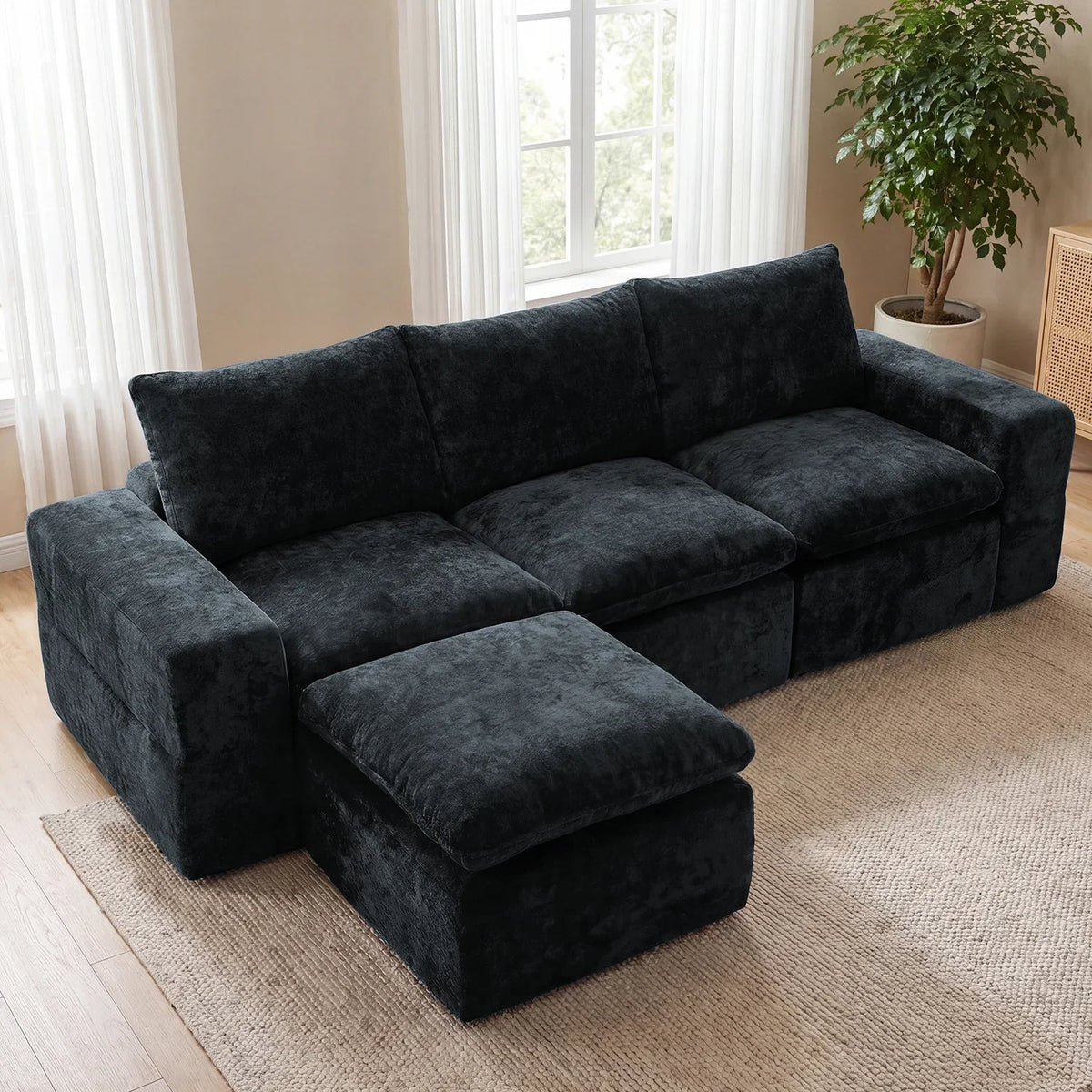
A sectional distributes exposure unevenly. Mark the favorite seat and chaise, inside corner, arm tops, front rails, seat-back junctions, module seams, ottoman, and outer sides. Then record whether each zone uses the same fabric, has a removable component, can be reached from both sides, and is included in the performance evidence.

This map matters because a swatch result does not automatically describe seams, backing, foam or adhesives. ASTM's D4852 practice for attached upholstery fabrics evaluates attached upholstery and inherent loose cushions before and after care-related procedures, but it expressly is not a performance standard. The characteristics and acceptance criteria still have to be specified. In practical terms, ask how the tested fabric result carries into the finished sectional.
Triage the spill before applying cleaner
Pause use, photograph the starting condition, identify the substance if possible, and locate the exact care information. Do not let “stain resistant” become permission to scrub, saturate, heat, or mix household remedies.

Fresh liquid
Blot with a clean, absorbent white cloth without rubbing. Change to a clean area of the cloth as transfer occurs. Stop adding moisture: the first job is to remove excess liquid, not force it through the fabric into the filling.
Solid or thick residue
Lift loose material with a dull edge that will not snag the upholstery. Work without pressing or spreading it across piping and into module gaps. Then identify the remaining stain before choosing any cleaner.
Dried, unknown, or already changed
Stop when the substance is unknown, the fabric has changed color or texture, the mark crosses materials, or liquid may have reached foam, backing, a seam, connector or electrical feature. Get a written product-specific route or qualified upholstery advice instead of escalating at random.
Follow a controlled seven-step spot-cleaning process
New Mexico State University Extension's fabric home-furnishings guide separates oil-based, water-based, mixed and unknown stains; advises removing excess liquid or solid material; and calls for a hidden-area check. The sequence below keeps those principles subordinate to the exact sofa instructions.
- Identify the exact surface. Record the module, panel, fabric, color, seam involvement and whether the component is expressly removable.
- Read the complete care route. Confirm the allowed cleaner class, moisture, tool, direction of work, rinsing or residue-removal step, drying method and professional-care condition.
- Remove excess material. Blot liquid or lift solids with a clean compatible tool. Do not rub the contamination into a larger area.
- Run the authorized hidden-area check. Use only the product and method permitted by the instructions. Let the test reach the stated dry condition before checking color, texture, transfer or a ring.
- Treat the smallest practical area. Use the minimum permitted product and moisture, keep the work controlled, and avoid pushing contamination into a seam, gap, backing or cushion fill.
- Complete the stated finishing step. Remove allowed residue, align the pile or texture only as directed, and dry with the approved airflow or method. Do not use direct heat unless the exact instructions allow it.
- Inspect and record the dry result. Compare the treated zone with the starting photo and adjacent panels before returning the seat to use.
A zipper is not a wash instruction. Do not remove or machine-wash a cover unless the exact component is confirmed removable and the complete care route permits that process. Separate washing can change fit, backing, color or texture.
Know when cleaning is complete—and when to stop
A completed spot-cleaning attempt has reached the instructed dry state; no stain or cleaner transfers to a clean white cloth; the color, sheen, pile, hand, seam and cover fit remain stable; no ring, sticky residue or new odor is present; and any remaining mark is photographed. “The spot is lighter” is not enough if the surrounding finish has changed.
| Observation | Immediate action | Recovery route |
|---|---|---|
| Color transfers or fades | Stop product and friction | Preserve the cloth and photos; request fabric-specific advice |
| Pile mats, stiffens or changes sheen | Stop brushing and adding cleaner | Let the area reach the allowed dry state, then escalate if the change remains |
| Ring expands | Stop wetting the edge | Do not chase the ring across the panel; seek a whole-panel professional route |
| Moisture reaches foam, seam or hardware | Stop use and additional moisture | Follow the model-specific drying and inspection guidance |
| Stain remains but surface is stable | Do not repeat automatically | Check the permitted repeat limit or professional-care instruction |
| Instructions conflict or are missing | Do not improvise | Send the exact product, spill, photos and attempted steps to product support |
Maintain the whole sectional, not just the last spot
Follow the exact maintenance schedule and tool guidance for the upholstery. Remove loose soil before it is worked into high-contact zones, inspect arm tops and the favorite seat more closely than low-contact outer backs, and clean module transitions without sweeping debris into the gaps. Rotate or exchange cushions or modules only when the product instructions permit it; equalizing use does not justify unsupported disassembly.
Keep a simple care log: date, substance, location, starting photo, product and dilution if applicable, hidden-area result, treatment, dry result, and support advice. Review whether any claimed finish has an after-cleaning condition or renewal requirement. Never add a consumer protectant merely because the original fabric was described as stain resistant; confirm compatibility, appearance risk, ventilation and warranty effect first.
Apply the boundary to current Monvane sectionals
The current Monvane pages reviewed for the Cushioned Modular Sofa (4 Seats) and L-Shaped Sectional Couch in Chenille say to spot clean gently with a damp cloth and avoid harsh chemicals, excessive moisture and direct heat. On August 13, 2026, neither checked page contained the words “stain resistant.”
That produces a clear boundary: use the current care wording for those exact pages, but do not upgrade “spot clean” into a resistance claim, a test result, machine-wash permission or universal cleaner approval. If your order, label or product page differs, the exact model information controls. Contact the Monvane Support Center with the order number, product name, fabric/color, affected panel, spill identity and photos when the route is incomplete.
Make the final purchase and care decision
Buy on the documented combination of performance scope and practical care. A useful stain-resistant sectional is one whose evidence covers the spills you actually expect, whose treated panels match the high-contact surface map, and whose approved care you can complete without risking color, texture, fit or hidden construction. Pause when any of those links is missing.
For an existing spill, make the next decision from the dry evidence: resume use when the stated completion conditions pass; follow the permitted repeat only when the instructions allow it; or stop and escalate the exact unresolved condition. That disciplined boundary protects both the upholstery and the credibility of the “stain resistant” claim.
Sources and scope
The AATCC TM22/TM118/TM130 summaries, ASTM D4852-24, New Mexico State University Extension's fabric-furnishings guide, the two current Monvane product pages and Monvane Support Center were checked August 13, 2026. The test methods distinguish claim categories; they do not prove performance of a Monvane or other sectional unless the seller binds an exact result to that product. This guide is a bounded purchasing and care framework, not a laboratory report, warranty interpretation, universal cleaning authorization or professional restoration guarantee.