

Comfort and Fit
Deep Sectional Sofa: Practical Guide
Separate four depth measurements, test each regular user and posture, then tape the full sectional footprint before deciding whether extra depth adds value.
On this page
A deep sectional sofa is worth the floor space only when its extra usable seat depth supports a posture your household actually uses. The word deep is not a complete measurement: overall depth controls the room footprint, listed seat depth depends on the seller's measuring points, back cushions reduce the working seat, and a chaise projects farther than a standard seat. Before buying, record all four, assign each regular user a suitable seat zone, and tape the complete configuration with its table and circulation space.

Separate the four measurements hidden inside “deep”
There is no single number in this guide that turns every sofa into a deep sectional. Instead, ask the seller for the exact endpoints behind each published dimension. Loose back pillows, rounded fronts and different measuring conventions can make two identical-looking numbers describe different working space.
| Depth field | Measure from and to | Decision it controls | Do not substitute |
|---|---|---|---|
| Overall depth | Backmost shell or cushion to the frontmost point of the configured sofa | Floor footprint, wall offset and room projection | Seat depth |
| Listed seat depth | Front seat edge to the seller's stated back-support reference | First comparison between exact product pages | A number with unknown endpoints |
| Usable seat depth | Front seat edge to the actual working face of the installed back cushion | Body and posture fit in daily use | Overall depth minus back thickness |
| Chaise projection | Back of the configuration to the frontmost chaise or ottoman edge | The long leg of an L or U footprint and the route around it | The depth available on every seat |

If a page gives only one depth number, do not guess the other three. Save the dimension drawing and ask whether the seat figure ends at a fixed back, a loose cushion or another reference. For a reversible ottoman or modular layout, request the footprint for the exact arrangement you plan to use.
Map where the depth is actually available
A sectional can look uniformly generous while offering different posture options by position. Build a simple zone map of the exact configuration rather than multiplying one seat-depth number by the advertised seating capacity.
Regular seats
These are the best places to judge upright and relaxed back-supported sitting. Record the working back-cushion face, front-edge shape and seat height for each distinct module. A published seat depth does not prove that a corner, armless middle and end seat have identical usable space.
Inside corner
The inside corner may add lateral room for curling up, yet back cushions, seams and the angle between runs can change how much of that area is comfortable. Count it as a normal seat only after a person can use it without being pushed forward or relying on a seam as the main support.
Chaise, return, or ottoman
This zone supports legs or side lounging, but its long projection is not ordinary seat depth. Check whether it is attached, reversible or a separate ottoman; whether a back cushion supports the intended posture; and whether moving it changes the official footprint, connection or anti-slip requirements.
Keep two counts. Record how many positions work for upright back-supported sitting and how many work for full-leg lounging. “Seats six” does not mean six people receive the same depth or posture.
Give the extra depth a specific job
More depth has value when it creates a posture you will use—not when it merely moves the sofa farther into the room. Name the primary job before comparing products, then define a visible pass and failure condition.
| Primary job | What useful depth should allow | Failure to notice |
|---|---|---|
| Upright conversation or reading | Back reaches support while the front edge stays clear of the knee crease and the chosen foot support is stable | Sliding forward, perching, or needing a large permanent filler behind the back |
| Relaxed lean | Hips can move forward while the upper body and legs remain supported in the intended position | The user collapses into a gap, loses back contact, or cannot return upright easily |
| Cross-legged or curled-up sitting | The regular seat—not just the chaise—provides the required surface without crowding another user | Knees press into an arm, corner or neighboring seat |
| Full-leg lounging | A verified chaise or ottoman supports the body in the planned direction | The listing's seat-depth number is used as a substitute for chaise length |
| Mixed household use | Each regular user has at least one repeatable seat/posture combination that passes | One person receives every usable upright seat or everyone needs a different loose-pillow rescue |
Occupational chair guidance from the Canadian Centre for Occupational Health and Safety recommends checking the shortest and tallest users, back support and pressure behind the knees. A lounge sofa is a different task with different cushioning and postures, so use those as observations—not as a sofa dimension standard or health claim.
Build a household depth map
Run the decision for every regular sitter, not the average person. Use one row per person and one column per posture that genuinely matters. A child, occasional guest or pet does not need to control every dimension, but the people who use the sectional daily should not disappear inside an average.
- Name one must-pass posture for each regular user. Examples include upright reading, relaxed TV use, tucked-leg sitting or chaise lounging.
- Choose the intended zone. Mark a regular seat, corner or chaise; do not assume the same place can serve everyone simultaneously.
- Observe five fit signals. Back contact, knee-edge clearance, stable leg or foot support, ability to change posture and an unforced return to standing.
- Record any accessory. A small stable back pillow may be an intentional adjustment. A sliding or bulky pillow needed for every upright position is evidence of a geometry mismatch.
- Test the shared layout. Put all regular users in their likely places at once and check whether one posture steals another person's seat or blocks the exit route.
The sectional passes the household test when every regular user has a named zone and required posture that works without a persistent failure. If one person wants a deep lounge seat and another needs a shorter upright seat, a sectional with a deliberate mix of chaise and standard positions may be more useful than making every position equally deep.
Use two familiar seats as your online-shopping baseline
When you cannot test the candidate in person, measure furniture you already understand. Choose one seat that works well for upright use and, if different, one that works for lounging. Put their cushions in the normal daily position, then record overall depth, the front edge to the actual back-cushion face, seat height, back-cushion thickness and the posture each seat supports.

Compare the candidate with those reference seats only after its measuring endpoints are clear. If the familiar back pillow is removable, moving it can demonstrate how a different working back plane changes posture, but it cannot reproduce another sofa's cushion response, seat angle or support. Treat the exercise as a directional comparison, then keep an in-person trial or a clear return path where the remaining uncertainty matters.
Make the full footprint earn its space
Tape the exact outside configuration, not a rectangle based on seat depth. Add the intended wall gap, coffee-table gap and table footprint, the main route, door swings, recliners and any module movement needed for daily use. Then walk the route while another person occupies the chaise. The layout fails if the deepest point leaves a paper-clear path that does not work in real use.
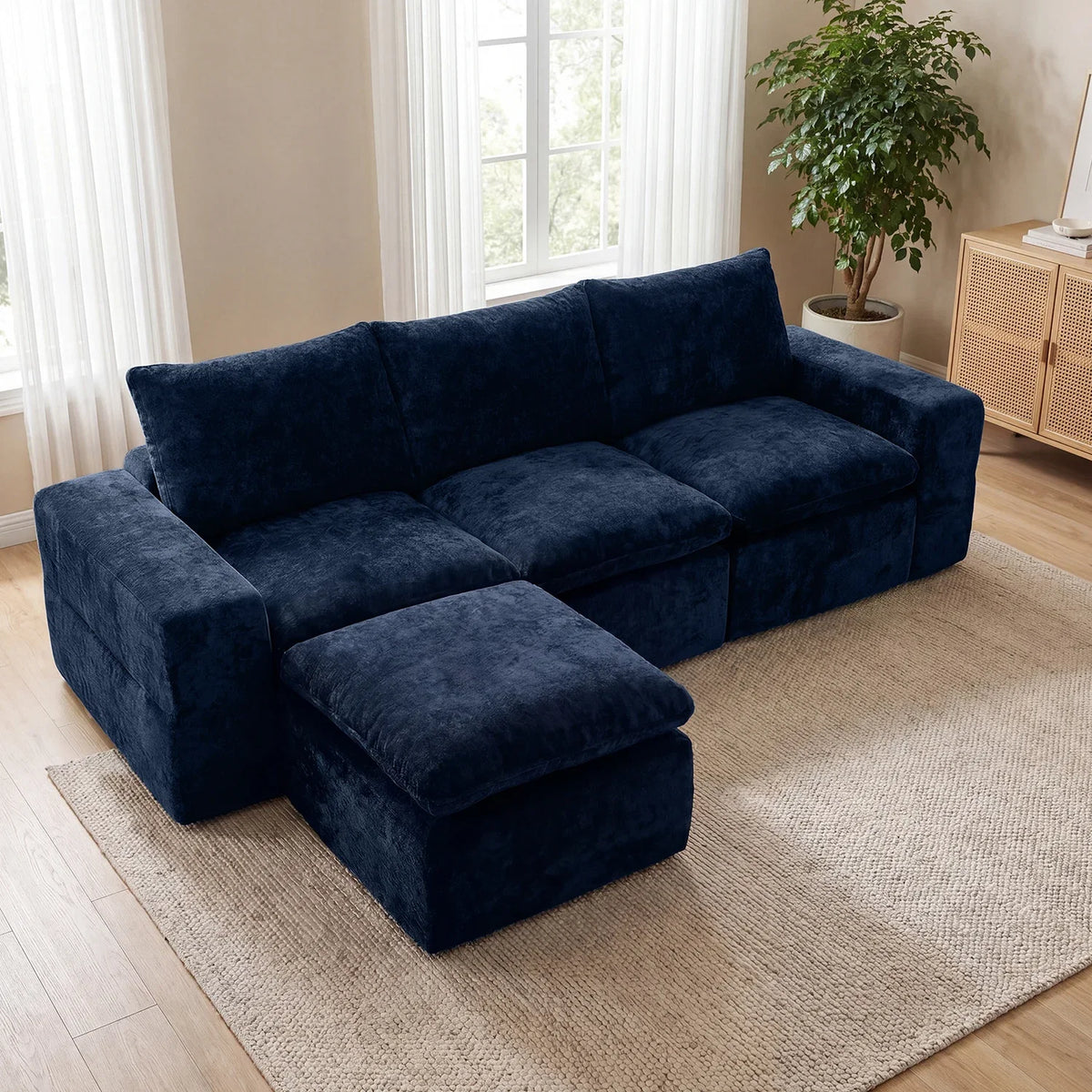
Current Monvane figures show why the measurements must stay separate. The L-Shaped Modular Couch lists 65 inches of overall depth and 27.5 inches of seat depth. The current Sofa Size Guide gives the 8-seat U-shaped configuration an approximate 94-inch planning depth while its product information lists a 27.56-inch seat depth. Those nearly equal seat-depth figures do not imply nearly equal room footprints; the U-shaped configuration and returns control the larger planning envelope.
| Current exact configuration | Published room-depth figure | Published seat depth | Safe conclusion |
|---|---|---|---|
| L-Shaped Modular Couch | 65" overall depth | 27.5" | One exact L-shaped geometry; confirm the planned arrangement and working back plane |
| 8-seat U-Shaped Couch | Approx. 94" planning depth | 27.56" | Nearly the same listed seat depth can sit inside a much deeper configuration footprint |
These are current product-specific examples checked August 13, 2026—not a range for all deep sectionals, a comfort ranking or permission to transfer one model's dimensions to another. The 8-seat footprint is explicitly presented as a planning approximation, so the exact product page and confirmed configuration still control an order.
Decide from body fit and room operation
Choose a deep sectional only when both passes are complete. The body pass requires a verified usable-depth reference, a named posture and zone for each regular user, no persistent knee-edge or back-support failure, and manageable accessories. The room pass requires the exact overall configuration and chaise projection to preserve tables, doors, circulation and module operation.
Reject the extra depth when it adds only unused surface, forces every upright sitter into a large pillow correction, gives the lounge function to too few positions, or consumes the route the room needs. Proceed when the depth creates a repeated household posture, every regular user has a workable place, and the taped configuration remains operational. That is when an extra-deep sectional earns its footprint rather than merely enlarging it.
Sources and scope
The current Monvane L-Shaped Modular Couch page, Sofa Size Guide, 8-seat product information and CCOHS occupational-chair guidance were checked August 13, 2026. Product numbers apply only to the named configurations and dates. The four-depth model, zone map, household matrix and two-pass verdict are bounded editorial decision tools; they are not a universal furniture standard, medical advice, proof of personal comfort or a substitute for exact seller-confirmed dimensions.