

Buying Guide
Best Sofa Beds for Small Spaces and Guest Rooms
The best sofa bed is the exact candidate that preserves the room’s daily job, converts without collisions, supports the intended guest setup and resets completely afterward.
On this page
The best choice among sofa beds for small spaces and guest rooms is the exact candidate that lets one room complete four jobs: normal daytime use, safe conversion, an occupied guest-night setup and a full morning reset. Start with the room’s everyday job and the intended sleeper, then reject any model that passes only in its compact closed form. A sofa bed earns the room when doors, storage and work zones remain usable by day; the mechanism can open without a collision; the guest can enter, exit and reach essentials; and every moved item and piece of bedding has a place after the bed closes.
Define the room before comparing sofa beds
A small living room and a guest room can need the same furniture for different reasons. In a studio, the sofa may be a primary chair or lounge every day and an occasional sleeper. In a home office, the desk, chair and storage may control the daytime plan. In a dedicated guest room, the closed sofa may create reading or play space, but the bed state still has to support the expected guest routine.
Write a one-sentence job before shopping: “This room must work as an office for one adult every weekday and host one adult for two nights a month,” for example. Name the likely sleeper, visit frequency and duration. This does not prove comfort or medical suitability; it prevents a compact label from replacing the actual use case.
| Room condition | Record before shopping | Reject when |
|---|---|---|
| Everyday job | Seating, office, play, reading or mixed use | The closed sofa disables the activity that happens most |
| Guest job | Who sleeps, how often and for how long | The sleep setup is based on an unnamed “occasional guest” |
| Fixed room | Doors, windows, closet, desk, storage, vents and outlets | Any state covers a required access point |
| Movable room | Table, desk chair, rug, lamps and bedding storage | A moved item has no safe parking or reset location |
Make one exact candidate pass four states
Copy the exact model, variant and mechanism before drawing the room. Obtain the closed outside dimensions, completed open footprint and instructions that show which parts move. Treat missing endpoints as unknown rather than estimating from a lifestyle photograph.

State 1: everyday room
Tape the closed outside footprint and place every normal-use item. Sit, work, open the room and closet doors, reach storage and walk the busiest route. A smaller width does not compensate for a depth that blocks the desk chair or a low, deep seat that cannot perform the required daytime posture.
State 2: conversion action
Follow the exact opening sequence. Add the operator’s standing or kneeling zone, moving-part travel, cushion parking and any table movement. If the instructions or product page do not identify the action, ask the seller; do not infer a fold, pull or slide from the category name.
State 3: occupied guest night
Trace the complete open footprint with the intended bedding and a person in the normal sleeping position. Recheck the room door, a night light, phone or water access and a route to leave the room. Record where bags and any removed cushions go. The state fails if the guest becomes the obstacle holding the route closed.
State 4: morning reset
Strip or store bedding as the exact instructions require, return displaced furniture, close the mechanism and restore the everyday activity. Name where every item lives. The reset is complete only when the sofa, route, desk or play zone and storage are back in their planned condition without creating a daily pile.
Separate the product fields that decide fit
A “small sofa bed” label does not answer the four-state test. Build one candidate record with separate fields:
- Closed size: outside width, depth and height with labeled endpoints.
- Open footprint: the furthest finished length and width after conversion.
- Usable sleep surface: the actual supported area, kept separate from the overall open footprint.
- Conversion action: parts that fold, slide, pull, lift or detach, plus the user-action zone.
- Guest-use scope: the seller’s exact guidance for sleep use and any unresolved limit.
- Daytime seat: usable seat dimensions and the posture required by the room’s daily job.
- Care and reset: approved cleaning, bedding removal, cushion placement and recovery instructions.
- Delivery and ownership: package dimensions when listed, entry route, setup, return eligibility and warranty scope.
Do not replace a missing product weight with weight capacity, or treat package dimensions as the assembled footprint. If a decisive field conflicts or remains absent, pause the purchase and request confirmation for the exact option.
Best mechanism by room routine—not a universal winner
| Conditional shortlist | May fit when | Disqualifier to test |
|---|---|---|
| Best for one occasional guest in an office: a documented single-unit floor-fold sleeper | One sleeper is expected; panels can extend into a temporarily clear office zone; bedding has storage | The intended guest cannot comfortably get down to or up from the low surface, or the desk-chair parking and exit route fail |
| Best to shortlist for a shared living room: a documented pull-out sleeper | The household needs normal sofa seating and the exact model documents the required sleeping capacity and mattress arrangement | Forward travel, the operator zone or overnight bed footprint blocks the coffee table, door or room route |
| Best to shortlist when wall placement is flexible: a documented folding-back design | Back and side clearance can stay available, and the finished sleep surface suits the intended guest | Each conversion needs the whole sofa dragged away from an immovable wall, or the occupied route fails |
| Best for preserving daytime floor area: a documented chair sleeper | A single daytime seat is sufficient and the exact chair documents a supported single-person sleep state | Two sleepers or regular multi-person sofa seating are required; width, height or usable sleeping area is unresolved |
These are conditional selection routes, not product awards or a hands-on comfort ranking. Shortlist the pattern that solves your binding room constraint, then make the exact model pass the four-state test using its current page and manual.
Use the intended guest—not a generic comfort claim
Test sitting and sleeping as separate jobs. For the daytime state, compare usable seat depth and height with a familiar seat and the posture the room needs. For the open state, verify the supported sleep-surface dimensions, transitions between panels, edge behavior and the seller’s stated use scope. A soft surface can still create an awkward seat, and a supportive chair can still open into a sleep surface that does not suit the intended person.
When a showroom or returnable trial is available, have the regular sitter and likely sleeper reproduce their actual positions. Otherwise keep comfort conditional and prioritize observable fields. Do not turn a photograph, foam-density number, star rating or the word ergonomic into a promise of universal comfort.
Read the current Monvane option at exact-page scope
The current Monvane Sofa Bed collection displayed one product when checked October 29, 2026: the Oversized Sofa Bed. Its current page describes a 3-in-1 sofa, lounger and flat sleeper with no assembly, a closed size of 38 inches deep by 33.86 inches wide by 16.54 inches high, and an 86.6-inch-long by 33.86-inch-wide flat state with a 76.77-inch-long sleeping pad. It lists one package and a 300-pound weight limit.

Those values describe one current product page, not a standard for small sofa beds or proof that it fits every guest room. The page also labels 38 inches as seat depth, but that does not establish the usable space with the back cushion occupied. Test the actual daytime posture rather than assuming that “compact” means upright-chair geometry. The cover shows a historical folding-sofa-bed design for open-state context only; it is not a current product recommendation or source of specifications.
Work one small-office example before ordering
For a hypothetical office with 110 inches available along the planned bed line after fixed furniture is excluded, the Oversized 3-in-1 Teddy Velvet Folding Sofa Bed’s listed 86.6-inch outside open length leaves 23.4 inches on that same line. Its 76.77-inch pad is a separate sleeping-surface field, not a reason to tape a shorter bed footprint. The remaining 23.4 inches is arithmetic—not an approved walkway. If the door, guest exit or required desk access needs that space, change the orientation or reject the layout. Tape the 33.86-inch width too, park the desk chair and bedding, then test the occupied route and next-morning reset.
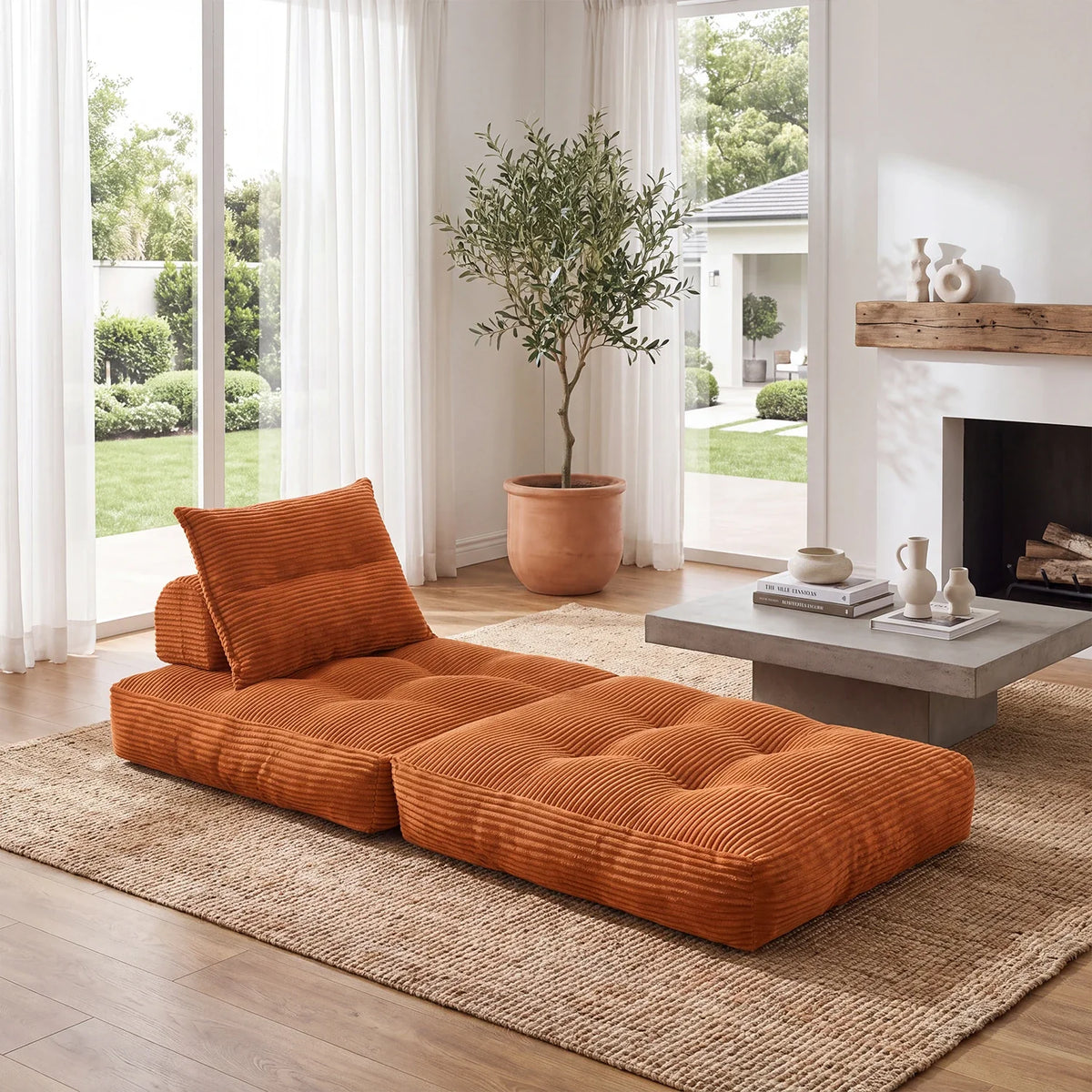
Do not substitute the Boneless Sofa & Floor Lounger simply because its older handle contains “sleeper.” Its current description documents a removable top cushion placed on the floor as a chaise or footrest; that is not a documented guest-bed mattress arrangement. Confirm guest-sleep support before putting any product with unresolved sleep scope on the finalist list.

Choose the conditional winner
Create one row per exact finalist and mark each state pass, unresolved or fail. Remove any candidate that disables the room’s primary daily job, cannot be converted within the verified action zone, leaves the occupied guest without essential access or cannot complete the morning reset. Pause a decisive unknown until the seller identifies the exact field in writing.
| Choose this candidate when | Do not choose it when |
|---|---|
| The everyday layout works with all normal furniture in place | The room functions only after a permanent item is displaced |
| The documented conversion has a repeatable action and parking plan | A moving part, operator or removed cushion has no verified zone |
| The expected guest fits the documented sleep surface and retains a route | The decision relies only on “twin,” “full,” “compact” or “occasional” wording |
| The reset restores the entire room and ownership terms are acceptable | Daily clutter, care, delivery or a decisive support question remains unresolved |
The winner is the candidate that passes all four states for this room and this guest with the fewest unresolved dependencies—not automatically the smallest closed model or the sofa with the most features. This all-state test identifies the best sofa beds for small spaces and guest rooms without pretending one model wins every home. Compare the current Monvane sofa-bed collection only after the room job, exact state record and reset plan are complete. For an unresolved Monvane measurement, setup or product question, the Support Center provides current contact details.
Sources and scope
The current Monvane Sofa Bed collection, Oversized 3-in-1 Teddy Velvet Folding Sofa Bed and Boneless Sofa & Lounger descriptions and Support Center were checked October 29, 2026. The four-state room test and conditional verdict are editorial planning methods.
FAQ: Sofa beds for small guest rooms
Can one compact chair sleeper replace a two-person guest bed?
Not from its closed size or category name. Check the documented number of sleepers, supported surface width and length, and load limit for the exact model. The Oversized 3-in-1 Teddy Velvet Folding Sofa Bed example here is a single guest-bed candidate; it is not a two-person recommendation.
Should I measure the open bed or the sleeping pad?
Measure both for different jobs. The full outside open footprint controls furniture and door clearance; the usable supported pad controls the guest’s sleeping space. For the Oversized 3-in-1 Teddy Velvet Folding Sofa Bed, do not confuse the listed 86.6-inch outside length with the separate 76.77-inch pad length.
What if the room works only after moving the desk chair and coffee table?
That can be practical for occasional visits only if each item has a named parking location outside the guest route, and the reset restores normal work or seating. Rehearse the full move before buying. A pile in the hall is not a completed plan.
What if the intended guest finds a floor-level bed difficult?
Eliminate the low-floor pattern even when its taped footprint fits. Compare documented raised sleep systems and their exact conversion/entry requirements instead. Compact dimensions do not override the guest’s ability to enter, leave or use the surface comfortably.