


Buying Guide
Soft Sectional Couch: Comfort Factors and Buying Checklist
A soft sectional works when its surface feel, initial sink, continued support, seat geometry and recovery suit each regular user across the exact configuration.
On this page
A soft sectional couch is a good choice when its surface feel, initial sink, continued support, usable geometry and recovery match the people who will use every regular seating position. “Super soft” or “fluffy” is not a complete comfort specification. Define the wanted feel first, inspect the exact configuration’s documented fields, then repeat the same timed trial at the center, outer edge, module join, corner and chaise. No photograph, density number or “plush” label proves that result, and a pleasant first press cannot rescue a seat that becomes awkward to use or difficult to leave.

Turn “soft” into six observable factors
Treat “soft” as six separate observations. This prevents a hand press on one cushion or a fuzzy surface from deciding the entire purchase. The factors interact, but they are not synonyms.
| Factor | Observe | Do not assume |
|---|---|---|
| Surface feel | Texture against hands, arms and legs | A soft textile makes the finished seat soft |
| Initial sink | How far and how quickly the seat yields as you sit | More sink is better for every posture |
| Sustained support | Whether the position remains usable after several minutes | First-touch softness predicts the later feel |
| Body fit | Back contact, usable depth, feet or leg support and ease of standing | One geometry suits every regular user |
| Zone consistency | Whether every regularly assigned sectional position performs its job | The center cushion represents the edge, join, corner or chaise |
| Recovery | What the surface and seat do after you stand, within the seller’s stated setup conditions | A quick visual rebound proves durability |
A pleasant first press can coexist with poor fit after ten minutes. The reverse is also possible: a surface may feel less pillowy at first but work better for a user who needs a more controlled sitting position. The useful outcome is not the softest possible sectional; it is a documented softness profile that fits the intended use.
Write the softness brief before comparing products
Record one line for each regular user: primary position, normal posture, typical sitting duration, a familiar seat they like, what feels too soft or too firm, and whether standing up without pushing through a deep cushion matters. Add the household routine—upright conversation, reading, movie lounging, napping or mixed use. A guest who uses the chaise occasionally should not erase the needs of the person who uses a standard seat every evening.
Then assign every regular sectional zone a job. A center seat may serve upright sitting, an end may support cross-legged reading, and a chaise may serve reclined lounging. The same construction does not need to create one identical posture everywhere, but each assigned position must pass for its real user. When two people disagree, preserve both requirements rather than averaging them into the word medium.
Read product evidence without awarding comfort
Ask for the exact model, variant and complete configuration. Record upholstery wording, cushion or fill construction, usable seat depth and height, back arrangement, edge and join construction, setup or expansion instructions, care requirements and whether the same build covers every module. Keep an unknown field marked unknown.
Density, firmness and support are not interchangeable foam properties. The Polyurethane Foam Association describes density as mass per unit volume, firmness through 25% indentation force deflection, and support factor through a relationship involving deeper compression. A density disclosure can be relevant evidence, but it cannot by itself tell you how firm a completed sectional feels. Likewise, an upholstery adjective describes a surface, not the response of the full seat system.

Use an evidence ladder. A complete exact-product specification is stronger than a category label; a current physical sample or showroom trial is stronger for personal touch; and a matched, returnable in-home trial is stronger for the finished configuration. Star ratings, lifestyle images and words such as cloud, plush or sink-in may help form questions, but they do not replace the missing variables.
Run the same test in every regular seat zone
Test only after the product has completed the maker’s stated setup or expansion period. Keep the person, posture, duration and observation order the same. Use the actual selected configuration, because a center seat, outer edge, module join, corner and chaise do not create the same boundary conditions.
- Start from standing. Sit normally without dropping into the cushion or positioning it by hand.
- Note first contact. Record surface feel and initial sink separately.
- Hold the real posture. Read, talk or watch in the position the seat must support; do not switch to a pose chosen for the test.
- Check fit. Note back contact, usable depth, leg support, pressure at edges or joins and any effort used to remain in position.
- Stand normally. Record whether the expected user can leave the seat in the way they plan to use it.
- Observe recovery. Photograph the zone immediately after standing and again after one fixed interval chosen for comparison; this is a shopping note, not a laboratory durability test.
Repeat the six steps in every regularly assigned zone and for each regular user whose needs differ. Do not average away a failed regular seat. If one person can use the chaise comfortably but another cannot use the only standard seat assigned to them, the exact configuration has not passed.

Know when softer is the wrong direction
A softer sectional is the wrong direction when the regular user cannot maintain the required posture, loses needed back contact, cannot use the available depth, feels a disruptive join or edge, or cannot stand in their normal way. It is also a poor match when the household will not accept the surface changes, cushion resetting or care routine that the exact product requires.
Separate a product failure from a configuration failure. If one zone fails but a different documented module or layout gives every regular user an appropriate position, revise the configuration and repeat the full trial. If the exact build, firmness, module coverage or recovery condition is missing or conflicting, pause and request written clarification. Do not fix missing evidence by adding decorative pillows, guessing a layer or assuming the display sample represents a delivered variant.
Apply the checklist to current Monvane specifications
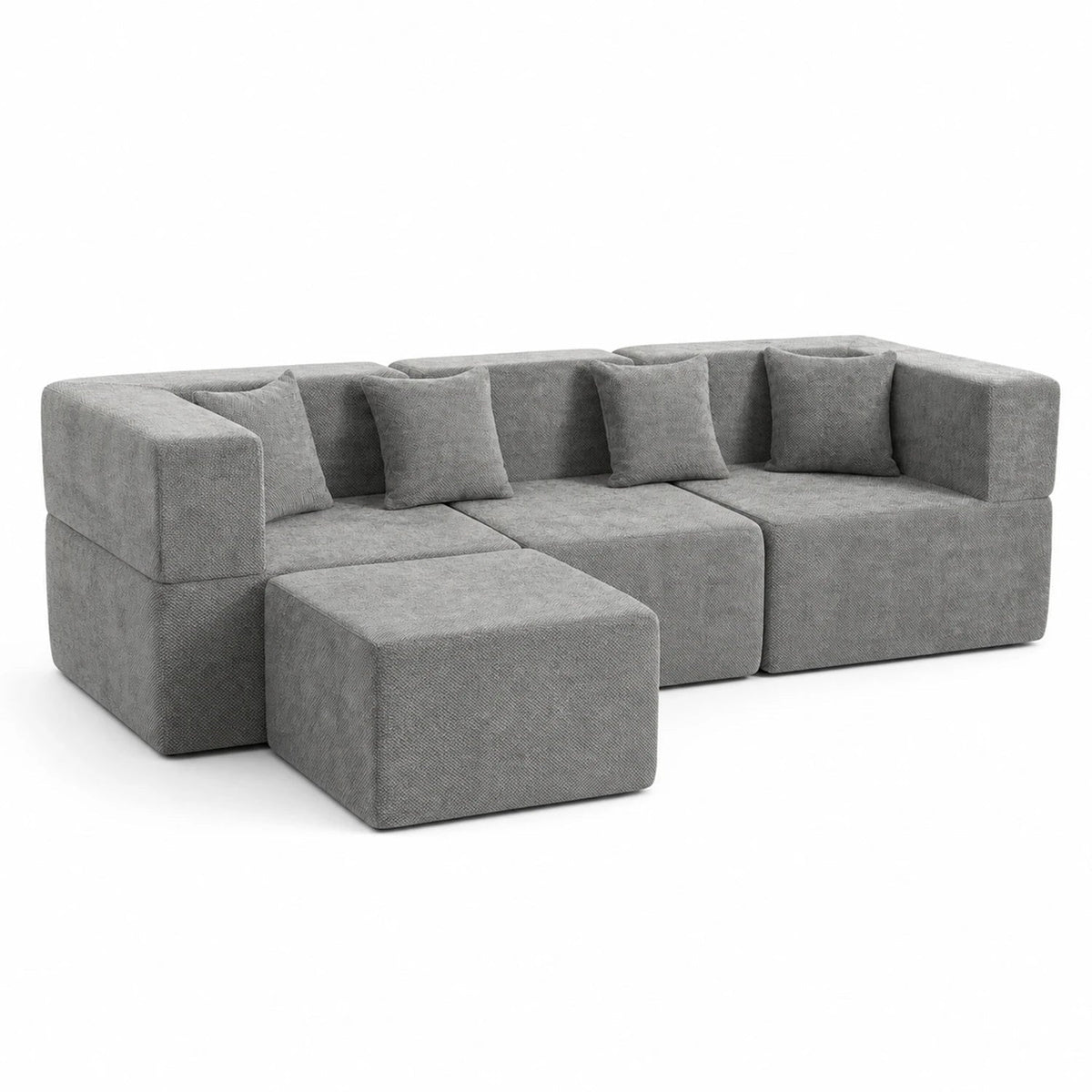
The current Monvane L-Shaped Modular Couch page lists a 65-inch-deep by 103-inch-wide by 30-inch-high configuration, a 27.5-inch seat depth, a 16.5-inch seat height, chenille upholstery, an anti-slip base and high-density 30D foam at 1.87 pounds per cubic foot. Its FAQ says no assembly is needed and to let the sofa expand within 48 hours. These fields support a trial; they do not replace one. In particular, 30D is a density disclosure, not a published finished-firmness verdict.
The current U-Shaped Modular Couch page lists a larger 65-inch-deep by 130-inch-wide by 30-inch-high configuration with the same listed 27.5-inch seat depth and 30D foam density. The U page currently conflicts with itself on seat height: the Specifications block displays 15.75 inches while a comparison block displays 16.5 inches. Do not choose one value or average them. If that field could change a regular user’s fit or ability to stand, pause and ask Monvane Support to confirm the selected configuration in writing.
These pages also illustrate why the exact configuration matters. Matching density and listed seat depth do not prove that an L and U arrangement provide the same regular positions, boundary conditions or completed feel. Apply the same softness brief and matched-zone trial to the exact layout you intend to buy.
Complete the soft-sectional buying checklist
Create one row for each finalist and keep product evidence separate from user observations. The evidence ladder and final checklist are purchasing aids; exact current documentation and the users’ completed trials control the decision.
| Checklist field | Approve when | Pause or reject when |
|---|---|---|
| Exact identity | Model, variant and full module set are fixed | Evidence comes from another fabric, size or configuration |
| Softness profile | Surface, sink, support, fit and recovery match the brief | The decision depends on one adjective or hand press |
| Regular users | Each person passes their real posture and exit | One body or use pattern is treated as universal |
| Regular zones | Every assigned center, edge, join, corner or chaise position passes | A failed regular seat is averaged into the group |
| Evidence limits | Missing or conflicting decisive fields are resolved in writing | Density, photos or reviews are used to invent firmness |
| Ownership | Setup, recovery, care, reset and return terms fit the household | The household will not perform or accept the required routine |
Approve the exact configuration only when every regular user has a passing assigned position, the finished zone responses fit the declared softness profile, and no decisive product field remains unresolved. Reject an observable fit or use failure. Pause an evidence conflict. The best soft sectional couch is therefore not the one advertised as the fluffiest; it is the one whose documented build and repeatable, zone-by-zone trial match the household’s preferred feel and real routines.
Sources and scope
The current Polyurethane Foam Association Foam Performance, Monvane L-Shaped Modular Couch, U-Shaped Modular Couch, Materials & Durability and Support Center pages were checked August 14, 2026. Product wording can change; current exact documentation controls. The six-factor brief and matched-zone trial are Monvane editorial shopping tools, not medical, ergonomic, laboratory or durability tests. They do not identify hidden construction, predict lifespan or guarantee comfort.