

Buying Guides
Futon vs Sofa Bed: Key Differences and Which to Choose
Compare futons and sofa beds using exact construction, conversion, room-fit and daily-use criteria instead of relying on overlapping retail labels.
On this page
Choose a futon-style candidate when you want direct control over a foldable mattress and frame, its lower or simpler daytime form suits the regular sitter, and repeated folding and bedding reset fit the household. Choose a sofa-bed candidate when its exact daytime form, integrated or separately specified sleep system, conversion action and open footprint work better. Neither category wins automatically. Retail names overlap, so the useful comparison is the exact build in its seated state, sleeping state and morning reset—not the word on the product card.

Start with the conversion record, not the label
Treat futon and sofa bed as search labels until the seller documents what supports the sitter, what becomes the sleep surface and what moves during conversion. A current bifold futon can be a frame sold without a mattress. A current sleeper sofa can also use a mattress on a converting frame. Another sofa bed may unfold a padded foam body instead. The nouns alone do not tell you whether the mattress is included, replaceable, hidden or shared between both states.
Before comparing, fix the intended job: name the regular daytime users, the intended overnight users, how often conversion will happen, where bedding will live and which furniture or doors must still work in both states. A guest piece opened twice a year can tolerate a different reset routine from a studio seat converted every night.
Build one eight-field comparison
Record these eight fields for every finalist. Use the same units and the same complete configuration. An unknown remains unknown; do not fill it with a category average or a dimension from another mattress, cover or frame size.
| Field | Record | Why it can change the choice |
|---|---|---|
| Exact build | Frame, deck, mattress or foam body, cover, pillows and included hardware | Shows which components are included, compatible and replaceable |
| Support system | Slats, platform, metal underframe, foam base or another documented structure | Separates the visible upholstery from what carries the seated and sleeping loads |
| Sleep surface | Exact material or mattress, usable width and length, seams and gaps | Determines whether the intended sleeper and bedding fit |
| Conversion action | What lifts, folds, slides, rolls or must be removed | Controls effort, reachable clearance and whether another person is needed |
| Closed footprint | Maximum outside width, depth and height in seating form | Controls daily floor use, furniture relationships and delivery planning |
| Open footprint | Maximum outside width, length and height after conversion | Controls the overnight route, door use and remaining floor area |
| Day and night fit | Regular sitter’s posture and exit; intended sleeper’s usable surface and access | Prevents one successful state from hiding a failure in the other |
| Reset and service | Bedding storage, cushion handling, cover care, assembly, replacement parts and return terms | Reveals the recurring work and the recovery path after a problem |
Closed and open footprints are different records. Tape both as outside rectangles, then add the furniture, doors and routes that must remain usable in each state. A compact-looking seat can project much farther when opened; a wide frame can also open along its width rather than into the room. Only the exact dimensions show which problem you have.
Let the mechanism reveal the real tradeoff
Mechanism changes what moves, what stays under the sleeper and where the household carries the work. These are common routes, not universal definitions:
| Exact route | What changes state | Verify before choosing |
|---|---|---|
| Bifold futon frame with separate mattress | The hinged deck changes angle and the foldable mattress bends with it | Included components, compatible mattress size and thickness, sitting geometry, wall/floor clearance and replacement path |
| Click-clack or fold-down sleeper frame | An underframe lifts or slides while the back and mattress flatten | Locking sequence, complete bed dimensions, storage access, cover removal and the supported surface in both states |
| Folding foam sofa bed | The padded body unfolds across the floor into a longer sleep surface | Confirmed expanded outside dimensions, seams, floor conditions, bedding storage and how the body is folded back |
A separate mattress can make cover or mattress replacement more legible, but only if the exact frame and mattress are compatible. An integrated padded body can reduce assembly and loose-component handling, yet it may put the sleep surface closer to the floor and move the open footprint farther into the room. A sofa-like back and arms can improve the daytime role for one household while adding mass, parts or conversion steps for another. These are conditions to inspect, not category-wide pros and cons.
Test daytime and overnight jobs separately
Use the exact selected components and follow the maker’s instructions. Complete any stated assembly, expansion or setup period before judging the finished piece. A candidate must pass both states and the transition between them; a comfortable five-minute sit does not establish guest-sleep fit, and a sufficient sleep surface does not establish everyday seating.

Run the occupied daytime pass
Place the piece where it will normally live. Have each regular sitter use their normal posture for a realistic session, not a showroom pose. Check usable seat depth and height, back contact, edge or frame pressure, pillow stability and the normal way of standing. Open nearby doors, pull out adjacent furniture and walk the daily route. Record a failure for the person and exact position that failed rather than averaging everyone into one comfort score.
Run the prepared overnight pass and morning reset
Remove or reposition only the parts named in the instructions and convert the piece through the real room. Make the bed with the sheets, protector, pillows and blankets the household will actually use. Check the usable—not advertised nominal—sleeping width and length, access on the required side, surface gaps or frame contact, and whether a door or route becomes blocked. The intended sleeper should test the surface for the intended use; an occasional-guest pass is not evidence for nightly sleeping.
The next morning, strip or fold the bedding, return every component to daytime form and restore the room. Time is less important than repeatability: the reset passes when the normal user can complete it as instructed, store everything in its assigned place and recover the daily route without improvised force or an unwanted pile of bedding. If conversion binds, an instruction is missing, or the actual surface does not match the documented record, stop and use the seller’s service or return path.
Count the ownership work the label hides
The purchase includes a routine, not only a piece of furniture. A frame sold without a mattress requires a compatible mattress decision now and a replacement route later. A removable cover can simplify one kind of cleaning while creating laundering, refitting and spare-cover work. An integrated foam body may eliminate a separate mattress but still require expansion time, spot care, floor protection and space for bedding.
Write the ownership load beside each finalist: assembly and package route; mattress or cover compatibility; maker-specified floor conditions; bedding and loose-cushion storage; conversion frequency; cleaning and drying method; replacement parts; warranty scope; and return logistics after opening or assembly. Keep cost attached to the complete working set. A low frame price is not the whole futon cost if the required mattress and cover are separate, just as a sofa-bed price does not reveal bedding storage or future component availability.
Also decide which visual compromise the household accepts. A visible foldable mattress can make the dual function obvious. A more conventional daytime sofa silhouette may better suit a main living room. Neither appearance resolves sitting fit, open footprint or sleep-surface support, so let the completed two-state test veto styling when they conflict.
Read three current product records
Current exact products show why the noun does not finish the comparison. These examples illustrate different records; they are not category averages or a ranking.
A frame sold without its mattress
The current KD Frames Studio Bifold Futon page describes a frame that changes from couch to bed, has four adjustable positions and rear wheels, and is sold without a mattress. KD Frames recommends a foldable futon mattress. That is a clear frame-plus-separate-mattress record, but the page does not let a buyer assume the feel or fit of an unselected mattress.
A sleeper sofa with separate frame, cover and mattress
The current IKEA NYHAMN Sleeper Sofa page documents a click-clack action: pull the underframe upward and fold the backrest down. The named configuration has separate frame, cover and pocket-spring mattress packages, under-seat storage and a removable cover. It lists a 78 3/4-inch width, 38 1/4-inch closed depth, 55 1/8-inch bed width and 78 3/4-inch bed length. This seller calls it a sleeper sofa even though a mattress bends on a converting frame—precisely why mechanism and components are more useful than label folklore.
A fold-out foam body with an unresolved open record
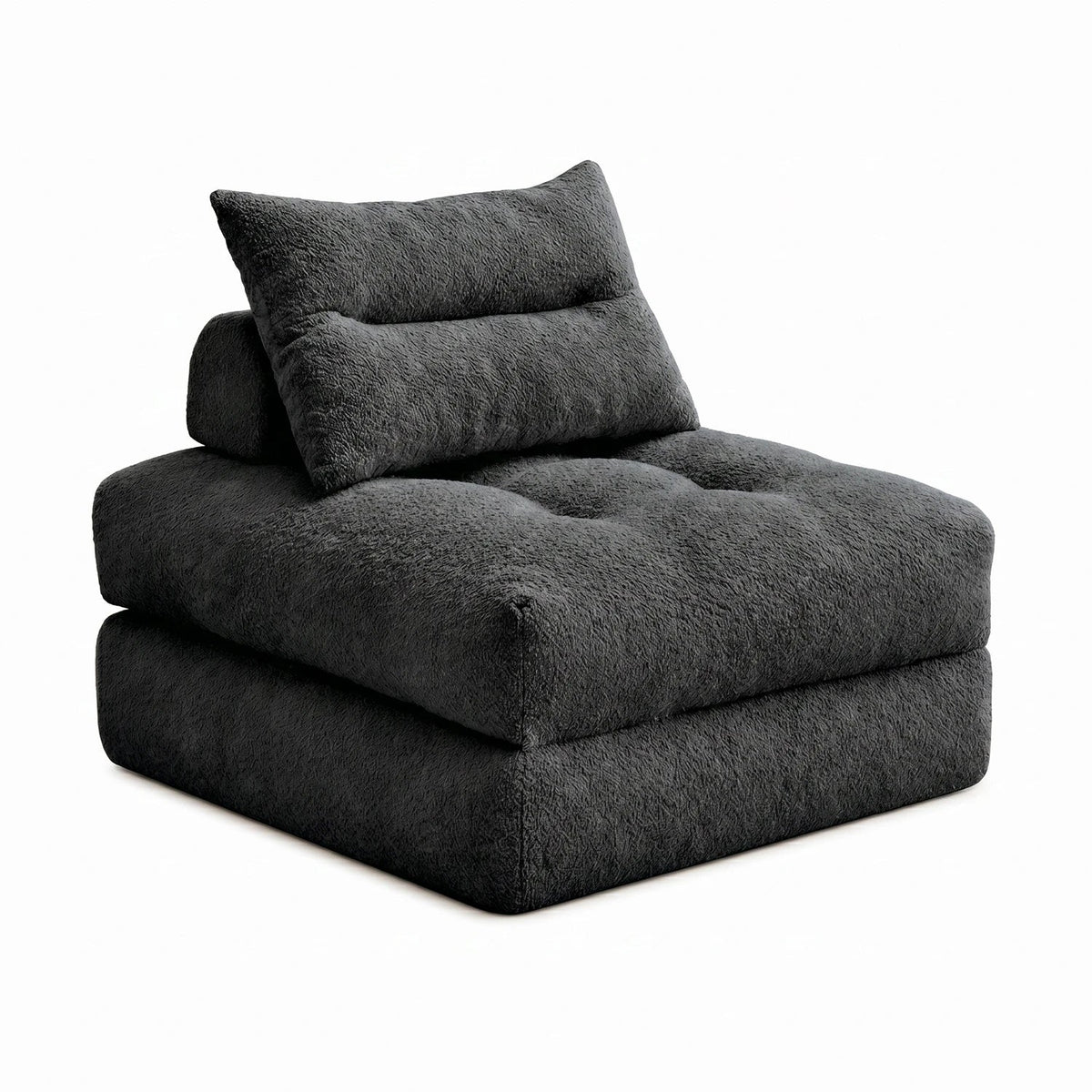
The current Monvane Oversized Sofa Bed page documents a different route: a no-assembly high-density-foam body that unfolds from seating to a sleeping surface and is allowed to expand after unboxing. The consistent closed record is 33.86 inches wide by 38 inches deep by 16.54 inches high. Its open record is currently conflicting. The FAQ says approximately 75 inches long by 38 inches wide, while the current page graphic labels an 86.61-inch expanded overall length and 33.86-inch width, with a 76.77-inch surface callout.

Do not average or choose one of those open-state records. If the expanded footprint could change the room decision, send the selected variant and both locations to Monvane Support and request the current outside and usable-surface dimensions in writing. Until that conflict is resolved, the product may continue to be compared on its documented build and closed state, but it has not passed room fit.
Choose the candidate that completes both jobs
Choose the exact candidate—not the category—with the fewest unresolved hard conditions. The final matrix is a conditional purchasing aid; current documentation, exact instructions and completed room/use tests control the decision.
| Verdict | Choose when | Do not choose on this basis alone |
|---|---|---|
| Choose a futon-style candidate | The verified frame and foldable mattress work as a set; replaceable component control matters; the regular sitter accepts the seating geometry; and repeated folding, cover care and reset pass | A belief that every futon is simpler, cheaper, firmer or easier to move |
| Choose a sofa-bed candidate | The exact daytime form better fits the room and sitter; the documented sleep system and open footprint pass; and its conversion, bedding and service routine are acceptable | A belief that every sofa bed hides a mattress, looks conventional or sleeps more comfortably |
| Choose neither yet | A decisive open dimension, component, compatibility or instruction is missing or conflicting; the daily sitter or intended sleeper fails; conversion blocks a required route; or the household rejects the reset | A category average, lifestyle image, star rating or salesperson’s unlabeled dimension |
A futon can be the better choice for visible component control and a straightforward shared mattress-and-frame system. A sofa bed can be the better choice for a particular daytime form or a different conversion system. The winner is conditional: it is the exact configuration that passes the same eight-field record, occupied daytime use, prepared overnight use and morning reset with no decisive evidence gap. If neither passes, keep the room requirements and change the candidate rather than weakening the test.
Sources and scope
The current KD Frames Studio Bifold Futon, IKEA NYHAMN Sleeper Sofa, Monvane Oversized Sofa Bed and Monvane Support Center pages were checked August 14, 2026. Product fields can change; the current exact page and written clarification control. The conversion record and three-pass test are Monvane editorial shopping tools, not certification, laboratory testing, ergonomic assessment or nightly-sleep approval. They do not prove hidden construction, comfort, durability or medical suitability.