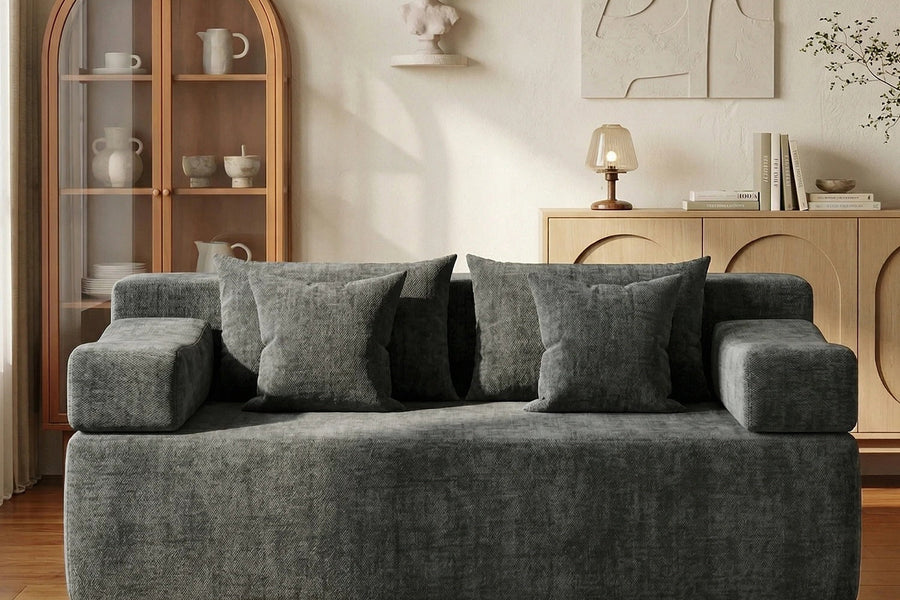


Couch Buying Guide
Sofa Materials and Fabrics: How to Judge the Whole Build
A sofa is not one material. Learn how upholstery fiber and construction, cushion density and firmness, suspension, frame assembly, connectors, care instructions, and test evidence work together—then use a two-pass checklist to compare real products.
On this page
The best couch material is not a single fabric name. A sofa is a system: the upholstery cover, cushion core and wrap, suspension, frame, joints, base, and—on modular designs—connectors all affect how it feels and how it responds to use. Start by naming your household’s main stressor, then compare the same layer and the same evidence on every sofa.
Replace the “best material” question with a five-layer audit
Two sofas can use the same visible couch fabric and perform differently because their yarns, pile construction, finishes, seams, cushion builds, supports, or frames are different. The reverse is also true: two covers with different appearances can meet the same household need when the complete builds and care routines are suitable.

Use these five layers as a comparison record:
- Cover system: fiber content, yarn and fabric construction, finish, backing, seam execution, color behavior, and cleaning instructions.
- Cushion system: core material, density, firmness, wraps, compartment design, whether cushions can be reversed or removed, and what can be replaced.
- Suspension: the webbing, springs, platform, or other support beneath the seat, including how it is spaced and attached.
- Frame and base: structural members, joints, reinforced load points, legs or floor base, and how those elements are assembled.
- Connectors and service: module locks, zippers, removable covers, care access, warranties, and availability of replacement parts.
This method prevents a common shopping error: comparing one sofa’s fabric marketing with another sofa’s full construction specification. Put equivalent facts beside each other or mark the information “not disclosed.” Missing evidence is not proof of poor quality, but it is a decision uncertainty worth pricing into the purchase.
Read the upholstery label in four separate parts
Upholstery names often mix fiber, construction, surface effect, and brand language. Separate them before drawing a durability conclusion.
1. Fiber content: what the yarn is made from
Fiber content may identify polyester, cotton, nylon, wool, rayon or viscose, and blends, usually as percentages. It matters because fibers differ in moisture behavior, resilience, dye response, and care compatibility. It does not, by itself, describe yarn twist, fabric density, backing, pile anchoring, finish, seam strength, or the assembled sofa.
2. Fabric construction: how the components are assembled
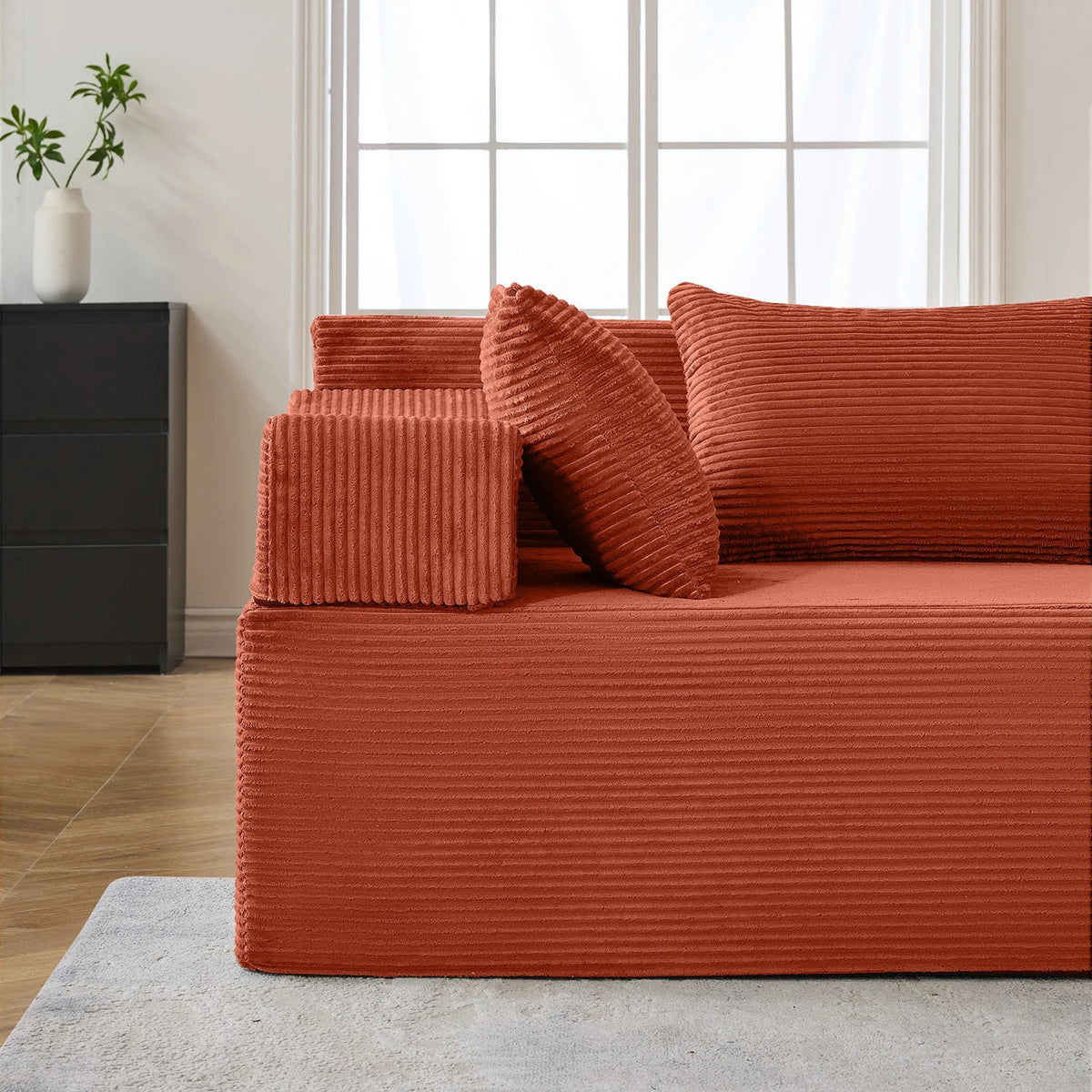
Construction terms describe structure. Velvet is a pile fabric; corduroy is also a pile fabric with visible ribs or wales. CottonWorks’ technical weaving guide explains that corduroy can use different pile shapes and binder arrangements, and that those choices can affect how firmly the pile is held. Its complex woven fabric guide also describes velvet as a warp-pile construction. This is why a surface name is not a complete fiber or performance specification.
For any couch fabric, request both the fiber percentages and the construction or supplier specification when they are available. CottonWorks’ quality-testing overview treats fiber, yarn, and fabric construction as distinct inputs whose assembly affects physical properties and performance.
3. Finish and color: what happened after construction
A stain-resistant treatment, backing, coating, brushing process, or printed color can change care requirements and surface behavior. Ask whether a performance claim belongs to the base fabric or to a finish, whether the finish is permanent, and which cleaning products the supplier permits. If strong sunlight, dark denim, pet saliva, food spills, or frequent spot cleaning is likely, ask for evidence relevant to that exposure rather than relying only on an abrasion number.
4. Product execution: how the fabric is upholstered
Inspect the actual sofa or detailed product images. Look for straight seams, consistent pile direction, sensible pattern matching, protected high-friction corners, zipper access, and whether cushions or covers can be removed. A strong fabric can still disappoint if a seam, zipper, or unsupported edge becomes the first failure point.
Separate cushion density from cushion firmness
“High-density foam” does not mean “firm,” and “soft” does not mean “low density.” The Polyurethane Foam Association explains that density and firmness are independent properties. Density is the foam’s mass per volume and is associated with support and durability; firmness is commonly described by indentation force deflection, or IFD—the force required to compress a foam sample by a defined amount. See the PFA’s foam performance guide.
A useful cushion comparison therefore needs more than one adjective. Ask:
- What is the core material and, for polyurethane foam, is density disclosed?
- Is a firmness or IFD value available, and what test conditions or sample thickness does it represent?
- Does the core use a fiber, feather, down-alternative, or foam wrap that changes the first-contact feel?
- Is the seat a single slab, layered build, pocketed construction, or loose fill in compartments?
- Can the cushion be removed, rotated, reversed, refluffed, or replaced?
- Does the warranty distinguish normal softening from a covered defect?
Then test the task, not just the first sit. Spend several minutes in your normal posture. Move from the center to the edge, stand up, and observe recovery. If multiple people use the sofa, include the lightest and heaviest regular users. A showroom impression cannot establish long-term durability, but it can reveal whether the geometry, first-contact softness, edge support, and ease of standing suit the household.
Judge suspension, frame, and connectors as an assembly
Frame material is only one input. A species or category name does not show member dimensions, moisture control, joint design, fasteners, reinforcement, load paths, workmanship, or how the suspension is attached. Avoid converting “solid wood,” “engineered wood,” “metal,” or “frameless” into an automatic quality grade.
Instead, request observable or documentable answers:
- What supports the seat beneath the cushion, and how is that support attached to the structure?
- Which areas carry repeated loads—the front rail, corners, arm connection, chaise junction, sleeper mechanism, or module connector—and how are they reinforced?
- For a sectional, what prevents modules from drifting, and can connectors be replaced?
- Does the base sit level on the intended floor, including when some legs are on a rug?
- Are structural test reports, test methods, or conformance documents available for the exact product or product family?
BIFMA describes furniture performance standards as a common basis for evaluating safety, durability, and structural adequacy independent of construction material. Most BIFMA standards apply to specified commercial, institutional, or occasional-use categories—not every residential sofa—so first confirm scope. The practical lesson from its standards overview is to value a relevant product test and traceable report over a material buzzword.
Decode test claims: method, result, and context
A test number is not self-explanatory. Record the method, the reported result, and the context in which the result is being used. If any one is missing, treat the claim as incomplete rather than automatically good or bad.

Abrasion results do not predict a sofa’s lifespan
ASTM D4157 is an oscillatory-cylinder abrasion method commonly associated with the Wyzenbeek approach. ASTM notes that abrasion behavior is complex and influenced by fiber, yarn, fabric construction, finish, and test conditions, and that the method may not suit every fabric construction. Review the official ASTM D4157 scope and limitations.
The Association for Contract Textiles publishes performance guidelines for contract upholstery. ACT explicitly warns that results above its guideline do not indicate product lifespan, that different laboratories can produce variable results, and that Wyzenbeek and Martindale numbers do not directly correlate. Its abrasion guidance is therefore most useful as a lesson in test context—not as a residential-sofa lifetime calculator.
When a listing says “50,000 double rubs” or “100,000 cycles,” ask which method was used, what endpoint ended the test, which exact colorway and finish were tested, whether the report is current, and whether the seller is comparing like with like. Also review pilling, seam behavior, colorfastness, cleaning compatibility, and the cushion and structure; abrasion is only one failure mode.
A flammability label answers a different question
U.S. upholstered furniture is subject to federal flammability requirements under 16 CFR part 1640, which incorporates the smoldering test methods of California TB 117-2013. The CPSC’s official business guidance explains the testing, certification, recordkeeping, and labeling framework.
A permanent label may state: “Complies with U.S. CPSC requirements for upholstered furniture flammability.” That statement addresses the regulation’s flammability requirement; it is not evidence of abrasion resistance, stain resistance, cushion lifespan, structural strength, or general chemical safety. Keep each proof attached to the question it actually answers.
Route the choice by the household’s main stressor
| Primary stressor | Inspect first | Evidence to request | Do not assume |
|---|---|---|---|
| Frequent spills or children | Care access, seam traps, removable parts, color transfer risk | Exact cleaning instructions; approved products; finish and cover-removal details | “Easy care” means every household cleaner is safe |
| Pets | Snag points, pile or loops, hair visibility, zipper access, cushion rotation | Swatch test; care guidance; pilling/abrasion method if supplied; replacement-cover policy | One fiber is scratch-proof or pet-proof |
| Strong daylight | Window exposure, dark or saturated colors, reversible cushions | Lightfastness test and rating if available; placement and care limits | Abrasion performance predicts fade resistance |
| Daily heavy lounging | Seat geometry, cushion build, support beneath the seat, edge recovery | Density and firmness data if supplied; suspension and frame details; warranty scope | Soft equals weak, firm equals durable, or density equals firmness |
| Frequent moves or reconfiguration | Module weight, handholds, connectors, base protection, assembly access | Assembly instructions; connector and replacement-part availability; module dimensions | “Modular” guarantees easy carrying or secure connections |
| Allergy or chemical concern | Exact material scope and the concern being evaluated | Named standard, certificate number or report, issuer, covered component, and validity | One certification covers every material or every health outcome |
Use a two-pass sofa comparison before buying
Do not try to force every material fact into one score. Complete a sensory and serviceability pass, then an evidence pass. The result is a short record you can use across stores.
Pass 1: what you can observe or test
- Order swatches in the exact colorways under consideration and view them in daytime and evening light.
- Rub the surface gently in multiple directions; note pile shading, loose loops, texture, and whether pet hair or lint is conspicuous.
- Inspect seams, piping, corners, zippers, underside access, connector locations, and the alignment of modules.
- Sit in your normal position, move to the edge, stand up, and check whether seat depth, cushion feel, and support match the task.
- Confirm which parts can be rotated, removed, washed, professionally cleaned, or replaced without dismantling the sofa.
Pass 2: what the seller should document
- Fiber content, fabric construction or supplier name, backing or finish, and exact care instructions.
- Any abrasion, pilling, colorfastness, or seam result with its method, value, tested specimen, and limitation.
- Cushion core, wrap, density and firmness information where available, plus the recovery and rotation instructions.
- Suspension, frame, joint, base, and connector details at a level that explains the assembled system.
- Flammability label and any certifications, with the covered component and exact claim scope.
- Warranty exclusions, normal-wear language, spare cover or part availability, and the process for a service claim.
End with three lines for each candidate: verified advantages, verified limitations, and unknowns that matter. Choose the sofa whose supported evidence matches the household’s stressor and maintenance tolerance—not the sofa with the longest list of unscoped adjectives.
Know when this guide is not enough
A general materials guide cannot verify an individual SKU, predict service life, diagnose allergies, or replace a product test report. Pause the purchase and obtain specialist or seller confirmation when:
- a household member has a medical sensitivity or a material-specific allergy concern;
- the sofa will be used in a commercial, hospitality, healthcare, rental, or code-regulated setting;
- the product includes a sleeper, recliner, motor, heater, battery, or other mechanism with separate safety and service requirements;
- a certification or environmental claim materially affects your decision but cannot be traced to the exact component or model;
- the only available specification is a marketing term and the return policy does not protect an in-home evaluation.
Compare Monvane sofas with the same evidence standard
Monvane’s Materials & Durability page introduces the brand’s current fabric, foam, and construction language. Use it as a starting map, then verify the exact material, dimensions, care instructions, certificates, and service terms on the product you are considering. To compare current configurations, continue to the modular sofa collection and apply the five-layer record above to each candidate.