

Buying Guides
Comfortable Modular and Floor Sofas: Support, Layout and Fit
A modular or floor sofa is comfortable only when the exact support, seat height, depth and layout fit the people and routines that will use it.
On this page
A comfortable modular sofa is not simply the softest model or the layout with the most pieces. It is an exact configuration whose seat height, usable depth, back contact, cushion response and exit path work for the people who will use it. A comfortable floor sofa adds one more fit decision: its lower sitting position must still feel manageable when you sit down, change posture and stand up. Compare the complete support system, test the lowest planned layout, and choose the fit that serves your main routine without forcing pillows, tables or neighboring modules to do jobs they were not designed to do.

Modular describes pieces that can be arranged within the product’s supported system. Floor sofa can describe floor-contact cushions, a boneless body or simply a very low profile. The terms can overlap, but they are not synonyms. Verify the exact structure, finished seat height, support, base and permitted configurations before transferring any layout or fit conclusion between them.
Start with the position you need to support
Before comparing sofas, name the position that must work most often. “Lounging” may mean sitting upright with feet on the floor, leaning back for a movie, curling into a corner, sitting cross-legged, or extending the legs on an ottoman. Each position uses the seat, back and surrounding space differently.
Write a one-line brief for every regular user: the main position, approximate session length, preferred seat location, and whether standing up without pulling on nearby furniture matters. If a person has pain, a mobility limitation or a clinical seating need, use appropriate individual guidance; this article is a household fit test, not medical advice.
Check four fit points on the exact configuration

Seat height: test the compressed sitting level
Use the finished seat height published for the exact model, then compare it with a seat you already understand. For a low or floor sofa, make a stable mock-up at that height and repeat sitting down and standing up. A listed height is only a starting point because the cushion may compress differently under each user.
Usable seat depth: measure from the working back
Overall depth is the room footprint. Seat depth is the listed seating dimension. Usable depth is what remains after the back cushion occupies space and the user reaches a comfortable back contact. Test upright and relaxed positions separately. A deep seat can support legs-up lounging and still require a cushion for a shorter user who wants both back contact and feet on the floor.
Back contact: record where support actually meets you
Note whether the cushion supports the lower, middle or upper back in the intended posture and whether it remains in place when you shift. Do not award a comfort verdict from the foam description alone. The Polyurethane Foam Association distinguishes density from firmness, and its furniture guidance explains that comfort depends on the complete seating system, including foam, decking, seat depth, height and angle.
Exit path: keep the movement space clear
A low, deep seat may be pleasant once you are settled and awkward when the ottoman, coffee table or neighboring module blocks your feet. Test sitting down, standing up and walking away while the room is in its normal state. Do not count a movable table or an unsecured module as a grab support.
Separate first-touch softness from lasting support
Surface softness answers what the sofa feels like in the first moment. Support answers what the cushion, back, base and geometry do as the session continues. Recovery answers whether the compressed or loaded cushion returns to its intended shape. Record those three observations separately.
A foam density figure does not tell you firmness. A fabric name does not tell you how far the back cushion moves. A total weight-capacity claim does not prove that every module feels the same. Ask for the exact cushion construction, firmness information if available, finished dimensions, recovery instructions and whether added pillows are included or merely shown in styling photography. If the missing information changes your decision, keep the feel marked unknown instead of translating a marketing adjective into proof.
Make the layout serve the posture
Modularity matters because layout changes the available support. Do not evaluate loose pieces in isolation and assume every arrangement preserves the same sitting experience.
| Layout choice | Comfort opportunity | What to verify |
|---|---|---|
| Straight row | Clear forward orientation and simple entry | Enough supported back positions; no exposed side or drifting end module |
| L shape | One legs-supported lounge position plus upright seats | Return direction, chaise/ottoman stability and whether the corner remains usable |
| U shape | Several users can face inward or share a lounge zone | Independent entry, inner-turn leg conflicts and room for the complete footprint |
| Separated seats or ottomans | Flexible foot support or individual positions | Manufacturer-supported use, finished exposed faces and movement on the actual floor or rug |

Choose one daily layout before treating alternate arrangements as value. Draw each module from above, mark its back and any arm, then assign a real job: upright seat, legs-supported seat, shared corner, movable ottoman or spare guest position. If a piece has no supported job, it is not adding comfort merely because it increases the module count.
Run one comfort test for each regular user
- Begin after the product’s stated recovery period. Place every module, back cushion and included pillow in the planned daily arrangement.
- Sit in the main position. Check feet or legs, usable depth, back contact, arm relationship and whether a seam falls under the intended sitting area.
- Stay for a realistic session. Notice repeated scooting, pillow adjustments, pressure, loss of back contact or sinking that changes the exit.
- Change position naturally. Move between upright, relaxed and legs-supported positions that actually occur at home; do not stage postures you will never use.
- Stand up and re-enter. Keep the table and ottoman where they normally live. Record whether the route is clear and whether a module shifts.
- Repeat in the alternate layout. Reconfigure only as the instructions allow, then run the same observations rather than assuming the comfort transfers.
Use a simple result—pass, adjust, or stop—for each person and configuration. “Adjust” is appropriate when an included movable cushion or a documented layout change resolves the issue without creating a new one. “Stop” is appropriate when a required position fails, a regular user cannot enter or exit comfortably, modules move, or the fix depends on unverified accessories or unsupported arrangements.
Fit the floor sofa to the room, not only the body
A comfortable floor couch must also preserve the room’s operating space. Tape the exact outside footprint, not just the seating surface. Add the normal table location and the open space needed for feet during standing. Walk the door-to-seat route while another person is already seated.
Check the bottom edge as a separate ownership issue. Verify the exact base material or anti-slip method, compatibility with the selected floor or rug, access for cleaning, and whether the modules may be moved without dragging. Confirm those floor-interface questions from the exact sofa instructions and the floor or rug maker’s current guidance; do not infer them from a low-profile product photo.
Read current Monvane specifications without guessing comfort
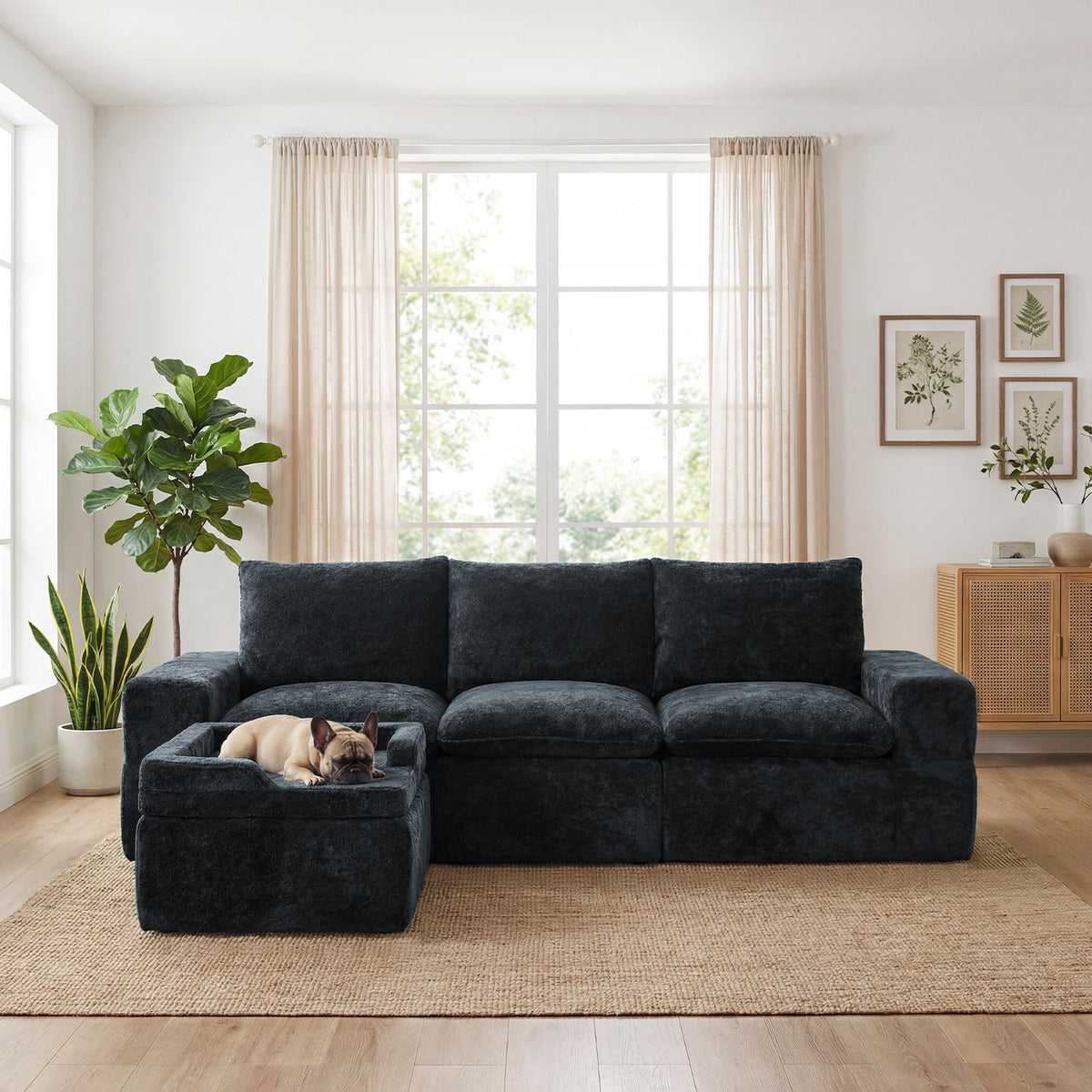
Current Monvane product pages show why an exact-model check matters. The L-Shaped Modular Couch currently lists a 27.5-inch seat depth, 16.5-inch seat height, 65-by-103-by-30-inch overall dimensions, 10-inch arms, high-density 30D foam (1.87 lb/ft³), a boneless structure and an anti-slip base. The U-Shaped Modular Couch currently lists the same 27.5-inch seat depth and a 65-by-130-by-30-inch overall footprint, but its specification block gives a 15.75-inch seat height.
| Published fact | What it lets you test | What it does not prove |
|---|---|---|
| 27.5-inch seat depth | Mock the depth and compare upright versus relaxed back reach | Universal comfort or usable depth after cushion compression |
| 15.75- or 16.5-inch seat height | Test the exact sitting and standing level | Easy standing for every person |
| 30D / 1.87 lb/ft³ foam | Record a material specification for the exact listed product | Firmness, finished cushion feel or identical response across all seats |
| L or U overall footprint | Tape the daily layout and exit routes | That a larger configuration is more comfortable |
| Modular, no-tool, anti-slip wording | Verify the stated setup and reconfiguration path on the exact model | Every imaginable arrangement or no movement on every floor |
Those figures are decision inputs, not a ranking. Even the pages’ comfort claims do not replace the user test. Product content can also repeat dimensions differently in comparison blocks, so use the exact current specification section and ask the Monvane Support Center to confirm a conflict in writing before purchase.
When a modular or floor sofa is not the right fit
- The lowest regular user cannot sit down or stand up comfortably from the mocked finished height.
- The preferred upright posture requires a loose pillow that constantly moves or removes too much usable seat space.
- Only one location works and the household needs several regular seats at the same time.
- The planned ottoman or return blocks the foot position or path needed to exit.
- Module joins separate, a floor-contact piece drifts, or the exact stabilization method is unknown.
- The sofa fits the body only in a configuration that breaks the room route, table relationship or supported product layout.
- A medical or mobility need is being answered only by generic “ergonomic,” “supportive” or “comfortable” marketing language.
Choose the configuration you can verify
Approve the sofa only when each regular user passes the exact seat-height, usable-depth, back-contact and exit-path checks in the daily layout. Confirm that alternate layouts are documented, the room still functions and any adjustment remains simple and repeatable. Save the exact product page, planned layout and test notes so “comfortable” remains a verified fit rather than a memory of a showroom impression.
When those checks pass, compare the current Monvane modular sofa collection by exact dimensions and supported configurations. A modular or floor sofa earns its value when changing the layout expands useful positions without making the main position harder to support.
Sources and scope
Current Monvane L-Shaped Modular Couch, U-Shaped Modular Couch, Sofa Size Guide and Support Center pages were checked August 13, 2026. Foam-property distinctions were checked against current Polyurethane Foam Association technical guidance. Product dimensions and wording can change; the exact product page and written support confirmation control the purchase. The four fit points, layout consequence table, pass-adjust-stop test and rejection rules are bounded Monvane editorial recommendations for comparing modular and floor-sofa configurations—not a manufacturer test, ergonomic certification, medical assessment or guarantee of individual comfort.