


Buying Guides
Leather Sectional Couch: Comfort, Durability and Maintenance Trade-Offs
Leather is not one uniform upholstery. Identify the exact material and covered areas, then match comfort, durability expectations and care to that specification.
On this page
A leather sectional couch can be comfortable and durable, but “leather” alone is not enough information to judge comfort, durability, or care. First identify the exact material, surface finish, and panels it covers. Then compare cushion comfort, seam and module wear, your household’s scratch and spill risks, and the maker’s care instructions. Full-grain, protected or pigmented leather, bonded leather, and faux leather are not interchangeable labels. If a listing does not disclose the material and covered areas clearly, pause before buying rather than filling the gaps from a photo.

Start with the upholstery record
Leather is not one uniform upholstery specification. A sectional may use one material on the seat, back, and inner arms, then a different leather-look material on outer or rear panels. A current IKEA MORABO sectional, for example, identifies treated top-grain leather on contact surfaces and coated fabric elsewhere. That is one documented construction—not a rule for every sectional—but it shows why “leather sofa” is an incomplete record.
| Field to record | What the listing should tell you | Why it changes the decision |
|---|---|---|
| Material name | The seller’s exact wording: full grain, top grain, split, bonded, PU/coated fabric, or another named material | Different structures should not inherit the same wear or care assumptions |
| Surface finish | Aniline, semi-aniline, protected/pigmented, embossed, coated, or unspecified | Finish affects natural variation, surface protection, and compatible care |
| Coverage | Which seat, back, arm, side, and rear panels use each material | A mixed-material sectional can age differently by panel |
| Care document | Approved routine cleaning, products to avoid, and spill response | A generic “wipe clean” phrase may not resolve cleaner or conditioner compatibility |
| Exact configuration | Section count, chaise orientation, seams, connectors, cushions, and warranty scope | Material does not tell you whether the sectional works as a complete system |
Preserve the exact wording and take screenshots before ordering. This record organizes evidence; it does not verify composition or predict service life. The FTC’s Leather Guides reinforce the broader importance of accurate material representation for the products they cover, but the agency’s own 2019 review separately asked whether furniture upholstery should be added. This guide therefore uses the FTC material only as disclosure context—not as a claim that those Guides govern your sofa.
Decode the material name before judging value
A material name tells you what to investigate; it does not rank the whole sectional. The Leather Working Group defines full grain as leather that keeps the entire grain surface. Corrected grain has part of that surface mechanically removed and enhanced by finishing treatment. Cushion support, panel thickness, sewing, frame, and the amount of each material still need their own evidence.

Aniline and lightly finished full-grain leather
A lighter surface treatment can preserve more natural marks, color variation, and the tactile character that many leather buyers want. It also makes the finish and household conditions especially important. One current first-party example—the IKEA STOCKHOLM in Seglora—describes aniline, dyed-through full-grain leather with a thin protective coating and explicitly notes greater sensitivity to sunlight, dirt, liquid, and scratching than fully coated leather. Apply that tradeoff only to a product with comparable written documentation.
Protected or pigmented leather
A treated, embossed, or pigmented surface can look more uniform and may be selected by shoppers who prefer less visible natural variation. Do not translate “protected” into scratchproof, waterproof, or maintenance-free. Ask what the topcoat is, whether the color is surface-applied, and which cleaner or conditioner the maker allows. A finish can change the care method even when the underlying material is leather.
Bonded leather
Bonded leather is a composite rather than an intact hide surface. The FTC’s guidance for products within its scope treats bonded, ground, or reconstituted leather wording as requiring meaningful content disclosure rather than an unqualified leather impression. For furniture shopping, request the seller’s actual composition and backing instead of inferring them from the word “bonded.” Avoid assuming either bargain value or poor performance without exact evidence.
Faux leather or coated fabric
Faux leather and coated fabric are non-leather surfaces designed to create a leather-like appearance. Their substrate, coating, seam construction, and care can vary. They may fit a shopper who wants a particular look or cleaning routine, but they should be evaluated under their own specification. Leather cream intended for an animal-hide surface is not automatically appropriate for a synthetic coating.
Judge comfort in the conditions you will use it
The upholstery affects the first touch, but it does not determine comfort alone. Seat depth and height, foam or spring construction, back angle, cushion attachment, and the chaise position often matter more over a long sitting session. A soft hand sample cannot tell you whether the favorite seat will support your posture.
Test the exact configuration if possible. Sit upright, recline, move into and out of the corner, and stay long enough to notice pressure at seams. If buying online, compare the published seat dimensions and cushion specification with a sofa you already know. Also consider the room: sunlight and a nearby heat source affect placement, while a leather surface can feel different when the room is cool or warm. These are comfort conditions to evaluate, not universal flaws.
Inspect the wear map, not just the center cushion
A sectional spreads upholstery across more seams, corners, and shared boundaries than a single straight sofa. The first visible change may appear at the favorite seat, front rail, chaise edge, inner corner, arm, or the gap where adjacent sections meet. Ask for clear photos of those locations and inspect stitching tension, panel alignment, piping, and whether neighboring sections rub when people sit down.

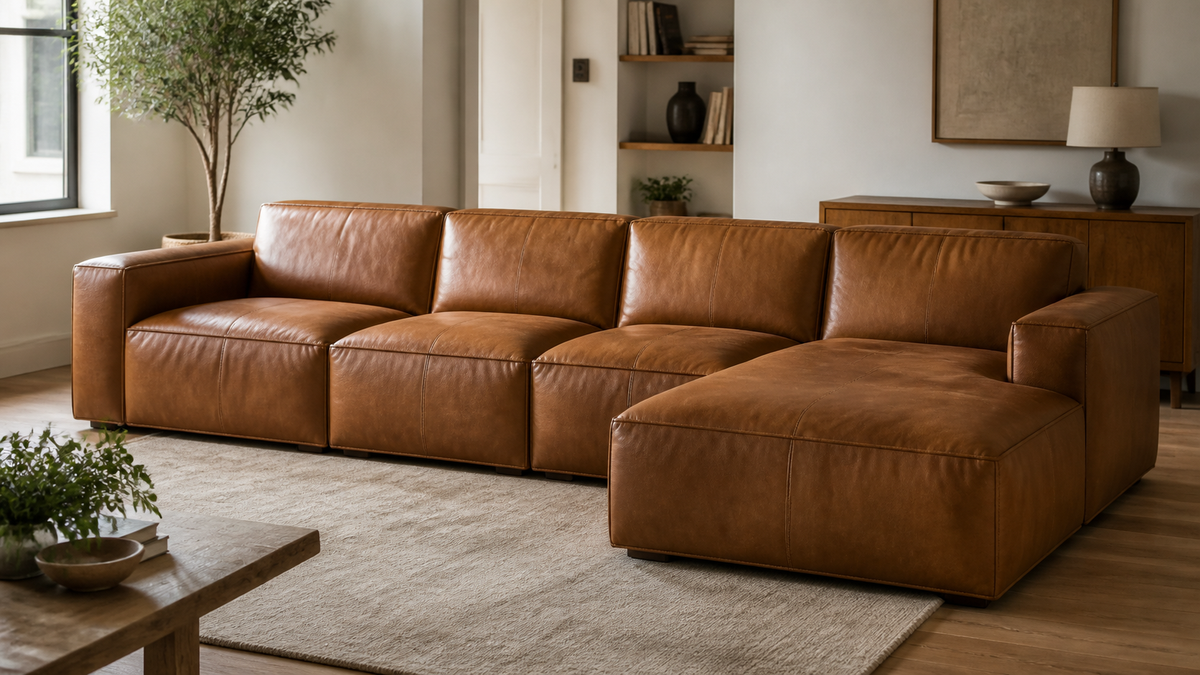
The image above performs one narrow job: it shows where a sectional’s panels and module boundaries sit. It cannot prove leather composition or hidden construction. On the leather model you are considering, make your own wear map:
- Favorite seat: expect the most repeated body contact and compression here.
- Inner corner: check wrinkling, rubbing, crumbs, and access for routine cleaning.
- Chaise and front edges: look for repeated leg, belt, shoe, or pet contact.
- Module boundary: verify alignment and whether the specified retention method limits rubbing or gaps.
- Outer and rear panels: confirm whether they use the same material and finish as contact surfaces.
No visual inspection can turn these locations into a lifespan prediction. It can, however, expose mixed coverage and clarify which surface will receive the household’s highest stress.
Use a care plan tied to the exact material
Begin with the product’s current care document. Soft-brush vacuuming or dry dust removal is a conservative routine for many upholstered leather surfaces, but cleaner, damp-cloth, and conditioner instructions vary. IKEA’s own material guide, for example, distinguishes among aniline leather, coated split leather, and coated fabric rather than giving all three the same cream or cleaning method. That variation is the lesson; its products and schedule are not prescriptions for another maker.
- Identify the affected panel. Confirm its material and finish, especially on mixed-coverage furniture.
- Check the exact instructions. Use the maker’s named method and prohibited-product list.
- Remove loose dust first. Use a soft attachment and avoid grinding particles into seams.
- Test only when authorized. Follow any hidden-area test direction before applying an approved product broadly.
- Stop at damage. For peeling, coating loss, dye transfer, cracking, a spreading stain, or an unknown material, pause and contact the seller or a qualified leather-care professional.
Do not treat conditioner as a universal remedy. It may be useful for a maker-approved leather finish and unsuitable for a coated or synthetic surface. Avoid home mixtures unless the manufacturer explicitly authorizes them for the exact material.
Match the surface to your household
The best choice is the documented tradeoff you can live with. Use the table to turn a broad lifestyle label into an evidence request and a stop condition.
| Household condition | Evidence to request | Decide before buying |
|---|---|---|
| Pets or sharp hardware | Exact finish, scratch-care guidance, panel placement, and repair/support route | Are visible marks acceptable, and can high-contact panels be protected without violating care instructions? |
| Frequent spills or young children | Spill response, cleaner restrictions, seam access, and light-color cautions | Pause if the routine depends on a product the maker does not approve |
| Strong daylight or nearby heat | Placement guidance for the exact upholstery | Reject the layout if you cannot keep the sectional within the documented conditions |
| Low-maintenance priority | Routine frequency, permitted tools, conditioning requirements, and mixed-material map | Choose only if you will realistically follow the specified routine |
| Natural patina is the goal | Written finish description and examples of expected natural variation | Confirm you accept uneven darkening, marks, and color change when the maker identifies them as normal |
“Pet-friendly,” “family-friendly,” and “easy care” are conclusions, not complete evidence. Ask which feature supports the statement and what exclusions remain. If your primary risk is claws, a spill claim does not answer it. If your priority is low maintenance, a beautiful surface that requires a routine you will not follow is the wrong fit.
A note about the current Monvane range
Monvane’s public homepage and Shop All catalog were checked on August 13, 2026. No current leather sectional was found, so this guide does not identify any current Monvane model as leather or use a Monvane fabric image as leather evidence. The catalog can change; verify the material selector and specification on the exact page at the time you shop.
If your goal is a current Monvane sectional, compare the documented fabric and configuration on the exact product page. For room fit, use the Sofa Size Guide separately. Material suitability does not replace measurement.
Make the purchase decision
Buy the evidence, not the category word. Proceed when the listing or seller confirms the exact material, finish, covered panels, care method, and sectional configuration—and those facts match your preferred feel, visible-aging tolerance, room placement, and maintenance routine. Pause when a missing field could change the answer. Reject the option if the seller substitutes broad praise for composition or care details, or if the required placement and routine are unrealistic for your home.
A well-chosen leather sectional couch is not simply the one with the most premium-sounding label. It is the one whose comfort, durability, surface, construction, and maintenance requirements are specific enough to evaluate—and whose trade-offs you are willing to live with.
Sources and limits
Terminology was checked against current Leather Working Group definitions. The IKEA STOCKHOLM and MORABO pages provide bounded first-party examples of finish sensitivity and mixed panel coverage; the IKEA sofa-material guide demonstrates why care must follow the exact surface. FTC material is cited only for disclosure context with its furniture-scope limitation. Monvane catalog scope was checked August 13, 2026. AI images are illustrations, not product or material evidence. No source used here supports a universal grade ranking or service-life prediction.