


Buying Guides
Durable Sectional Sofa: What to Check Before You Buy
A durable sectional must work as a multi-module system. Check the exact module roles, alignment method, configuration capacity, moving limits and replacement path before you buy.
On this page
A durable sectional must hold up as a system, not merely as a row of durable seats. Before you buy, verify five sectional-specific records for the exact configuration: what each module does, how adjacent pieces stay aligned, which layouts and loads the maker supports, how sections may be moved, and whether a damaged section can be serviced or replaced without orphaning the rest. Then confirm the selected upholstery and cushions.
No checklist can predict an exact lifespan. Daily load, favorite-seat use, moving, cleaning, floor conditions, and manufacturing variation still matter. The goal is narrower and more useful: expose the weak interface or unsupported assumption that a whole-sofa material checklist can miss.

Why sectional durability needs a different check
A straight sofa usually has one continuous body. A sectional may add armless seats, corners, chaises, ottomans, arms, backs, connectors, or separate floor-contact surfaces. The junctions between those pieces can affect shifting, gaps, edge wear, and how load moves through the arrangement. A strong upholstery claim cannot answer whether the modules remain usable together.
Start with the exact configuration rather than the collection name. Save its module count, parts list or plan, selected material, capacity wording, setup instructions, care information, and written support terms. Monvane’s current Materials guide also warns that configuration, cushioning, upholstery, and care vary by model and variant.
Check 1: Map the modules and the high-load positions
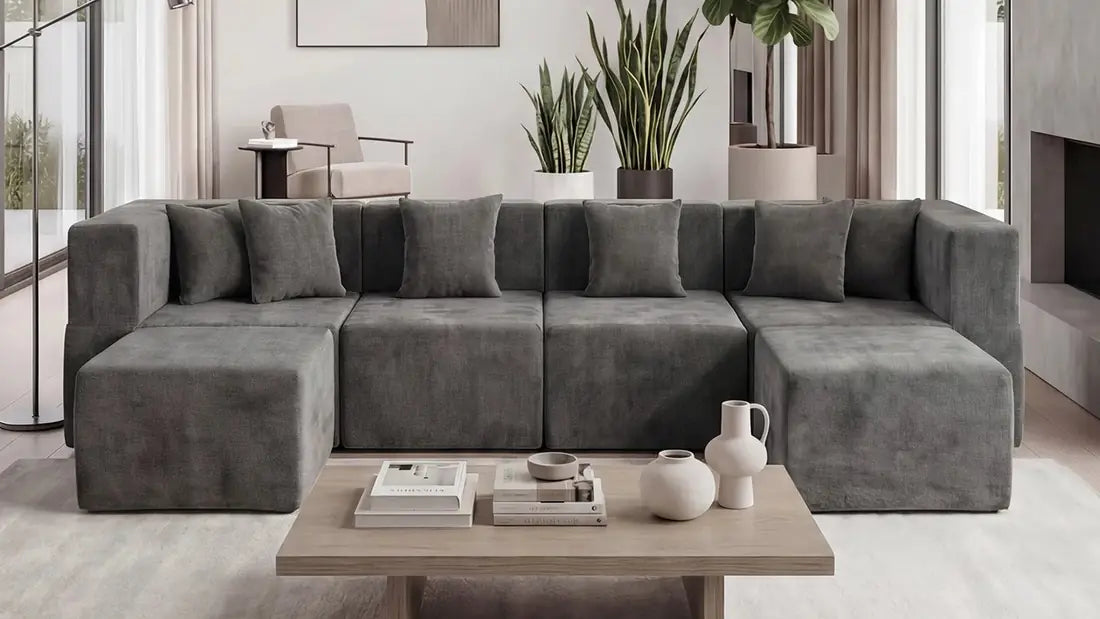
List every supplied piece and mark its job. An armless middle seat, corner, chaise, end seat, and ottoman may share a fabric while using different shapes, seams, support zones, or permitted orientations. Do not assume two similar-looking pieces are interchangeable.
Mark the favorite seat and exposed edges
Ask where people will drop into the sectional, pivot to stand, lean on an arm, or stretch across a chaise. Repeated use can concentrate at one cushion, front edge, corner seam, or boundary between modules. When one position will carry most of the routine, ask whether its cover, cushion core, or complete section has an exact replacement path.
Check every supported layout—not an imagined one
A product described as modular is not automatically approved for every arrangement. Require a plan, parts list, or current instructions for the layouts you intend to use. If a backless piece becomes a footrest in one layout and a seat in another, confirm that both uses are supported. An attractive user-created layout is not manufacturer evidence.
Check 2: Verify how adjacent sections stay aligned
Identify the exact retention method before deciding what “stable” means. Common product designs can use mechanical connectors, brackets, straps, non-slip bases, their own weight, or a combination. The method changes both the inspection and the maintenance question.
Mechanical or attached interfaces
For hooks, brackets, clips, or straps, ask for the current connection instructions and compatible part identifiers. Check whether every required connector is included, where it attaches, and whether the maker permits repeated disconnecting. Do not force misaligned hardware or infer a hidden connection from a room photo.
Friction-based or free-standing interfaces
For floor-based modules, confirm the base treatment, approved floor conditions, placement method, and any maintenance guidance. A non-slip base can help resist movement; it is not the same claim as a rigid connector and does not prove that every floor or layout will behave identically. Rugs, dust, smooth flooring, and uneven loading can change the interface, so the exact instructions should control.

Check 3: Read capacity at the configuration level
A capacity number is useful only when its unit is clear. Record whether it applies per seat, per module, or to the complete named configuration. Do not divide a total by the advertised seat count to invent a per-person limit, add module numbers together, or transfer a capacity from a smaller set to a larger layout unless the manufacturer expressly gives that rule.
Also ask whether the capacity assumes a particular arrangement, complete floor contact, attached arms or backs, or evenly distributed load. A large total does not answer what happens when two people choose one chaise or when someone sits on an edge not intended as a seat.
Check 4: Decide whether reconfiguration is occasional or routine
“Flexible layout” answers what the pieces can become; it does not state how often they should be moved. If you plan to reconfigure weekly, ask for the handling method, approved lift points, connector cycle guidance if any, and whether two people are needed. Dragging can stress upholstery, bases, legs, or hardware even when the final layout is allowed.
Separate moving the whole sectional from changing its layout. Record the module dimensions and weights when available, protect the route, disconnect only as instructed, and keep hardware identified by location. If the maker provides no repeated-reconfiguration guidance, treat frequent moving as an unresolved use condition rather than a guaranteed benefit.
Check 5: Protect the sectional from one orphaned module
A sectional can become impractical when one damaged piece has no compatible replacement—even if the remaining pieces are sound. Before purchase, ask whether the seller can currently identify and supply:
- the exact cover, cushion core, base component, connector, or complete module;
- the compatible product generation, orientation, dimensions, and attachment method;
- the selected upholstery and color, including how later batches may vary;
- the ordering or support route, customer costs, and warranty treatment.
Availability today is not a promise of permanent inventory, so avoid presenting expansion or replacement as certain unless the terms say so. The useful evidence is a named part or module plus a current support path. A generic promise that “parts may be available” remains qualified.
Use fabric and cushion evidence as a baseline, not the conclusion
The selected upholstery and cushions still matter, but they do not need a second full durability framework here. Confirm that the material selector, specification, care instruction, and any test report all identify the same variant. A texture photo shows appearance—not abrasion, pilling, snag, stain, or cleaning performance.
If a seller provides an abrasion result, require the exact textile and test method. Current Association for Contract Textiles guidance treats Wyzenbeek and Martindale as separate methods, says they are not correlated, and warns that abrasion results do not reliably predict fabric lifespan. For cushions, record disclosed construction and density with units, but do not treat density as a guarantee of firmness, comfort, or shape retention.


Worked example: keep Monvane capacity tied to each set
Current Monvane pages offer a useful configuration-scope example. The three chenille U-shaped sets below use similar wording for 30D foam, boneless glue-free construction, and anti-slip bases, yet each page publishes its own module count, package count, and total capacity:
| Current configuration | Modules | Packages | Published total capacity |
|---|---|---|---|
| 8 Seat U-Shaped Couch (Chenille) | 8 | 4 | Up to 1,800 lb |
| 10 Seat U-Shaped Couch | 10 | 5 | Up to 2,400 lb |
| 12 Seat U-Shaped Couch | 12 | 6 | Up to 2,700 lb |
These are three separate exact-page totals checked on August 13, 2026—not a formula. Do not divide them into invented per-seat ratings, average them, or use one to estimate an unlisted arrangement. The pages establish boneless construction and an anti-slip base for these sets, but they do not describe a rigid module connector. That makes the floor interface and approved arrangement part of the durability decision.
Make the pre-purchase decision
Choose the sectional only when you can identify every module, explain how adjacent pieces stay aligned, match capacity to the exact complete set, confirm that your intended reconfiguration frequency is supported, and find a realistic service path for the section most likely to wear first. Upholstery and cushion evidence must also match the selected variant.
Pause when the seller shows only a collection-level material claim, a capacity with unclear scope, a “modular” label without approved layouts, a stability promise without an interface method, or a replacement claim without compatible part identification. If a decisive answer cannot be confirmed in writing, compare another configuration rather than asking price or warranty length to cancel the uncertainty. For Monvane, use the Support Center for model, module, care, or warranty questions. Its current public summary lists a two-year limited warranty plus one additional year after registration, but the written coverage and exclusions—not the duration alone—control the remedy.
Sources and scope. Product and support details were checked on current Monvane public pages on August 13, 2026. Upholstery-test interpretation follows current Association for Contract Textiles guidance. These sources support the checks before you buy a durable sectional sofa; the images illustrate visible inspection locations only and do not prove hidden construction, laboratory performance, compatibility, or service life.