

Buying Guides
What Is a Chaise Sectional? Reversible Chaise Types & Fit
A chaise sectional combines a sofa run with one extended lounging seat. Learn how to recognize the form, distinguish fixed, reversible, and modular types, and verify the exact orientation and footprint.
On this page
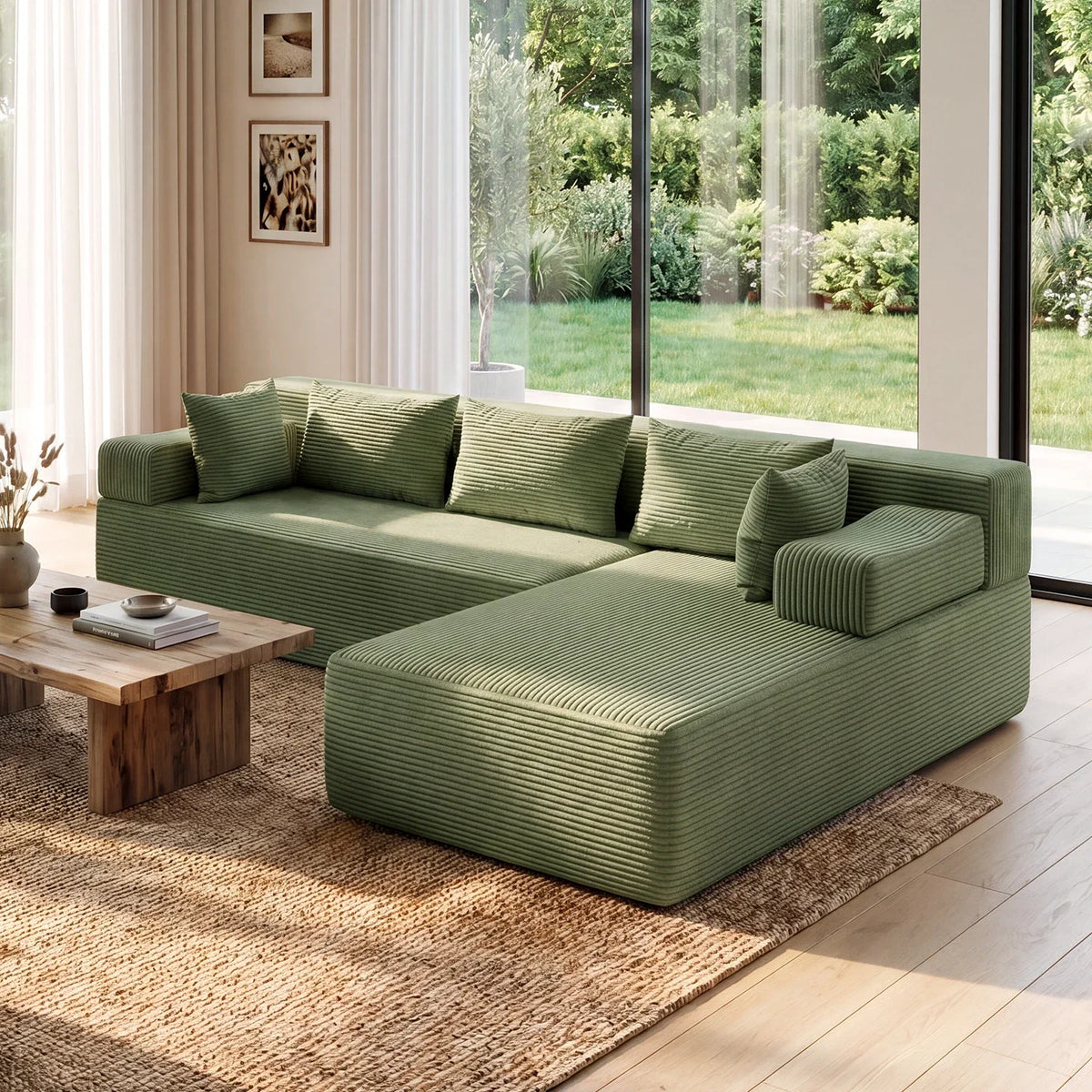
A chaise sectional is a sectional sofa with one seat that extends farther forward than the standard seats, creating a supported place to sit with your legs up. The regular seats form the sofa run; the extended end is the chaise. Chaise types include fixed, reversible, modular, and double-chaise configurations, and those labels are not interchangeable. Before choosing one, identify what physically creates the extension, confirm which side the seller means, and check its fit by measuring the full outside width plus the chaise’s deepest projection—not just the straight sofa portion.

The quickest way to recognize a chaise sectional
Ignore the product name for a moment and look at the plan view. A chaise sectional has two visible zones joined into one seating arrangement:
- A sofa run: two or more standard-depth seats arranged in a row.
- A chaise seat: an end seat whose platform continues forward far enough to support more of the sitter’s legs.
The result usually has an L-shaped footprint, but “L-shaped” alone does not prove that the return is a chaise. A corner sectional may turn into another row of backed seats, while a sofa and a loose ottoman may only look like a chaise from one camera angle. Confirm the exact parts and supported arrangement.
| What to inspect | What it tells you | What it does not prove |
|---|---|---|
| Extended end seat | Where the lounge position projects into the room | Whether it can move to the other end |
| Continuous cushion or supported platform | How the sitter’s legs are supported in the shown state | That a loose ottoman creates the same finished state |
| Plan drawing and parts list | Which pieces form the selected configuration | That every photographed configuration is included |
| Left/right or reversible label | A claim that needs the seller’s own orientation definition | A universal viewpoint or switching method |
Chaise sectional, sofa with chaise, or something else?
Retail names overlap, so classify the physical arrangement before relying on the label.
| Label or form | Physical distinction | Question to ask |
|---|---|---|
| Chaise sectional | A multi-seat sectional configuration with an extended lounge seat at an end | Which exact section creates the chaise? |
| Sofa with chaise | Often the same visible sofa-plus-extension form; the name alone does not reveal how many sections it uses | Is the chaise integrated, attached, movable, or modular? |
| Standalone chaise | One long reclining chair without a row of standard sofa seats | Is it designed to connect to this sofa series? |
| Sofa plus ottoman | A separate footrest may sit in front of a seat but may not form a supported, finished chaise state | Does the manufacturer show and authorize this exact arrangement? |
| Corner sectional | The return may contain additional backed seating around a corner rather than one forward-facing extended seat | Is the return a chaise platform or another seated row? |
“Sofa with chaise” and “chaise sectional” can describe the same visible shape on different stores. Treat the product page—not the category phrase—as the authority for construction, included pieces, and allowed layouts.
Four chaise types and what changes
These four labels answer different questions. Fixed and reversible describe orientation; modular describes how identifiable sections can be configured; double-chaise describes the number of extended ends. A product can belong to more than one group.
Fixed chaise: one specified side
A fixed chaise stays on the side specified for that configuration. This is the simplest choice when the room will not change, but the orientation must be correct before ordering. A mirrored product photo is not evidence that the opposite version is included.
Reversible chaise: an exact product supports both sides
A reversible chaise can be placed at either end using the supplied parts and the maker’s approved setup. That is a product-specific capability, not a promise attached to every chaise sectional. For example, the current IKEA FINNALA page states that its chaise section can be placed on the left or right and switched. Other products may be sold as separate left- and right-facing versions instead. Use the exact parts list, plan views, and setup instructions to verify both states; if either complete state is missing, treat reversibility as unverified.
Modular chaise: a named module within a system
A modular chaise is an identifiable unit intended to connect with compatible modules. Modularity may allow rearrangement, expansion, or freestanding use, but it does not automatically mean that one chaise module can serve both ends. Current JÄTTEBO listings, for instance, distinguish left and right chaise modules while describing ways to combine compatible modules. Verify the exact side and connection rules for the selected system.
Double-chaise: an extension at both ends
A double-chaise arrangement places an extended lounge seat at each end of the sofa run. It can create a shallow U-shaped footprint, but two chaises do not automatically make the sofa modular or reversible. Check whether both extensions are included, whether each has the support shown, and how much floor depth each side consumes.

How to read left- and right-facing labels
Do not assign your own viewpoint to “left-facing” or “right-facing.” Use the exact seller’s written definition and plan drawing for the selected configuration. The safe method is to make the label secondary to that drawing.
- Find the seller’s written viewpoint. Save the sentence or diagram that defines left and right for that page.
- Open a top-down plan. Locate the chaise extension, arms, backs, and any corner or terminal module.
- Describe the room position in plain language. Write “chaise beside the window when seated” or “chaise nearest the entry,” not just “left.”
- Match the selected variant. Confirm the variant name, thumbnail, dimensions, parts list, and cart line all refer to the same orientation.
- If it is called reversible, verify both complete states. Do not infer the second state from a flipped image or movable ottoman.
This plain-language room description survives a change in camera angle. It also gives customer support a clearer question if the label and drawing appear to conflict.
Will a chaise sectional fit your room?
Fit is controlled by the full outside footprint, especially the longest front-to-back projection. Record overall width, overall depth at the chaise, height, and the chaise side. Then tape that shape on the floor—not a simple rectangle based on the straight sofa seats.

A current Monvane planning example lists the L-Shaped Modular / Sectional footprint as 103 inches wide, 65 inches deep, and 30 inches high. Those figures apply only to the products covered by the current guide; they are not category averages. Monvane’s Sofa Size Guide also uses 30 inches or more for a main walkway and 16–18 inches between the sofa and coffee table as planning targets, not building-code guarantees.
Run these checks with the exact model:
- Projection: does the chaise enter a door path, cross-room route, or dining-chair pullout zone?
- Table access: can the chaise user and upright sitters reach the table without trapping one another?
- Openings: can doors, drawers, curtains, and windows still operate and be cleaned?
- Use: can another person enter or leave while someone remains stretched out?
- Delivery: do every package and section pass through the doorway, hall, elevator, and stair turn?
- Alternative side: if the model is reversible, tape both orientations before treating flexibility as a benefit.
Which chaise type should you choose?
| Your situation | Compare first | Disqualifier to watch |
|---|---|---|
| The room and chaise side are unlikely to change | Fixed chaise | The selected side interrupts the only useful path |
| You expect to move or reverse the room | Verified reversible chaise | The second state is not shown with the same included parts |
| You want to expand or regroup seating | Compatible modular system | The named chaise module fits only one side or one series |
| Two people regularly want a leg-supported end | Double-chaise layout | Either projection blocks circulation or table access |
| You need flexible floor space more than a dedicated lounge seat | Sofa plus separately usable ottoman | The ottoman is being mistaken for a supported chaise configuration |
Choose from the constraint your room cannot negotiate. If orientation is fixed by a doorway, eliminate the wrong side first. If future layouts matter, verify how the exact product changes rather than buying the word “reversible.” If floor depth is the limit, compare the chaise projection before upholstery, color, or seat count.
Make the final check from the exact configuration
A chaise sectional is defined by a sofa run plus an extended, supported lounge seat—not by an L-shaped photo alone. Before ordering, identify the physical chaise part, classify the model as fixed, reversible, modular, double-chaise, or a combination, translate its orientation into a stable room description, and tape the exact outside footprint. When those checks agree, compare current options in Monvane’s L-Shaped Sectional Couch collection. If any label, plan, parts list, or dimension conflicts, pause and ask for written confirmation for the selected variant.