

Comfortable Sectional
Most Comfortable Sectional Sofas: Map Every Seat Zone
The most comfortable sectional gives every regular user a reliable primary seat and a workable alternate. Map each zone, compare seat-to-seat differences and test mixed postures together.
On this page
The most comfortable sectional is not the one with the deepest average seat. It is the exact configuration that gives every regular user at least one reliable seat for their primary posture, provides workable alternate seats, and keeps corner, seam, return and arm-adjacent positions from becoming surprises.
Fast decision: define users and posture jobs, choose one anchor seat, compare every recurring seat against it, mark pass/alternate/unknown, test mixed postures at the same time, and reject a sectional whose comfort depends on one privileged position.
Replace “comfortable” with a coverage requirement
Write each regular user, primary posture, session type and likely position. Include upright conversation, relaxed viewing, legs-supported lounging, cross-legged or curled sitting, and sit-to-stand only when they are real household needs. Comfort coverage means the configuration supports those needs across the seats people will actually use.
This is a household preference assessment, not medical advice. A person with pain, mobility limits or clinical needs should use appropriate individual guidance. The goal here is to prevent a generic comfort adjective from substituting for observable fit.
Map the sectional’s comfort topology

A sectional is a small landscape. Arm-adjacent seats offer a boundary and may lose usable width. Standard middle seats can be symmetrical but lack a side support. Inner turns join directions and may contain cushion seams. Returns or chaises support legs and constrain entry. Test each zone as its own seat type.
| Zone | Potential advantage | Question to test |
|---|---|---|
| Arm-adjacent | Side support and defined boundary | Does the arm improve posture or consume usable room? |
| Standard middle | Neutral, repeatable seat | Can the user reach back support without an arm? |
| Inner corner/turn | Multiple lean directions | Do seams and neighboring legs make a stable posture? |
| Return/chaise | Leg support and longer body line | Can the user enter, orient, reach and exit? |
| Module edge | Flexible configuration boundary | Does movement or compression feel different at the join? |
Create an anchor-seat record
Choose a familiar seat each user understands. Record its usable depth, compressed height, back reach, arm relationship, cushion response and session outcome. Then choose one candidate sectional seat as the anchor and repeat the same observations.
Numbers translate the comparison; they do not decide it alone. Two seats with the same listed depth can feel different because back cushions, slope, arms, cushion boundaries and compression change the body’s usable position.
Audit seat-to-seat deltas
Compare every recurring zone with the anchor. Record only differences that matter to action:
- usable width after arms and cushion boundaries;
- usable depth after the back cushion compresses;
- seat height and stand-up experience;
- where back support contacts the user;
- compression at center, edge and module seam;
- arm, table and floor reach;
- independent entry and exit.
A delta is not automatically bad. One deeper return and one more upright seat can expand household coverage. The failure occurs when the difference is hidden, unstable or assigned to the wrong person.
Build a comfort-coverage matrix

For each person and required posture, name a primary seat and an alternate. The alternate matters when someone else takes the favorite corner, a module is being cleaned, or guests change the arrangement. Mark unknown until the exact seat is tested or evidenced.
A strong configuration covers different users without creating a throne problem: one excellent seat surrounded by tolerated positions. When two people share the sectional daily, test both primary postures simultaneously.
Test mixed postures as a system
- Place the regular users in their primary seats.
- Run upright, relaxed and any legs-supported postures that occur together.
- Check knee, elbow, blanket, arm and table conflicts.
- Have one person enter and exit while the other remains.
- Swap to alternate seats and repeat the primary activity.
- Restore cushions and movable pieces to the daily state.
The sectional passes when comfort is repeatable and socially workable. A pose that requires the entire household to rearrange every evening is a routine cost, even if one person loves it.
Separate surface comfort from support comfort
Surface feel includes texture, friction and immediate softness. Support includes the response of cushion, foam, base, back and geometry over the intended session. Recovery includes how the seat returns after unpacking and repeated use. Record these separately.
Do not use upholstery alone as a proxy for comfort. Ask for exact material, care, cushion/support construction, dimensions, compressed-delivery recovery and any model-specific usage instructions. A sample helps with touch and color but cannot reproduce the entire seating system.
Read current product facts without awarding a winner
The current Monvane 8 Seat U-Shaped Couch (Chenille) page describes eight modular units, 27.56-inch deep seating, 10-inch armrests and four-package delivery. Those facts identify aspects to test: how depth changes with back cushions, which positions have arms, how modular joins feel and when the complete configuration has recovered. They do not prove that all eight positions feel alike or suit every body.
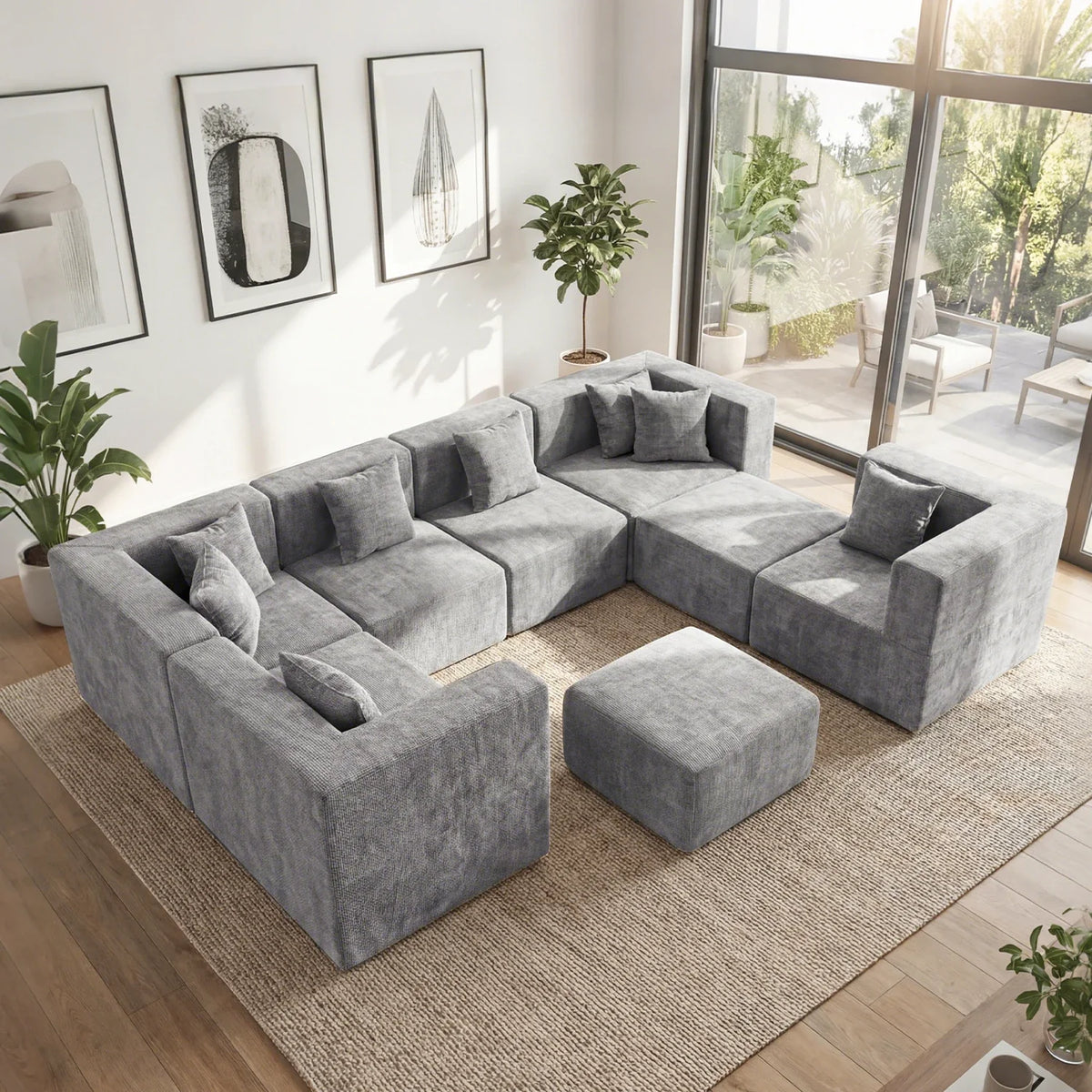
The supplied featured image from the same archive family visibly shows a large light-gray U configuration with standard seats, inner turns, returns, arms, cushions and a detached ottoman. It is useful for mapping zone types; it does not prove module count, dimensions, comfort or stability for the current SKU.
Use a realistic session protocol
Test for the household’s real activity length rather than a quick showroom drop. Start from a neutral state, note initial support, then record posture changes, pressure or fidgeting, table reach and exit. Repeat after the exact product has completed its stated recovery period.
Keep a brief log by user and seat zone. Avoid diagnostic claims. The decision is whether the configuration supports the intended routine acceptably and consistently.
Check comfort after room fit
A sectional cannot be comfortable if the room makes users climb over an ottoman, lose the table or block a route. Tape the exact footprint and adjacent furniture first. Then test comfort inside that real operating envelope, not in an open showroom.
Orientation matters: screen angle, window glare, conversation direction and table placement can make otherwise similar seats serve different postures. Keep layout observations separate from cushion judgments.
Comfort evidence to request online
| Evidence | Question it answers | What it cannot prove alone |
|---|---|---|
| Dimension diagram | Outer and usable geometry | Compression or long-session fit |
| Construction details | Named support layers/interfaces | Preference for every user |
| Configuration plan | Zone and module relationships | Seat-to-seat consistency |
| Care/setup guide | Recovery and maintenance process | Comfort before recovery completes |
| Return/trial terms | Decision window and conditions | A reason to skip pre-purchase evidence |
When a comfortable sectional shortlist should stop
- Only one seat supports a required posture.
- Regular users cannot occupy primary zones simultaneously.
- Corner or seam positions are counted but not usable.
- Unknown construction or recovery facts materially affect the decision.
- The exact footprint breaks the operating route or table relationship.
- Medical suitability is being inferred from generic marketing language.
Comfortable sectional questions
What seat depth is most comfortable for a sectional?
No universal depth works for every body and posture. Compare usable depth, back reach and height with a familiar seat for each user.
Are sectional corner seats comfortable?
They can support angled or nested postures, but seams, neighboring legs and lack of a clear forward orientation must be tested.
Is a U-shaped sectional more comfortable than an L shape?
Not inherently. A U offers more zone types and may add return conflicts; comfort depends on coverage for the household’s actual routines.
Does deep seating mean better comfort?
Deep seating can help relaxed postures and make upright back contact harder for some users. It is one dimension, not a verdict.
How many seats should we test?
Test every zone type that will recur—arm, middle, turn, return, edge—and the exact primary and alternate seats for regular users.
Choose coverage, not one perfect cushion
Approve a sectional when each regular user has a reliable primary seat, a workable alternate, mixed postures coexist, seat-to-seat deltas are understood, and the room still works. Keep the topology and coverage matrix with the shortlist.
After that proof, compare current options in Monvane’s Best-Selling Sofas collection without treating sales order as a comfort ranking.