

Sofa Materials
Velvet Sectional Couch: Test the Surface Before You Buy
A velvet sectional should be judged as a large directional surface, not by softness alone. Confirm the exact velvet construction and care code, test a swatch under side light, map high-contact and sun-exposed modules, and decide which appearance changes your household will accept.
On this page
A velvet sectional can be a good choice when you like a directional, light-responsive surface and can follow the exact upholstery care instructions. It is a poor choice when visible nap changes will bother you, the seller cannot identify the fabric and cleaning method, or different modules cannot be matched and maintained as one continuous surface.
Fast decision: request the selected upholstery specification and care code, then view a physical swatch with and against the nap in daylight and evening light. Mark the sectional’s high-contact, strong-light, module-join and hidden-test zones. Approve only when the expected surface variation and care workload fit your household.
“Velvet” is not a complete upholstery specification
Ask for the supplier’s exact fabric name, fiber content, pile construction, backing or finish information, color, batch information if available, performance data and cleaning instructions. Terms such as velvet, crushed velvet and Teddy Velvet can describe visibly different surfaces. Do not move care advice or durability claims from one term to another.
The Smithsonian Museum Conservation Institute’s velvet literature record notes that true and flocked velvets can respond differently to wear and care, and that pile length, density and construction affect behavior. It also notes that flattened pile changes light reflectance. The home-shopping lesson is limited but useful: verify the selected textile and learn how its pile is expected to look after contact. Museum conservation is not a cleaning manual for a household sofa.
Separate touch comfort from sitting comfort
A velvet surface may feel soft or warm to the hand, but that does not establish seat depth, support, cushion firmness, heat comfort or ease of standing. Test the swatch against bare skin and common clothing, then evaluate the seat system separately. If more than one person uses the sectional, record disagreement instead of averaging it away.
Also test friction during movement. A surface that feels inviting for feet-up lounging may grip clothing more than a smoother weave. Neither result is universally better. Match it to the actual routine and body fit rather than using “luxury” as evidence.
Run a directional-light and recovery test

- Mark the nap direction. Draw an arrow on the swatch backing and photograph both orientations under side light.
- Make a controlled path. Use only the brushing or handling method permitted by the supplier. Note whether the path recovers and how long you observed it.
- Compare two lights. Check the sample in representative daylight and with the evening lamps normally used in the room.
- Test care only when authorized. Follow the exact label on a hidden part of the sample. Let it dry fully before judging a ring, color transfer, matting or texture change.
- Set an acceptance rule. Decide whether directional shading, hand marks and seat impressions read as desirable character or distracting variation to the household.
Do not diagnose every light/dark area as dye inconsistency. First compare pile direction, lighting and a known untouched area. If the difference remains unexplained, ask the seller rather than inventing a cause.
Map the whole sectional surface

High-contact zones
Mark the seat used every day, the entry edge, arm tops, pet route and places where bare skin or denim regularly touches. Ask for relevant color-transfer, pilling and appearance-retention evidence. A result for one property does not answer all the others.
Strong-light zones
Trace the window light across the day and note which modules receive it. Request applicable colorfastness-to-light information for the exact fabric. Curtains or furniture rotation may reduce exposure, but do not promise that they prevent change. Decide whether modules can rotate without reversing the visual nap.
Module joins
Look across the sectional from the doorway and main seat. Nap arrows, seam direction and batch variation can become more noticeable where two modules meet. If you may expand later, ask whether a replacement or added module can be color- and construction-matched; do not assume future batches will be visually identical.
Hidden test zone
Identify a location that is truly inconspicuous and included in the same upholstery. Keep a before photo. A removable cover does not automatically mean it is machine washable or safe to clean separately; follow the exact care instructions.
Read durability data as a group, not one number
The Association for Contract Textiles organizes its voluntary performance guidance around separate properties including abrasion, wet and dry crocking, colorfastness to light and physical properties. ACT also warns that abrasion test results are not necessarily reliable indicators of fabric lifespan and that multiple factors affect durability and appearance retention.
For a residential velvet sectional, use that as a question framework rather than importing a contract threshold blindly:
- Abrasion: what exact method, result, fabric and intended use does the number cover?
- Crocking/color transfer: was wet and dry transfer evaluated for the selected color?
- Light: is there applicable colorfastness information, and how will the room expose the modules?
- Physical properties: are pilling, seam behavior or other construction-relevant results available?
Do not convert “passes a test” into years of life. Documented tests can reduce uncertainty at their stated scope; household users, maintenance, sunlight, pets, soils, seams and cushions still matter.
Build the care card before the first spill
Save the care label, product page and supplier instructions with the exact color and variant. Record the permitted dry-soil method, permitted spot-cleaning agent, moisture limit, brushing direction, drying instruction, whether professional cleaning is recommended, and whether covers may be removed.
ACT’s upholstery-cleaning paper describes W, S, WS and X as commonly recognized cleaning codes, while also cautioning that the codes do not provide adequate information by themselves for every upholstery-cleaning decision. Treat the code as a starting direction and the manufacturer’s exact instructions as required context. If the tag and page disagree, stop and obtain a written answer.
| Situation | Safe decision order | Avoid |
|---|---|---|
| Dry dust or crumbs | Check the permitted vacuum or brushing tool and pile direction | Aggressive suction or brush chosen by habit |
| Fresh spill | Protect the area, read the label, blot only as instructed and escalate when uncertain | Rubbing, saturating or copying a generic recipe |
| Flattened or marked pile | Compare the untouched zone and use only the approved recovery method | Unapproved steam, heat or moisture |
| Large or old stain | Document the fabric and stain history for a qualified professional | Layering multiple household products |
Evaluate the supplied Teddy Velvet sectional accurately
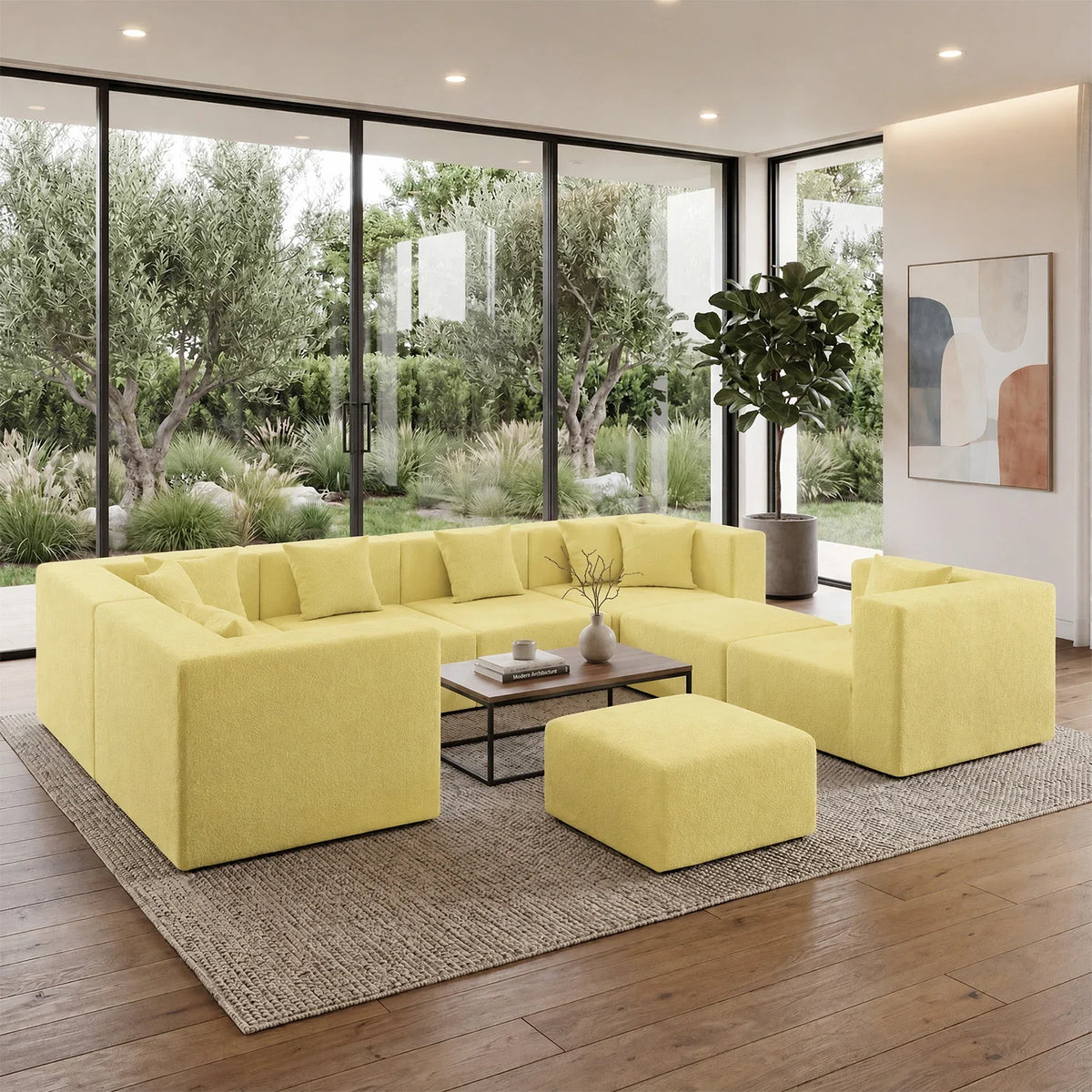
The supplied Monvane visual shows an unoccupied yellow U-shaped sectional with multiple matching modules and a separate ottoman-like piece in a bright room. It is stored in the “8-Seat U-Shaped Couch (Teddy Velvet)” folder. The current product page identifies the upholstery as Teddy Velvet, lists eight modular units and instructs buyers to spot clean with a damp cloth and gently pat to restore shape.
Those are product-specific facts, not permission to use the same method on every velvet sectional. For this candidate, save the current instructions, confirm they apply to the selected yellow option and ask for the cleaning code and fabric performance details if those are important. The broad U shape in the image is also a reason to map daylight across the modules and inspect visible joins from more than one angle.
Who should choose velvet—and who should reconsider
Velvet may suit a household that likes visible surface movement, enjoys a tactile fabric and accepts a care routine based on the exact label. A large velvet sectional can make light and color variation part of the room rather than hiding it.
Reconsider when any hand mark looks like damage to you, the strongest window exposure cannot be managed, the care code is missing, frequent soils conflict with the approved method, or future module matching is essential but undocumented. Choose a smoother or less directional upholstery when consistent appearance is a higher priority than velvet’s surface effect.
Questions about velvet sectional couches
Is velvet durable enough for a sectional?
It can be, but the word velvet is not proof. Review the exact construction, intended use, applicable abrasion, pilling, color-transfer and lightfastness evidence, seam behavior and care instructions. Keep test scope visible.
Does velvet always show marks?
Directional pile can change appearance when brushed, contacted or viewed under different light. The amount and recovery depend on the exact textile and use. Test the selected swatch and define what variation you accept.
Can I use water on a velvet couch?
Only when the exact manufacturer label or instructions permit the specific method. Velvet constructions and finishes differ. Do not infer water compatibility from another sofa or from a generic online recipe.
Is red velvet practical for a sectional?
Practicality depends on the exact red textile, room light, color-transfer evidence, care code and household soils—not the color name alone. View a large physical sample in the real room because a sectional creates a much larger color field than a swatch.
Will replacement modules match later?
Do not assume so. Ask about compatible construction, pile orientation, exact color and batch variation. Photograph and retain the original labels and fabric information.
Approve velvet with a surface dossier
Keep the exact specification, physical swatch, nap arrow, two-light photos, sectional zone map, performance documents, care card and household acceptance rule in one folder. Only then compare the current Teddy Velvet option with other layouts in Monvane’s U-shaped sofa collection.
A velvet sectional is successful when its surface behavior is understood and accepted before it fills the room—not when every future mark is mistaken for either harmless character or guaranteed damage.