

Buying Guides
Loveseat vs. Sofa for Small Spaces
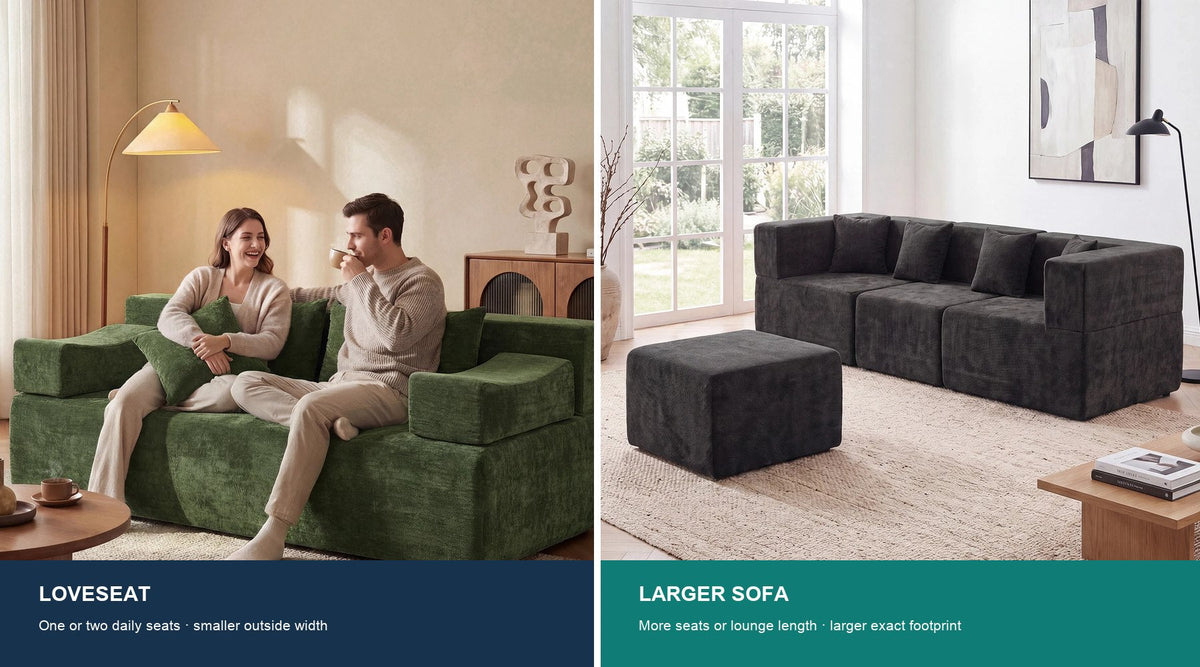
Choose a loveseat when one or two daily seats and saved circulation matter; choose a sofa when its extra seat or lounge length is used and the exact footprint, doors and delivery path still fit.
On this page
A loveseat saves space only when the smaller exact footprint preserves something useful. A larger sofa earns its room when the extra seat or lounge length is used often.
What is the practical difference between a loveseat and a sofa?
A loveseat is a two-person sofa category. In everyday shopping language, sofa is broader: it may describe a two-seater, a longer straight sofa or another upholstered seating format. Retail labels overlap, so the useful difference is not a universal inch cutoff. It is the combination of published seating capacity, outside dimensions and the job the piece is designed to do.
For this comparison, “sofa” means a larger straight main seat that normally adds a third seating position or more lie-across length. Sectionals, sofa beds and matching furniture sets are separate decisions. If a product title uses couch, apartment sofa, two-seater or loveseat differently, ignore the label until you verify the specification sheet.
| Decision point | Lean loveseat | Lean sofa |
|---|---|---|
| Daily users | One or two people use the main seat most days | Three people need seats most days |
| Primary benefit | Ends sooner on the wall and may protect circulation | Adds a seat, lounge length or one stronger room anchor |
| Main trade-off | Two-person capacity and limited lie-across length | More outside width and often more delivery/placement difficulty |
| Do not assume | Every loveseat is shallow, compact or easy to move | Every sofa is too large for a small room |
| Required proof | Exact W × D × H, usable seating, door and path check | The same facts, plus proof the extra capacity will be used |

Start with the daily seating job
Write down who uses the room on an ordinary weekday evening. Count assigned seats, not the number of people who could squeeze in for ten minutes. A single adult or couple may get more value from a loveseat plus open floor. A household of three may be frustrated by a piece that technically fits but forces someone into a dining chair every night.
Then name the posture. Upright conversation, reading with a pillow, sitting side by side and lying across the seat use different dimensions. A loveseat can be generous for one person and still be too short for regular full-length lounging. A longer sofa can justify its width when that horizontal use is part of the real routine.
Finally, count the furniture the choice removes. A sofa may occupy more wall space but replace an accent chair. A loveseat may look compact yet require another chair, leaving two footprints and a tighter conversation path. Compare the complete room plan, not isolated product rectangles.
Compare outside footprint and usable seat space
Outside width tells you whether the piece fits the wall. Outside depth tells you how far it projects into the room. Height affects windows, sight lines and visual mass. Usable seat width and seat depth tell you what the footprint buys. Two products with similar outside widths can deliver different usable space because their arms, back and cushion geometry are different.

Do not choose from a category average and then hope the selected model matches it. Copy each candidate’s overall width, overall depth, overall height, seat depth, seat height and published seating capacity. If the listing omits a dimension that controls your room or posture, ask for it before ordering. A detailed loveseat measuring method belongs in the loveseat dimensions guide.

Make four small-room fit checks
A piece can fit between two wall marks and still make the room fail. Tape the exact outside footprint and test the movements that happen around it. Monvane’s current room-fit guide uses 30 inches or more as a main-walkway planning target, 16–18 inches between seating and a coffee table, and 2–6 inches behind a sofa when possible. Treat those as planning guidance—not building code or a guarantee for every person or home.
| Check | What to test | Failure signal |
|---|---|---|
| 1 · Main path | Walk from the entry to the next room with the footprint taped | You turn sideways, step inside the tape or reroute daily traffic |
| 2 · Moving parts | Open the room door, closet, drawer and any nearby chair | A door or pulled-out chair collides with the footprint |
| 3 · Seating zone | Place the real table outline and sit at the planned edge | Knees, feet or table access depend on moving furniture each time |
| 4 · Delivery | Measure doors, halls, stair/elevator turns and package data | Assembled size fits, but the package or turning path is unknown |
Run all four checks for both options. If the loveseat restores a necessary route, that saved width has a real benefit. If the sofa passes without collisions and supplies seating you would otherwise add elsewhere, its larger footprint may be the more efficient room choice. Use the current Sofa Sizes & Room Fit Guide for the full planning sequence.
When is a loveseat the better choice?
Choose a loveseat when the everyday requirement is genuinely one or two seats and the shorter exact width prevents a meaningful conflict. Common examples are a couple’s apartment with one tight entry path, a bedroom reading zone, a home office that must still accommodate a desk, or a guest corner where a full sofa would dominate the wall.
It is also a strong choice when open floor matters more than occasional extra capacity. The benefit is not that every loveseat is petite; it is that the selected model performs the seating job with less unused furniture. Choose by published dimensions, not the word compact, and verify that two adults actually have the seat space and posture they expect.
A loveseat is weaker when three people compete for the main seat every day, when lie-across lounging is essential, or when a second chair will be added immediately. In those cases, saved width can become false economy if the room ends up holding more pieces.
When is a sofa the better choice?
Choose a sofa when the extra place has a named, frequent user or when the longer usable span supports a posture the household repeats. A carefully selected straight sofa can work in a small room when it uses one long wall, keeps depth under control and replaces smaller seats that would otherwise fragment the floor.
The strongest case is not “bigger is more comfortable.” It is “this exact larger model fits, and we use the added capacity.” Narrower arms, a shallower body or raised legs may reduce visual and physical bulk, but those details must be confirmed on the candidate product. Do not infer comfort or room fit from a styled photograph.
A sofa is weaker when its third seat becomes a place for bags, when the depth blocks the main route, or when the delivery path is uncertain. Extra capacity that makes daily movement worse is not useful capacity.
Run a five-step floor-tape test
Use painter’s tape, the two exact product pages and the furniture you already own. Keep both outlines on the same room plan so the comparison is fair. The test should take minutes; living with a wrong footprint takes much longer.
- Mark fixed boundaries. Tape walls, door swings, vents, radiators, built-ins and the route to the next room.
- Tape the loveseat footprint. Use exact outside width and depth, then place the real table and pull nearby chairs out.
- Repeat for the sofa. Keep the same table, focal direction and path so only the seating option changes.
- Act out the routine. Enter with a bag, open doors, sit, stand, cross the room and use any desk or dining chair.
- Choose by pass conditions. Select the smallest outline that provides the required seats or lounge length without a movement or delivery failure.

Use current Monvane examples without turning them into standards
Current Monvane products show why labels cannot make the decision. The Chenille Loveseat is listed at 69.3 inches wide and 43.3 inches deep; another current Loveseat Sofa (2 Seater) is 75 inches wide but 37.4 inches deep. Both are two-seat products, yet one is longer and the other projects farther into the room.
For contrast, the current L-Shaped Modular Couch is listed at 103 inches wide and 65 inches deep with four-seat capacity. It is a larger L-shaped product—not the straight sofa category used in the main comparison—but it makes one lesson visible: adding seating can change both axes and the delivery job, not width alone.
| Current exact product | Published planning facts | How to use the example |
|---|---|---|
| Loveseat Sofa (Chenille) | 2 seats · 69.3"W × 43.3"D × 33.5"H · 26" seat depth | Tests a shorter-width, deeper two-seat option |
| Loveseat Sofa (2 Seater) | 2 seats · 75"W × 37.4"D × 30"H · 27.56" seat depth | Shows that a loveseat can be longer but shallower |
| L-Shaped Modular Couch | 4 seats · 103"W × 65"D × 30"H · 27.5" seat depth | Larger-sofa illustration only; not a straight-sofa standard |
Current product sources checked August 4, 2026: Chenille Loveseat · 75-inch 2 Seater · L-Shaped Modular Couch
Common loveseat-versus-sofa mistakes
- Choosing from the room label. “Studio” or “small living room” does not replace exact measurements.
- Comparing width only. Depth, arms, usable seat span, doors and delivery can reverse the apparent winner.
- Buying for the largest rare gathering. Count ordinary daily users first, then solve occasional overflow separately.
- Assuming a loveseat seats two comfortably because the title says two-seater. Verify usable space and posture.
- Adding a chair after choosing the loveseat without retesting the complete layout. Compare total furniture footprints.
Frequently asked questions
Are loveseats better than sofas for small rooms?
Not automatically. A loveseat is better when one or two seats are enough and its exact smaller footprint protects a needed walkway, door or second function. A sofa is better when the extra seat or lounge length is used frequently and the exact model still passes the room and delivery checks.
Should I get a sofa or loveseat for one person?
Start with posture and room use. A loveseat often gives one person generous sitting space with less outside width. Choose a sofa if lying across the seat is routine or the larger piece replaces other seating without harming circulation.
Can two adults sit comfortably on a loveseat?
A loveseat is intended as a two-person seat, but comfort is not guaranteed by the label. Compare usable seat span, seat depth, arm width, cushion layout and the adults’ preferred posture on the exact model.
Is an apartment sofa the same as a loveseat?
Not necessarily. Apartment sofa is a retail description rather than a universal size standard. It may be longer than a loveseat while using a shallow body or narrow arms. Compare published dimensions and capacity instead of product names.
Do I need both a sofa and a loveseat?
No. In a small room, a matching pair can consume two walls and create a dead corner. Buy both only when the complete layout passes circulation checks and the seats have frequent users; otherwise one main seat plus a lighter chair may work better.
Is a loveseat easier to move than a sofa?
It may have a smaller assembled footprint, but moveability depends on package dimensions, weight, detachable parts and the delivery route. Do not infer an easy move from the category label; verify the exact packaging and handling instructions.
Choose the smallest option that fully works
The better small-space seat is not always the smaller one. It is the smallest exact product that delivers the required daily seats or lounge length, uses its outside footprint efficiently, keeps the room operable and can reach the final position. If both pass, choose the one whose extra capacity you will actually use.
If the loveseat wins, compare current models and their exact dimensions. If the sofa wins, use the room-fit guide until a verified straight-sofa destination is available. If either choice depends on an unpublished dimension or uncertain delivery turn, pause and ask before ordering.
Compare current loveseats · Check exact room fit · Review loveseat dimensions · Ask Monvane support
Sources and methodology. Routes and exact-product facts were checked August 4, 2026. Product statements are limited to named current pages; Monvane room clearances are planning guidance. Search results were sampled for intent and format, then replaced with a task-first framework. Matching photographs from the supplied website-writing archive were used first; unrelated decks and company-profile files were omitted.