

Buying Guides
How Big Are Sofa Beds? Measurements and Room-Fit Guide
Measure a sofa bed in both states, separate the usable sleep surface from the overall footprint, and test the room, route and bedding with exact model dimensions.
On this page
How big are sofa beds? There is no single standard answer. This guide uses exact measurements for a room-fit decision: record the closed shell, maximum open shell, usable sleep surface, space needed to convert and circulate, and delivery package for the exact model. Then tape both use states in the room. A Twin, Full or Queen label may provide context, but it cannot replace the actual sleeping boundaries or the product’s maximum projection.

Start with five measurements, not one size name
A category label answers only a broad question. “Sofa bed” says the furniture converts; “loveseat sofa bed” suggests a smaller daytime seating format; “hotel sofa bed” describes where it is used. None of those phrases proves how far the exact unit projects when open, how much of that footprint can support a sleeper, or whether its cartons fit through the delivery route.
| Envelope | Measure or obtain | Decision it controls | Common misreading |
|---|---|---|---|
| Closed shell | Maximum outside width, depth and height in the supported seating state | Daytime wall, floor and sight-line fit | Using seat depth as overall depth |
| Open shell | Maximum outside length/projection, width and height in the exact sleep state, including every support | Overnight floor footprint | Using the sleeping surface as the total open shell |
| Usable sleep surface | Length and width between boundaries that actually support bedding and a sleeper; record thickness or shape where relevant | Sleeper, sheet, topper and replacement compatibility | Assuming the shell is a separate standard mattress |
| Operating and route zone | Space needed to convert the unit, park moved furniture, open doors and preserve the selected circulation path | Whether the room still functions in both states | Checking only whether the mechanism can physically open |
| Delivery package | Carton count, each carton’s dimensions and weight, plus any documented removable-part state | Door, hall, stair, elevator and handling fit | Using assembled dimensions or capacity as package data |

The five fields should stay separate even when two values happen to look similar. The open shell may extend beyond the usable sleeping area because of a frame, hinge, bolster or support. A compressed carton may be smaller than the assembled shell but heavier or harder to control. Five envelopes, five different decisions.
Measure the closed and open shells
Use the current product page or exact model guide as the primary specification, then verify the real unit when you can. Record the source and date beside every value. If a page calls a dimension approximate, keep that label; do not silently turn it into an exact field.
- Set the exact supported state. Arrange the product as the maker shows for seating, then for sleeping. Do not press cushions inward or hold a flexible edge out of the way to improve the result.
- Measure the closed width. Go from the farthest outside point on one side to the farthest point on the other. Include arms, bolsters or cushions when they form the natural maximum shell.
- Measure the closed depth and height. Depth runs from the frontmost supported point to the backmost; height runs from the floor to the highest supported point. Seat depth and seat height are different comfort fields.
- Open the unit through its documented sequence. For the operating method, use the exact instructions or the sofa-bed opening and closing guide. Once fully supported, record the farthest length/projection, width and height of the entire shell.
- Measure the sleeping boundaries separately. Record the surface that can actually support bedding and a sleeper, not the surrounding frame or unsupported gap. If it tapers or has multiple panels, measure at more than one point and note the shape.
- Close the operating and delivery fields. Mark the standing space and movement path needed to convert the unit. Obtain every carton’s current dimensions and weight for the exact order; never derive them from the assembled shell.
Measure between the maximum outside points in the exact supported state. For soft cushions, identify the natural edge without deliberate compression. For rigid frames or feet, include any part that reaches farther. These endpoints are a repeatable household check; the exact manufacturer’s current measuring definitions still control the published specification.
Use mattress labels as references, not guarantees
The Better Sleep Council lists the following approximate U.S. freestanding mattress dimensions. They are useful reference points after—not before—you have the exact usable sleep surface.
| Reference label | Approximate dimensions | What it does not prove about a sofa bed |
|---|---|---|
| Twin | 38 × 75 in | Separate mattress identity, uniform thickness, exact sheet fit or open-shell size |
| Twin XL | 38 × 80 in | That the convertible surface reaches 80 inches or uses a removable Twin XL mattress |
| Full | 53 × 75 in | That every surface called “full-size” shares the same boundaries or shape |
| Queen | 60 × 80 in | That the furniture shell, mechanism or route fits a Queen-mattress footprint |
Similarity is not a mattress identity. An integrated foam panel that is approximately 38 × 75 inches when flat may resemble the reference Twin length and width, but that alone does not establish a removable Twin mattress, a standard depth or a guaranteed fitted-sheet result. For topper and replacement decisions, use the actual surface length, width, thickness, panel shape and mechanism clearances; the sofa-bed mattress and topper guide owns that compatibility task.
A hotel or loveseat label still does not close the measurement record. Before relying on a hotel sofa bed for a particular sleeper, ask the property for the exact usable sleep surface, model or mechanism, and its current occupancy policy. When shopping for a loveseat sofa bed, ask for the same five envelopes; compact daytime seating does not guarantee a short open projection.
Test both room states
Start with the room’s usable boundaries, not its nominal wall-to-wall size. Measure between baseboards, trim, radiators, curtains, fixed cabinets and door swings. Record outlets or controls that must remain accessible. Then tape two different floor plans.
- Seating state: tape the closed shell and its intended wall gap. Place the coffee table and side furniture at their real dimensions, not as dots or labels.
- Sleep state: tape the maximum open shell. Mark where the coffee table, ottoman or chair goes during conversion. A “movable” object still needs a real parking place.
- Operating state: walk through the conversion sequence inside the taped area. Protect the space needed to stand, unfold, pull, rotate or reposition the documented parts.
- Circulation state: open doors and drawers, pass the bed, and test the household’s normal route. Add space for mobility, traffic or caregiving needs instead of treating a planning target as a universal answer.
Monvane’s current Sofa Size Guide uses at least 30 inches as a planning target for a main walkway, 16–18 inches between the seating edge and a coffee table, and 2–6 inches behind a sofa when the layout allows. These are planning targets, not building-code or accessibility requirements. Your doors, traffic and household needs may require more.
Worked example: a 10-foot room that misses by 3 inches
Assume an illustrative room has 120 inches of usable depth. The exact model’s maximum open projection is 75 inches, and a fixed dresser occupies 18 inches of the same line. The remaining route is:
120 − 75 − 18 = 27 inches.
Compared with the selected 30-inch main-walkway planning target, the result is 3 inches short. The sofa bed can physically open, but this version of the layout does not pass the selected route check. The next decision is to rotate or reposition the sofa bed, move the fixed obstacle if that is genuinely possible, or compare another exact model. Do not shrink the sleeping-surface number or the route target simply to force a pass.

This is an illustrative room-fit calculation, not a building-code or accessibility determination. In the real room, replace all three inputs, account for swing zones and traffic, and use the exact model’s farthest supported open edge.
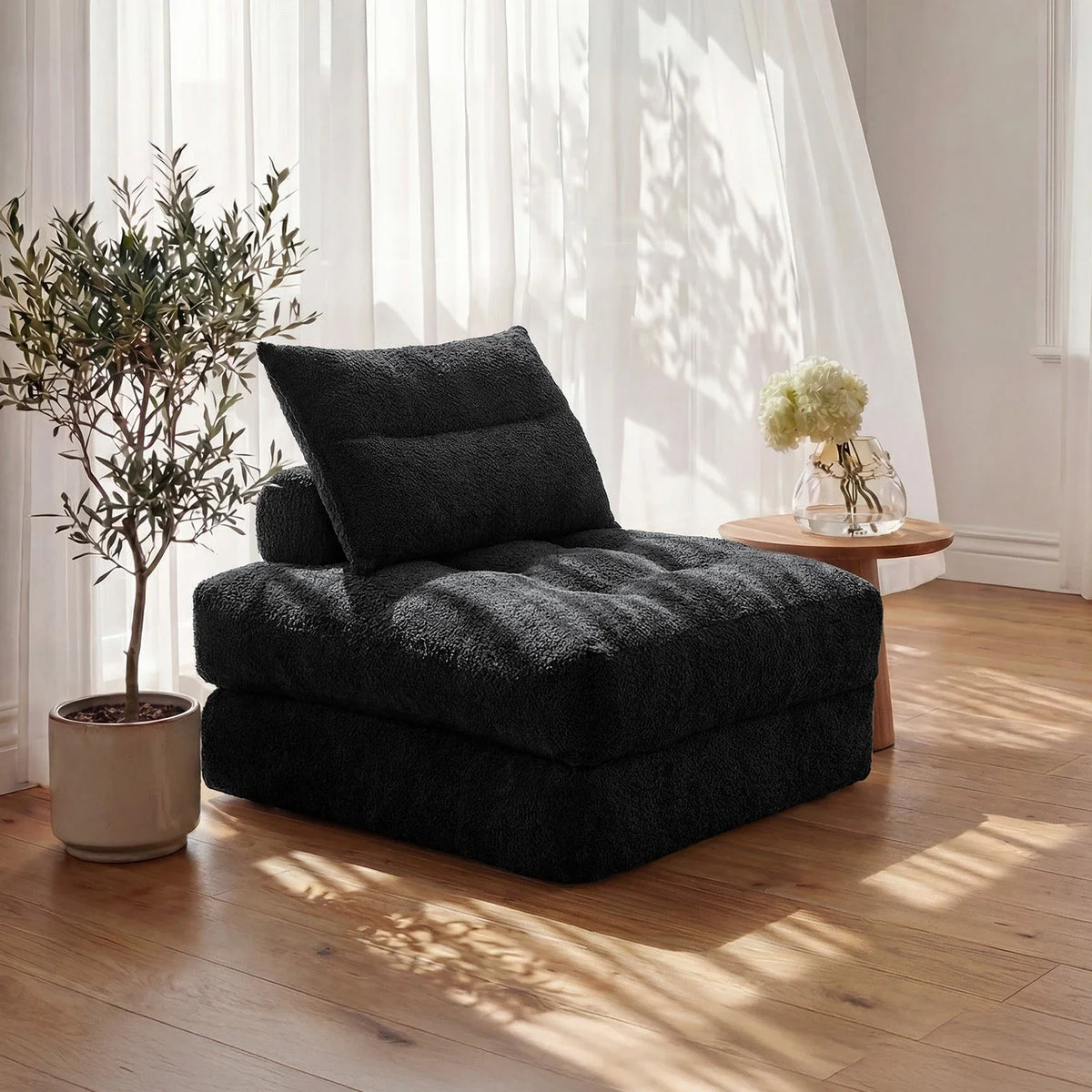
Apply the method to the current Monvane Oversized Sofa Bed
The current Monvane Oversized Sofa Bed page provides a useful partial record. The page closes some fields, not the whole record.
| Field | Current public record | How to use it |
|---|---|---|
| Closed shell | 38 in D × 33.86 in W × 16.54 in H | Tape the seating footprint and verify the page’s endpoint order before comparing another model |
| Laid-flat size | Approximately 75 in L × 38 in W | Use as the page’s approximate flat-state record; do not silently relabel it as a separate mattress |
| Listed capacity | 300 lb | Keep as a product-use field; it is not item weight or carton weight |
| Setup and package count | No assembly; one package listed | Use the count to request one current carton record; “no assembly” does not prove carton dimensions |
| Separate mattress identity/dimensions | Not published on the reviewed visible page | Measure the usable surface and confirm bedding or replacement needs separately |
| Item weight and carton dimensions | Not published on the reviewed visible page | Pause the delivery-route decision until the current exact-order fields are confirmed |
The page’s approximate 75 × 38-inch flat size resembles the Better Sleep Council’s approximate Twin reference dimensions, but similarity is not identity. The public record reviewed on August 18, 2026 does not identify a separate removable mattress or publish a separate usable-surface depth. It also does not publish item weight or carton dimensions in the visible fields reviewed. That is not evidence that those facts do not exist; it means the public record did not close them.
For the exact current order, ask Monvane Support for any decisive usable-surface, item-weight or carton field that remains missing. Keep the answer with the model, variant and date rather than transferring it to a similar-looking product.
Choose only when the size record closes
| Decision | Use it when | Next action |
|---|---|---|
| Pass | All decisive exact fields are sourced, both taped states work, the operating/circulation zone works, and every carton passes the measured route | Save the record with the exact model and variant; then evaluate comfort, upholstery and policy separately |
| Adjust | The product fits but a genuinely movable table, chair or orientation creates the conflict | Draw and test the revised parking place and route; do not rely on “we will move it somewhere” |
| Pause | A fixed obstacle fails, a door or route cannot operate, or a decisive sleep-surface/package field is missing | Obtain the missing exact field, change the room plan or compare another model before ordering |
Unknown is not the same as fits. Pass, adjust and pause are Monvane editorial decisions for this measurement record—not manufacturer approval or a fit guarantee. Once every field is sourced, the answer to “How big are sofa beds?” becomes specific and useful: this exact model has a known daytime shell, overnight shell, sleeping area, operating route and delivery envelope, and each one works in this exact room.
Sources and scope
The current Monvane Oversized Sofa Bed product page, Sofa Size Guide and Support Center were checked August 18, 2026. Approximate Twin, Twin XL, Full and Queen reference dimensions come from the Better Sleep Council’s mattress-size chart and are not sofa-bed standards or compatibility guarantees. The five-envelope record is a Monvane editorial measuring tool—not a furniture standard or product blueprint. These endpoints are a repeatable household check; the exact manufacturer’s current measuring definitions still control the published specification. This is an illustrative room-fit calculation, not a building-code or accessibility determination. Pass, adjust and pause are Monvane editorial decisions for this measurement record—not manufacturer approval or a fit guarantee.