

Buying Guides
Memory Foam Sofa Bed: Practical Guide
Verify the exact memory-foam layer, its coverage across folding panels, the support beneath it, and how the same sofa bed behaves when seated and flat.
On this page
A practical memory foam sofa bed guide should begin with one question: does the exact product document a viscoelastic layer, where it sits, and what supports it when the bed is fully open? A model is worth considering only when that construction is clear and its seated and flat states both suit the intended use. Foam, high-density, and 30D do not prove memory-foam identity. If the listing leaves the material or its coverage unknown, ask for exact-model confirmation before treating “memory foam” as a buying benefit.
Memory foam is a material claim, not a synonym for foam
The Polyurethane Foam Association describes memory foam as viscoelastic flexible polyurethane foam with a slow, rate-sensitive recovery after compression. That definition matters because a listing that says only “foam,” “high-density foam,” or a density grade has not identified viscoelastic foam.
Recovery behavior can also change with temperature and humidity. A sample that responds one way in a cool showroom may not respond identically in a different room. This does not make a household comparison useless; it means the conditions must be recorded and the result kept in scope. A brief press can help compare two zones under the same conditions, but it cannot identify chemistry, measure durability, or predict personal comfort.
Read a folding sofa bed as a system
A foldable sofa bed uses the same body in two configurations. Closed, panels may stack to form a deeper seat. Open, those panels become a longer sleep surface with folds or seams between them. Memory foam is one layer, not the whole support system. The surface response also depends on the cover, the layer beneath the claimed memory foam, panel joints, and the base supporting each section.
| Part to verify | What the listing should establish | Why it changes the decision |
|---|---|---|
| Cover | Fabric, removability, and exact care method | The cover affects maintenance and access, but does not identify the foam below. |
| Claimed memory layer | Material name, thickness, and which panels contain it | A claim attached to one cushion may not describe the complete open bed. |
| Support core | Material and thickness beneath each surface panel | A thin comfort layer cannot describe the support of the complete build. |
| Folds and seams | Where the build changes and how panels meet when flat | A panel center and a fold line may not respond alike. |
| Underside or base | What supports every panel in the open state | Similar top layers can feel different over different bases. |
A useful specification names these parts separately. If a seller provides only a broad “memory foam sofa bed” label, the layer location and underlying support remain open questions.
Map the claimed layer across every open panel

A claim on one panel does not automatically cover the whole bed state. For each panel used when the sofa bed is flat, record four fields: the claimed comfort layer, its stated thickness, the support immediately below it, and what changes at the adjacent fold. Then ask whether the construction repeats across all panels or changes from section to section.
The answer may be a continuous layer, separate layers with matching specifications, or different panel builds. None should be assumed from a photo. The panel-by-panel layer map is a Monvane editorial buying tool—not a cutaway of an exact sofa bed or proof of hidden construction.
If a listing uses a cutaway illustration, confirm that it belongs to the exact model and variant rather than a general material page. Save the written specification with the product name and date checked. That record is more useful than transferring a material claim from another item in the same collection.
Compare both states under matched conditions
A shopper who can inspect a retailer sample—or an owner checking a delivered product without damaging it—can compare four practical zones: the closed seat center, an open panel center, a fold line, and an outer edge. Use the same brief load or seated position in each comparable zone. Record the state, zone, room conditions, same brief load, response and return.

Compare state to state; do not use the check to identify chemistry. Note whether the response appears similar across panel centers, whether a fold is readily noticeable, and whether the outer edge changes the usable area. Stop if a test would crease, unzip, remove, or otherwise alter a store sample. A retailer may not permit hands-on testing.
The matched two-state check is a household comparison, not a standardized foam, comfort, durability, or safety test. It does not measure foam density, indentation force, fatigue, temperature performance, or service life. Its value is narrower: it exposes whether the two configurations and the zones within the open surface are consistent enough for the buyer’s preference.
Match the confirmed build to the intended use
Start with the use that cannot negotiate. A sofa bed used mainly as a daily seat has a different decisive state from one bought for occasional overnight guests. The material name alone cannot settle either decision.
| Intended routine | Evidence to prioritize | Question that changes the choice |
|---|---|---|
| Daily seating | Closed-state support stack, seat-center response, cover care | Do stacked panels create the seating response you prefer? |
| Occasional guest sleep | Open length and width, layer coverage, fold-line observation | Is the full usable sleep surface documented and acceptable to the guest? |
| Frequent conversion | Repeatable opening method, panel alignment, care instructions | Can the exact model move between states as often as the routine requires? |
| Changing room conditions | Matched observations in relevant conditions and a clear return policy | Has the buyer avoided treating one room-temperature check as universal? |
This is not a rule that memory foam is better or worse for any of these uses. It is a way to connect a verified layer and complete construction to the state that matters most. A shopper who cannot test the product should rely on exact documentation and applicable store terms rather than simulate certainty from generic reviews.
Read density and certification in their exact scope
A number or logo must stay inside its documented scope. The Polyurethane Foam Association treats density and firmness as independent properties. A density number therefore does not identify memory foam, tell you how firm the finished sofa bed will feel, or establish the support and recovery of the complete multi-layer build.
Certification needs the same discipline. CertiPUR-US states that its program certifies qualifying flexible polyurethane foam—not a piece of furniture, a company, or every material in a product. If an exact sofa-bed listing makes that claim, verify the participating foam producer in the current directory and ask the seller to confirm that the certified foam is used in the exact model. Appearance, a finger press, a density number, or a generic certification logo cannot fill an unknown layer field.
Current Monvane Oversized Sofa Bed: keep the claim exact
The current Monvane Oversized Sofa Bed page, checked August 18, 2026, identifies an Oversized 3-in-1 model in Teddy Velvet with high-density 30D foam at 1.87 lb/ft³. It also gives no-assembly expansion and spot-clean care guidance. The reviewed product page does not call its foam “memory foam” or “viscoelastic foam.” High-density foam is the verified claim; memory foam is not.
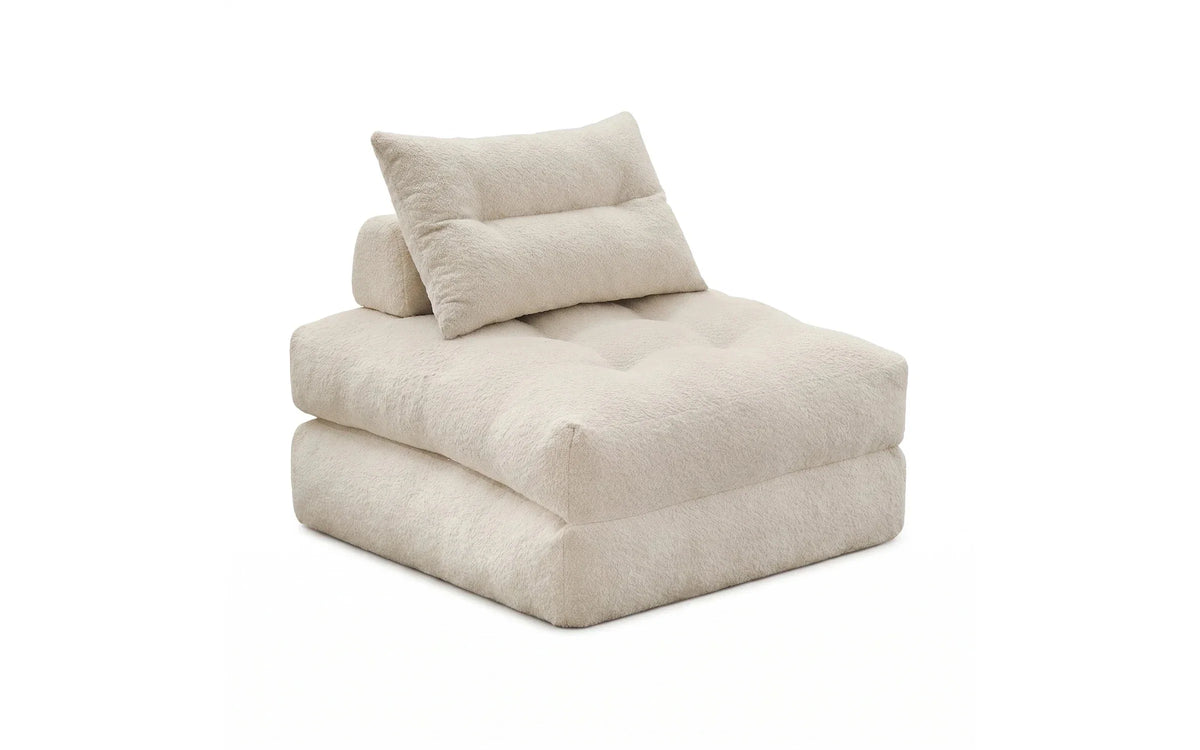
The product photo used with this guide shows the model’s folded form, but it cannot reveal a hidden layer stack or prove foam identity. Monvane’s Materials & Durability guidance also notes that cushioning construction and feel can differ by model and variant, so the selected product specification controls the purchase decision.
If the exact memory-foam identity, layer thickness, panel coverage, or supporting core is decisive and not published, send those fields as one written question through the Monvane Support Center. Do not convert a missing answer into a positive claim. Support can provide an escalation route; this guide does not promise what the answer will be.
Choose from evidence, not the material label
| Outcome | Use it when | Next action |
|---|---|---|
| Choose | The exact viscoelastic layer, its panel coverage, thickness or support, and both intended states are sufficiently documented. | Compare the confirmed build with room fit, care, and applicable store terms. |
| Clarify | A decisive material or construction field is missing. | Unknown material is a clarification task, not a positive memory-foam verdict. Ask for written exact-model confirmation. |
| Compare | The claim remains generic, or the confirmed response does not suit the intended use. | Compare another documented build rather than rationalizing the gap. |
Choose, clarify, and compare are Monvane editorial outcomes—not product certification or a comfort guarantee. The safest conclusion is conditional: consider a memory foam sofa bed when the exact layer is documented across the relevant panels, the support below it is clear, and both seating and sleeping states work for the intended routine. Otherwise, resolve the missing field or compare a better-documented construction.
Sources and scope
General foam definitions and property boundaries were checked against the Polyurethane Foam Association’s viscoelastic foam technical bulletin and foam performance guidance. Certification scope was checked against current CertiPUR-US FAQs, program rules, and directory. Monvane product, material, and support wording was checked on August 18, 2026. Editorial diagrams explain how to organize a buying decision; they do not disclose concealed construction or replace the exact product specification.