


Couch Moving
How to Move a Couch Safely: Step-by-Step Guide
A step-by-step guide to moving a couch safely: define the exact unit, screen the route, assign one caller and stop whenever control changes.
On this page
To move a couch safely, do not start with a lift. This step-by-step guide starts here: identify the exact moving unit, walk the complete route, choose suitable rated equipment and capable help, assign one caller, and prepare stable set-down points. Use qualified movers when the load cannot be grasped or seen around, the route or stairs cannot be controlled, product instructions are missing, or the team cannot complete a brief test lift without strain, shifting or conflicting commands. During the move, complete one stable state at a time; anyone can call STOP. Secure the load under the exact vehicle and restraint instructions, then compare the couch with its starting record before use.
Decide whether the moving unit is controllable
A couch is not approved for a household move simply because several people are available. Shape, mass distribution, handholds, fixed mechanisms, stairs, turns, equipment and each handler’s capability all affect control. OSHA and NIOSH workplace material-handling guidance supports conservative principles—clear access, suitable help or mechanical assistance, reliable grasp and reduced awkward handling—but it does not provide a household couch weight or a guaranteed helper count.
Write down the actual moving unit
Remove loose pillows, throws and accessories first. Then record whether the planned load is the whole couch or a specific part that the exact manufacturer instructions identify as owner-removable and stable on its own. A visible seam, zipper, bolt, cable, hinge or gap is not permission to separate it. If smaller units are necessary, obtain the exact model procedure before continuing; sectional owners can use the sectional separation guide for the minimum connector-specific questions.
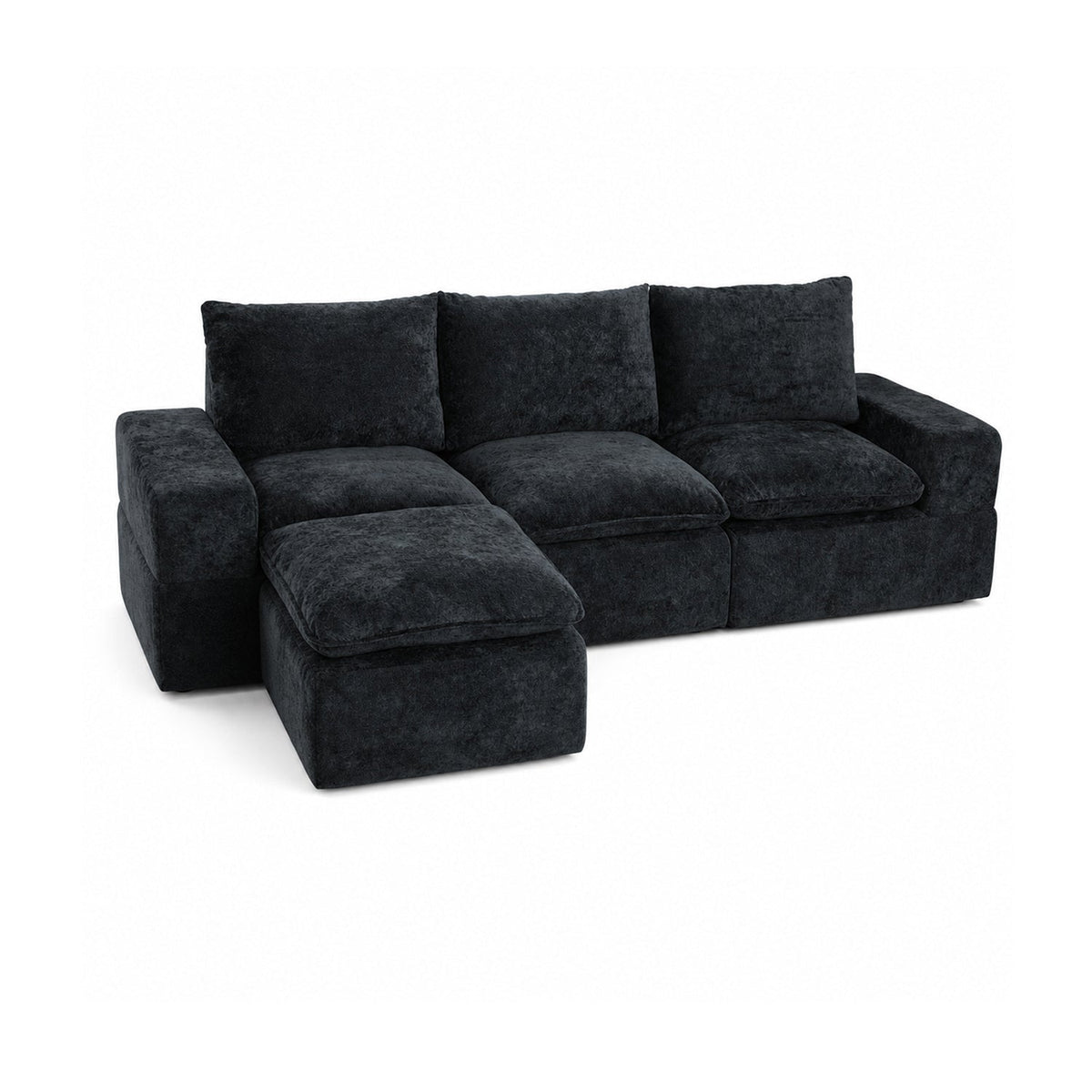
The moving unit is a planning record—not a manufacturer-approved lifting point, teardown instruction or weight assessment. Photograph every side, label any verified separate unit, and record dimensions for the actual transport orientation. Do not infer a grip or balance point from the featured image.
Choose qualified movers when the team cannot prove stable control
| Pre-move screen | Continue planning only when | Pause or use qualified help when |
|---|---|---|
| Grasp and sight line | Each handler has an exact, reliable control method and the caller can maintain a clear route view | Wrapping, couch shape or body position prevents a reliable grasp, or the load blocks the route view |
| Load behavior | A brief, low test lift remains balanced and predictable under the exact plan | The unit shifts, flexes unexpectedly, exposes a moving mechanism or cannot be set down under control |
| Route | Every opening, turn, level change, rest point and destination position has a verified plan | Any stair, landing, elevator, close turn, outdoor surface or vehicle transfer remains uncertain |
| Equipment | Each aid is suitable for the load and route, within its rating, inspected and used under its instructions | The team is improvising a dolly, ramp, strap, lift or attachment point |
| People and conditions | Handlers understand the same commands and can stop without holding the load in a disputed position | Pain, fatigue, poor lighting, wet or uneven surfaces, time pressure or building traffic reduces control |
Passing this screen does not certify the move. It only establishes whether a detailed plan can continue. Anyone with a health, mobility or lifting concern should avoid the carry and use appropriate assistance.
Build the command sheet and screen the route
Build one move-day command sheet
Keep the plan on one phone screen or printed page so the group does not reconstruct it while the couch is off the floor.
| Field | Record before moving | Not acceptable |
|---|---|---|
| Moving unit | Exact couch/model, current form, dimensions, loose items and only documented separate parts | “The sofa” with no current-state record |
| Route | Origin, usable openings, approaches, turns, level changes, rest pads, vehicle edge and final footprint | One doorway measurement |
| Control | Named caller, unconditional stop word, repeat-back commands and planned set-down response | Several people giving directions |
| Equipment | Exact aid, rating, inspection status, instructions and assigned operator | An unverified dolly, ramp or strap |
| Transport | Driver or loading professional responsible for vehicle fit, placement, restraint and final double-check | “We will tie it down later” |
| Destination | Clear staging area, approved final orientation and baseline-comparison owner | Finding a place after unloading |
If a field is unknown, the move is not ready. This command sheet is a Monvane editorial coordination tool—not professional mover training or equipment approval.
Walk the complete route with empty hands

A clear doorway is not a clear route. Start at the couch and walk to the final footprint. Confirm usable—not nominal—openings; the approach on both sides; door swing and removable-obstruction permissions; turns, landings and ceilings; stair or elevator access; lighting and surface condition; protected rest locations; the vehicle loading edge; and the destination staging area. Reserve elevators, loading zones and building access when required.
For a close doorway or turn, stop at screening and complete the exact object/opening/pivot work in the narrow-door moving guide or obtain a mover’s assessment. The empty-hand walk is a screening step; it does not prove that a close turn, stair or elevator move is controllable.
Prepare the couch without hiding the handholds
Place the couch in the exact model’s documented stable transport state. Remove loose cushions and accessories; close, lock or deactivate only the functions the current instructions explicitly cover. For a sleeper, recliner or powered couch, do not guess how a mechanism should be held closed or disconnected. If the stable state is missing, stop and obtain it.

Protection must not erase control. Use clean, material-compatible blankets or pads on likely contact surfaces under the exact mover and product plan. Secure protection without adhesive on upholstery. Keep known control zones, loose-item checks and set-down edges visible. Never route a restraint through a sleeper, recliner, wire opening, cushion gap or unknown cavity merely because it is convenient.
Inspect each dolly, ramp, strap, blanket and floor protector before use. Match the aid to the load, surface, transition and manufacturer rating; a flat-floor dolly plan does not approve stairs. Remove trip hazards rather than covering them with a loose protective layer. The protection diagram is general planning guidance; the exact upholstery, mechanism and mover instructions control.
Separate the carry into nine observable states

Complete one stable state before calling the next. The nine states are a Monvane editorial workflow—not a substitute for product, mover, equipment, vehicle or property rules.
Prepare: baseline, clear and stage
- Baseline. Photograph the couch, floor-facing edges, loose items, verified parts and current supported functions. Save the command sheet with those images.
- Clear. Close the route to unrelated traffic, remove obstacles, confirm permissions and check that the destination and planned rest pads are available.
- Stage. Position inspected aids and protection before anyone takes a load. Review each role, route segment and the stop response aloud.
Control the load: test, travel and rest
- Test. On the caller’s command, raise the unit only enough to check grasp, balance, protection and equipment behavior, then set it down. Change the plan if anything shifts or obscures control.
- Travel. Move one short, rehearsed segment at a time. Handlers follow the exact aid or mover instructions, keep the load within the planned route and turn with their feet rather than twisting under load.
- Rest. Set the unit fully on the next planned stable surface before changing grips, discussing a turn, opening a door or replacing protection. Confirm hands and feet are clear before releasing control.
Transport and close: secure, unload and verify
- Secure. The responsible driver or loading professional positions and restrains the couch under the exact vehicle, anchor and restraint instructions. NHTSA advises securing large cargo against shifting or leaving the vehicle and double-checking it before travel. Do not invent a universal couch orientation or strap pattern.
- Unload. Recheck the destination conditions before releasing restraints. Use the approved route in reverse only when its surfaces, access and staging state still match the plan.
- Verify. Set the unit in the cleared destination zone, account for every recorded part, restore only documented interfaces or functions, and compare the visible condition with the baseline before normal use.
Use one caller, while anyone can stop the move
Choose one caller who can see the next transition and is not simultaneously improvising another task. Before each action, the caller names the next state; every handler repeats the call or says they are not ready. Useful plain calls are READY, LIFT, WALK, TURN, LOWER and STOP. Do not substitute a shout, joke or countdown that the group did not agree on.
One person starts; anyone stops. STOP means stop without negotiation. If an immediate controlled set-down is possible, lower together. If the nearest planned rest requires a few controlled steps, the caller confirms that response; no one should be forced to continue when immediate set-down is necessary. Once stable, identify the changed fact—grip, wrap, path, fatigue, equipment, balance or command—and either correct the plan or end the DIY attempt.
The one-caller rule is Monvane editorial coordination advice; a qualified mover’s procedure overrides it.
Use a separate branch for stairs, elevators, vehicles and sleepers
Do not let one successful floor carry approve a different hazard.
| Condition | Required branch | Stop condition |
|---|---|---|
| Stairs, steep ramps or tight landings | Use a qualified mover or an exact professional/equipment procedure that controls slope, set-downs, sight lines and the complete unit | No stable rest, unclear role, improvised aid, blind handler or unverified landing geometry |
| Elevator | Confirm building permission, usable door/car geometry, protection rules, reservation and the mover’s loading plan | Nominal dimensions only, uncertain capacity, door timing or no destination-side staging |
| Truck, trailer or pickup | Use a vehicle that fits the couch and rating plan; the responsible loader follows exact placement, anchor, restraint and weight-distribution instructions | Excess loading, unverified anchor, makeshift restraint, movement after the first securement check or incomplete containment |
| Hide-a-bed, recliner or powered couch | Obtain the exact documented transport state, remove bedding or loose accessories, and follow the model’s power/mechanism instructions | The mechanism will not reach its documented stable state, a cable is unidentified, or the plan relies on wrapping through moving parts |
| Modular or sectional couch | Move only whole or exact model-approved stable units; label orientation and keep connectors protected rather than using them as grips | A unit flexes, a connector bears the carry load, or the separation/reconnection method is not documented |
Close the move with a condition check and recovery record
Arrival is not the completion state. The move is complete only when the visible condition, inventory, stable form and supported functions match the baseline. Keep the couch out of normal use while any difference remains unresolved.
| Observed difference | Recovery action |
|---|---|
| The test lift shifts, tilts or changes the wrap | Set down, remove the load from the aid, and change the unit, protection, equipment or professional-help decision before retrying |
| A checkpoint differs from the route walk | Return to the last stable rest, clear the condition, measure again and obtain any missing permission; do not solve it while carrying |
| A part, label or hardware bag is missing | Stop restoration and reconcile the inventory from the baseline record before normal use |
| New wobble, sound, tear, frame gap, damaged cable or mechanism problem appears | Isolate the couch from use, photograph the change and contact the manufacturer, support team or a qualified service professional |
| The couch is stable but the final footprint blocks the room | Return it to the cleared staging zone and approve a new room layout before another carry |
The closeout is a visible condition record—not a structural, electrical, mechanism or warranty inspection. Hidden damage and technical faults require qualified evaluation.
Current Monvane delivery facts do not define a future move
The current Monvane Cushioned Modular Sofa (6 Seats) page says the model ships in two separate packages and needs no tools for its unbox, position and natural-expansion setup. Those facts describe delivery and first setup. The page reviewed for this guide does not publish the future expanded moving units, their individual weights, owner carry points or a relocation procedure.
Delivery facts are not relocation instructions. Do not assume the expanded sofa can return to its factory-compressed state, fit the original packaging or separate wherever a photo shows a line. Record the current physical object instead. For exact setup or delivery questions, use the current Monvane Support Center; its page also reminds owners to measure rooms, doorways, stairways and elevator clearance.
Sources and limits
Current product and support facts were checked August 18, 2026. General bulky-load controls were checked against the NIOSH Ergonomic Guidelines for Manual Material Handling, the OSHA materials-handling guide and the current OSHA heavy-lifting eTool. Vehicle containment guidance was checked against NHTSA’s secure-load page. These workplace and road-safety sources supply conservative risk controls; they do not establish a household safe couch weight, helper count, lifting-point map, stair method or injury guarantee.
To move a couch safely, finish the planning before the lifting: define the exact unit, approve the complete route, equipment and control plan, move through observable stable states, secure transport under the exact rules, and close against the baseline. When any required fact remains guessed, change the plan or use qualified help.