

Buying Guides
What Size Throw Pillows for a Sofa? A Measurement-First Guide
Start with 18- or 20-inch squares, then use full-size paper templates and a seated test to choose the size and count that fit your exact sofa.

On this page
For a measurement-first guide to what size throw pillows fit a sofa, start with an 18- or 20-inch square. Try an 18-inch square when the back is visibly low or the corner is narrow; compare 22–24 inches only as a larger rear layer on a tall or deep sofa. A 16-inch square can be added as a Monvane editorial small-corner test, but it is not one of the square sizes established by the current retailer pages cited below. These are starting points, not fixed rules. The correct size is the one that fits the exact sofa and leaves its required sitting positions usable.
Measure three fields on the exact sofa
Overall sofa width is not enough. A pillow lives at the intersection of the back, arm and seat, so a useful record separates three fields. Keep the sofa in its normal configuration, including fixed back cushions, and measure the back field, corner field and occupied seat separately.

- Visible back height: measure from the top of the seat cushion, where the pillow will rest, to the top of the visible back. Do not measure from the floor or through a fixed cushion.
- Available corner width: measure from the inner arm/back corner to the point where the next sitter’s normal zone begins. On an armless sofa, use the intended outer placement rather than inventing an arm boundary.
- Remaining occupied depth: after a pillow or bulk proxy is placed against the back, check the usable seat from its front edge to the new support surface. The listed seat depth cannot tell you how much a filled throw pillow will take away.
The three-field method is a Monvane editorial sizing aid; the filled pillow and regular sitter still control the result. If the pillow is meant to provide functional body support rather than decoration, test that need separately and do not treat a size chart as ergonomic advice.
Choose the first template from the sofa, not its label
Use current square sizes as market anchors
Current US retailers sell several neighboring dimensions rather than one universal sofa size. Pottery Barn currently offers square inserts in 18, 20, 22, 24 and 26 inches. IKEA’s current US cover assortment highlights 20-by-20, 26-by-26 and 16-by-23-inch options. Those menus establish real candidates to test; they do not decide which one fits your sofa.

Turn the size ladder into a sofa test
| Square to test | Useful first situation | Move down when | Move up when |
|---|---|---|---|
| 16–18 inches | Low back, narrow arm corner, small accent or a second front layer; 16 inches is an editorial test option | The face still covers the sitter’s working zone | It looks detached from the back and the next larger template still leaves the seat open |
| 18–20 inches | First test for many two- and three-seat sofas | The pillow crosses the corner boundary or pushes a regular sitter forward | The back is tall or deep enough that the face looks underscaled after the seated test |
| 22–24 inches | Large rear layer on a tall-back, deep or oversized sofa | It consumes sitting depth, traps the arm or has to move every time someone sits | Do not move up automatically; 26 inches is another market option, not a required next step |
Treat 16 through 24 inches as a test ladder, not a rank. The 18-, 20-, 22-, and 24-inch square steps correspond to current square-product examples; the 16-inch square is a deliberately smaller editorial template to test in a constrained corner. Larger does not mean more luxurious, and smaller does not mean safer. The ladder is a Monvane editorial test menu—not a universal sofa-pillow standard or a claim that every size is stocked by the cited retailers.
Add a lumbar only after the rear square passes
A lumbar changes width and bulk, not only shape. Current retail examples include roughly 14-by-20, 16-by-23 and 16-by-26-inch faces. The shorter shape can create a front accent without repeating another full square, but it still occupies the sitter’s back or arm zone.
Place the rear square first. Then cut the lumbar face at its full labeled width and height and position it where the finished pillow would sit. A wide lumbar that bridges two seats may work for a solo lounging setup but fail a two-person conversation setup. A compact lumbar can still be too thick if it pushes the sitter forward. Width, height and projection need separate checks.
Velvet, chenille, linen and other cover materials do not receive different face-size rules in this guide. Material changes appearance and drape; it does not remove the need to test the exact dimensions and filled bulk.
Run the full-size template test
A screen mockup is not a full-size test. The sofa photo may be resized, cropped or shot from an angle, and the product card on your phone cannot preserve physical inches. Use inexpensive paper, cardboard, painter’s tape and a known household cushion or folded towel.
- Cut the face. Make an 18- or 20-inch square first. If you are comparing sizes, cut the second face rather than drawing a smaller square inside the first; overlapping outlines are harder to read at the corner.
- Place the bottom edge. Rest the template where the filled pillow will meet the seat and angle it as intended. Do not float it against the back to make it appear smaller.
- Check the three fields. Confirm that the face fits the visible back, stays inside the intended corner and does not cross into a protected sitting zone.
- Add approximate bulk. Put a folded towel, an existing pillow or another soft object behind the template. This does not reproduce the purchased fill; it exposes the missing third dimension.
- Sit, reach and reset. Have the regular user sit normally, use the arm or side table, stand up and restore the arrangement. Mark the result reduce, keep or enlarge, then test only the neighboring size.
The paper-and-bulk test is an approximation; it screens scale and seat intrusion but cannot reproduce the finished pillow. It also cannot predict compression, support, texture or drape. If two neighboring sizes pass, choose based on the intended visual layer and the easier daily reset—not an online rule.
Set the count after the size passes
Count usable sitting zones before you count pillows. Start with two outer anchors on a typical two- or three-seat sofa. Add one smaller square or lumbar only when it has a named support, bridge or accent job and the required seats remain usable. This is a Monvane editorial everyday-use rule; display styling may use a different count.
| Sofa situation | First size/count test | Passing condition |
|---|---|---|
| Two-seat sofa or loveseat used by two people | One 16–20-inch candidate at each outer corner | Both people can sit without moving a pillow; add a center piece only if both positions still work |
| Three-seat sofa | Two 18- or 20-inch outer anchors; optional smaller third piece | The center and both outer sitting zones remain available for the household’s normal use |
| Deep or large sectional | One passing anchor at each used outer arm; test 20 against 22/24 only at selected rear positions | The high-use corner and normal routes onto the sofa remain open |
| Dominant solo reading position | One rear square plus an optional lumbar at that position | The second position or guest state can be restored without storing a pile of pillows |
For a sectional, do not multiply the pillow count by the marketed module or seat count. Some modules form one continuous sitting zone; a corner can already have fixed back support; and a chaise may need clear length more than another decorative layer.
Match the cover and insert as a pair
Cover size and insert size are two separate purchase fields. Remove the insert and measure an existing cover flat, seam to seam; a stuffed pillow’s curved face is not the same measurement. Then record the intended insert’s labeled dimensions, fill type and the exact maker’s compatibility instruction.
Do not apply one universal “always size up” rule. IKEA currently sells several covers and inserts under the same nominal dimensions, while Pottery Barn gives exact insert guidance for named covers in its current product records. Cover-to-insert fit is product-specific; the named maker's dimensions and instructions override generic internet rules. If a listing does not state whether a dimension belongs to the cover or the insert, ask before ordering or choose a better-documented pair.
Use a styled photo for placement, not dimensions
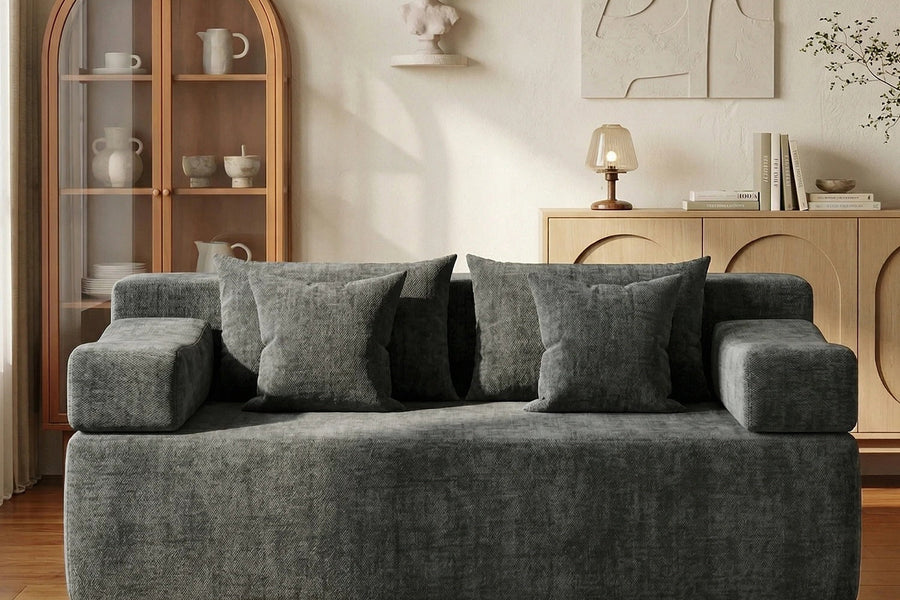
The current Monvane 8-Seat U-Shaped Couch (Chenille) page lists a 27.56-inch seat depth, 10-inch armrests and eight modular units. The exact-family featured scene visibly places matching square cushions at outer arms and selected inner positions. The photo shows a placement pattern; it does not publish a pillow size.
No exact decorative-cushion dimension appears in the current visible specification record reviewed for this guide. Do not convert pixels into inches, assume every cushion shown is included or transfer its apparent scale to another configuration. The sofa dimensions are valid context for making templates; they cannot fill the missing pillow field.
Use a styled scene to decide which corners you want to test, then use labeled pillow dimensions and the physical sofa to approve scale.
Sources and scope
Current size examples were rechecked September 8, 2026 on the IKEA US cushion-cover category and the Pottery Barn square-insert page. The cited pages support square examples beginning at 18 inches and lumbar examples with a 16-inch side; they do not establish a 16-inch square. The Monvane product record and exact-family imagery were also rechecked. Retail assortments can change. The 16-inch square template, size ladder, three-field method, starting sizes, count rule and template test are bounded Monvane editorial guidance—not universal design standards, product compatibility, ergonomic support or comfort guarantees.
Finish with a purchase-ready size record
Before ordering, save one line for each pillow: intended position, face size, square or lumbar shape, full-size template result, remaining sitting zone, cover dimensions, insert dimensions and maker compatibility. Keep a photo of the passing physical setup beside that record.
Choose the smallest set that completes the intended visual or support jobs without making regular users rebuild the sofa. If the template fits but the bulk proxy fails, reduce the face or test a different construction; do not approve the size from the flat outline alone. If the cover and insert relationship is unclear, pause the purchase rather than guessing.
For throw pillows on a sofa, the measurement-first answer is conditional: begin with an 18- or 20-inch square, then let the exact sofa measurements and seated test choose the final size.