

Buying Guides
One-Cushion Loveseat: Comfort Factors and Buying Checklist
A one-cushion loveseat gives both seating positions one continuous surface. Decide from shared-seat response, body fit, construction, care, rotation and replacement evidence—not cushion count alone.

On this page
A one-cushion loveseat can be a good choice when the intended users want one continuous seat surface and the exact loveseat passes a two-person trial. It is not automatically more comfortable than a loveseat with two seat cushions. Cushion count alone cannot tell you whether the loveseat will feel comfortable, fit your bodies, transfer movement or permit the full-width unit to be cleaned, rotated or replaced. Use the checklist below to approve the exact loveseat only after both comfort and ownership questions are resolved.
Define one cushion before judging it
In this guide, “one cushion” means one visible continuous seat surface; it is a practical retail description, not an industry-wide construction standard. You may also see terms such as bench cushion, bench seat or single seat cushion. The useful identification question is whether one continuous seat surface spans the two advertised seating positions.
That description does not tell you whether the seat is a loose cushion, an attached cushion or an upholstered surface integrated into the loveseat. It also does not identify the fill. On the current PB Comfort Roll Arm product page, for example, “Bench Cushion” versus “2 Cushions” is one selector, while “Memory Foam” versus “Down Blend” is a separate fill selector. That exact example shows why segmentation and fill belong in different fields; it does not transfer Pottery Barn construction or performance to a Monvane loveseat.
Before comparing comfort, save the exact product name, upholstery choice, configuration, product URL and date checked. If a listing uses only a styled photograph, ask the seller to state the seat architecture in writing. A photograph can establish a visible line or continuous surface, but it cannot reveal every internal or service-related detail.
Separate seat topology from comfort evidence
A one-cushion label describes segmentation—not fill, firmness or attachment. Use the label to identify the visible layout, then collect the evidence that actually controls sitting and ownership.
| Field | What one continuous surface can establish | What still needs exact-product evidence |
|---|---|---|
| Seat topology | No visible center division across the advertised seating positions | Whether there is a hidden structural division or more than one internal component |
| Feel | Nothing by itself | Fill, firmness, layers, tufting response and support beneath the seat |
| Fit | One uninterrupted surface may permit center sitting | Usable width, seat depth, seat height, back reach and edge response for the intended users |
| Movement | Two people share the visible surface | How the exact seat reacts when either person sits, shifts or stands |
| Ownership | The maintained unit may span the full seating width | Attachment, cover removal, permitted rotation, care method and replacement path |

A product photograph can confirm a visible continuous surface, but not whether the cushion is loose, removable, reversible or replaceable. Do not turn a missing center seam into a claim about softness, support, durability or quality. Those questions require their own specifications, trial or written answer.
Match the surface to the users
Start with the routine that actually uses the middle of the loveseat. A continuous seat may deserve a closer look when someone regularly sits near the center, a child sits between two adults, or the household simply dislikes a center boundary. The relevant benefit is the uninterrupted surface—not a guaranteed comfort improvement.
A split-seat loveseat may deserve priority when each person wants a clearly separate seating zone or when the household requires independent cushion handling. Separate units can make sense if the exact product allows one seat cushion to be rotated, cleaned or replaced on its own. Do not assume those actions are permitted merely because a center line is visible; confirm them for that product too.
Households with a large difference in body size or sitting style should pay particular attention to shared response. One person sitting cross-legged while the other sits upright, or one person shifting frequently while the other reads, can expose an interaction that an empty product photo will never show. These are shopping priorities, not predictions of personal comfort or long-term wear.
Check the variables cushion count cannot answer
The cushion count cannot tell you where a user's back, feet or knees will land. Keep the overall room-fit measurements separate from the following sitting fields, and test the exact loveseat whenever the return or showroom conditions permit.
| Variable | What to record | Observable question |
|---|---|---|
| Usable seat width | Space inside the arms or edges, including the center position | Can both intended users sit normally without crowding? |
| Seat depth | Front edge to the point where the back cushion begins | Can each user reach the back without an unwanted knee-edge conflict? |
| Seat height | Floor to the top of the settled seat | Can each user sit down and stand up comfortably during the trial? |
| Fill and support | Published fill or layer description plus the support beneath it | Does the exact seat give the intended feel in the center and at both edges? |
| Surface construction | Tufting, seams, crown and attachment stated by the seller | Do those features create pressure or movement the users dislike? |
Use dimensions to prepare the trial, not to predict the result. Two loveseats can publish similar seat depth and height yet respond differently because their fill, support, back angle and surface construction differ. Likewise, a tufted surface may look structured without establishing its firmness or the way it will feel to a particular person.
Run the two-person shared-cushion test
Test the center and both edges before two people sit together. Use the two people who will most often share the loveseat, normal clothing and normal sitting positions. The shared-cushion test is Monvane editorial guidance, not a standardized comfort or durability test.
- Center: One person sits in the middle long enough to notice back reach, knee position, edge support and any tufting pressure.
- Edges: Each person tries both normal seating sides separately. Record whether one edge feels different and whether either user needs to perch or slide forward.
- Together: Both users take their normal positions. Check usable width, shoulder space and whether either person moves toward the center or outside edge.
- Shift: One person changes position as they normally would. The other reports whether the shared surface moves enough to interrupt their preferred posture or activity.
- Exit: One person stands while the other remains seated. Observe whether the remaining user is pulled, tipped or forced to reset.
- Recover: After both stand, observe the surface during the available trial period. Record what you can see, but do not treat a short recovery observation as a prediction of long-term wear.

Write separate notes for each user instead of averaging the response into “comfortable.” A pass means both people accept the same exact seat during their normal shared routine. If either person cannot reach the back, dislikes the center or edge response, or is repeatedly disturbed when the other moves, that is an observable mismatch—not a problem that the one-cushion label can solve.
Record serviceability before buying
Attachment state is the first ownership question. Classify the exact seat as loose, attached or integrated only when the product page, manual or seller confirms it. A long cushion is not automatically removable, reversible or replaceable. Never unzip, pull, flip, rotate, wash, cut or refill a seat unless the exact instructions authorize that action.

Create one record with five fields:
- Attachment: Is the full-width seat loose, attached or integrated, and what handling is allowed?
- Cover: Is any seat cover removable? If so, which component, by what method and under which cleaning instructions?
- Rotation: May the seat be turned end to end or flipped? Record “not permitted” or “unknown” rather than inventing a routine.
- Care: What exact cleaner, tool, moisture level and drying process are permitted for the selected upholstery?
- Replacement: Can the full seat, its cover or another named component be ordered for the exact model and upholstery? Record the part identity and measuring method.
The five-field serviceability record is an editorial buying aid; the exact product instructions and written support response control permitted care and replacement. If a decisive field is absent, contact the Monvane Support Center with the exact product URL and variant. A full-width unit may affect more of the seating area when service is needed, so an undocumented replacement path deserves a pause rather than a hopeful assumption.
Read the current Monvane example without filling the gaps
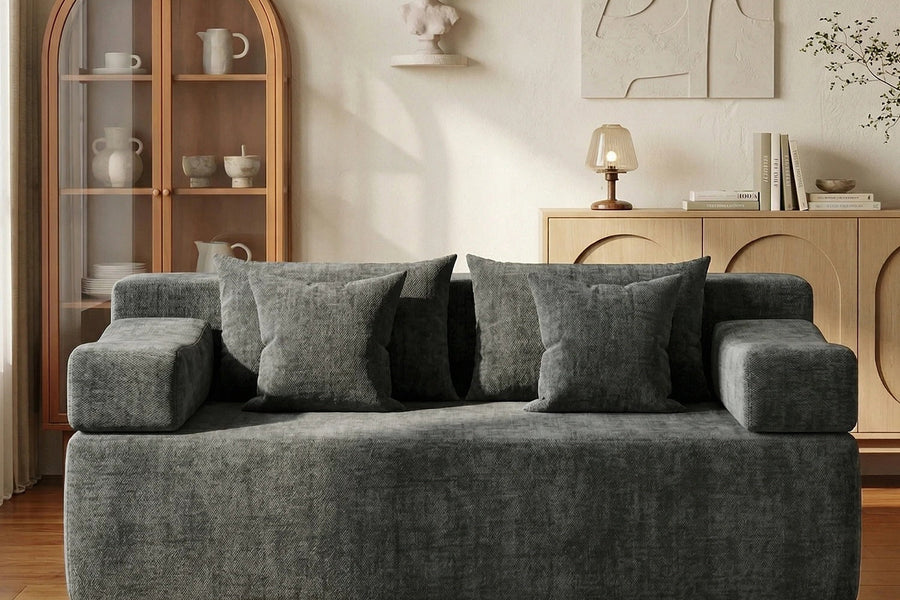
The current Monvane Convertible Loveseat page publishes a 43.3-inch overall depth, 33.5-inch overall height, 26-inch seat depth and 15.75-inch seat height. Its width records conflict: the dimension line gives 69.3 inches, while a separate “Overall Width” field gives 70 inches. Confirm the correct endpoint with Monvane before using either width for room fit. The page also lists 30D foam, chenille upholstery, a boneless and glue-free structure, spot cleaning and 48-hour expansion guidance. Its current exact product image visibly shows one continuous tufted seat surface.
Those fields can support identification, fit preparation and the care record. They do not complete the buying checklist. The current Monvane page does not label that seat removable, reversible or replaceable. It also does not turn the visible continuous surface into a promise about shared response or personal comfort.
For contrast, the current Loveseat Sofa (2 Seater) page identifies a 75-inch, two-seat, 30D-foam boneless loveseat, and the matched product-family asset used above visibly shows a center boundary between two seat units. That comparison is limited to visible topology. It does not establish that either loveseat has independently removable cushions, transfers less movement or will suit a particular household better.
Use a conditional verdict
| Decision | Required condition | Next action |
|---|---|---|
| Approve | Both users pass body fit and all six shared-response states; every decisive serviceability field is documented and acceptable | Save the exact product record, trial notes, instructions and return terms |
| Pause | The trial passes, but attachment, cover, rotation, care or replacement evidence remains missing or conflicting | Request an exact written answer, then update the record before ordering |
| Reject | Either user fails body fit or shared response, or a confirmed care or replacement limit conflicts with the household routine | Change the exact loveseat or compare a different seat topology; do not override the failure with a category label |
Pause when the trial passes but an ownership field remains undocumented. Reject when the exact seat produces an observable mismatch or a confirmed maintenance limit the household cannot accept. The verdict applies only to the exact loveseat, users and routine tested; it is not a category-wide comfort ranking.
Complete the one-cushion loveseat checklist
Approve the exact loveseat only when all of the following are complete:
- The product name, upholstery, configuration, URL and check date are fixed.
- One continuous visible seat surface is confirmed without assuming hidden construction.
- Both intended users accept usable width, seat depth, seat height, back reach, center and edge response.
- The pair passes the together, shift, exit and recovery observations during a permitted trial.
- Attachment, cover removal, rotation, care and replacement are documented for the exact product.
- Any missing decisive answer has been resolved in writing, and the current return terms fit the planned evaluation.
A one-cushion loveseat is therefore neither a universal upgrade nor a warning sign. It is one seat topology with a distinct shared-use and full-width ownership question. Begin with the current Monvane loveseat range, keep the exact-product record beside you, and choose the model that passes for both users without asking cushion count to prove more than it can.
Sources and scope: Current first-party pages for the Monvane Convertible Loveseat, Monvane Loveseat Sofa (2 Seater), Monvane Support Center and Pottery Barn PB Comfort Roll Arm were rechecked September 8, 2026. The conflicting 69.3- and 70-inch width fields are reported rather than reconciled. The terminology boundary also considered the current official Article Sven loveseat page, which describes its exact product as a tufted benchseat while listing fill separately. The topology table, shared-cushion test, serviceability record and verdict rules are Monvane editorial shopping tools—not industry standards, laboratory tests, medical guidance, durability forecasts or product guarantees.