

Chaise Lounge
Corner Chaise Lounge: Make the Corner Earn Its Footprint
A corner chaise is practical when one repeatable lounge job earns the extended footprint without breaking approach, exit, table, window or cleaning access. Compare it with the best realistic use of the same corner.
On this page
A corner chaise lounge is an extended sofa seat placed at the end of a run so one person can support their legs while using the room corner as a boundary. It is practical when that lounge job happens often and the projection does not block entry, table access, windows or the main route. The decision is a space exchange: one dedicated posture in return for a longer, less flexible footprint.
Fast decision: name the chaise’s regular resident and routine, tape the exact return, enter and exit while another person stays seated, reach the intended surface, service the wall/window, then compare the same corner left open or furnished differently.
What a corner chaise lounge is—and is not
A chaise seat has an extended platform supporting more of the legs than a standard sofa seat. A corner chaise usually sits at one end of a sofa or sectional near two meeting walls. The phrase can also describe a standalone chaise placed in a corner, so product pages and room plans must show the exact configuration.
Do not treat “corner,” “chaise,” “L-shaped” and “reversible” as synonyms. An L shape may use a standard return with a back; a chaise may be backless or partially backed along the projection; a reversible chaise must have a verified method for changing sides. This guide asks whether a fixed corner-chaise function earns the corner.
Audit the corner-chaise space exchange

List gains and costs in observable terms. “Cozy” is not a gain; “one person can read for an hour with legs supported and reach the table” is. “Large” is not a cost; “the main route narrows and the window cannot be reached” is.
| Exchange item | Pass evidence | Fail signal |
|---|---|---|
| Resident | A regular user and routine are named | The chaise is for an undefined future guest |
| Posture | Back, legs and preferred orientation work together | User twists toward screen or conversation |
| Entry/exit | Resident can enter and leave without displacing others | One person climbs past a table or seated person |
| Reach | A safe surface is available from the lounge posture | Drinks or controls sit on the upholstery |
| Service | Window, outlet, curtain and cleaning access remain workable | The entire configuration must move for routine access |
Choose the side from behavior, not the product photo
Stand where the sofa user will approach, then trace entry, preferred view, conversation direction, table reach and exit. Repeat from the other side. A visually balanced chaise can be behaviorally backwards when the user always turns away from the screen or blocks the only open approach.
Confirm how the seller defines left and right. Some descriptions use the viewer’s perspective; others use the seated user’s perspective. Use a marked floor plan, product diagram and final SKU/configuration rather than relying on the word alone.
Give the corner three zones
Contact zone
This is the body-and-furniture area: usable seat, leg platform, arms, back cushions and the posture transition. Test upright, reclined, side-sit and stand-up only when those are real routines.
Service halo
This is the space needed to reach curtains, windows, outlets, wall controls, floor edges and movable cushions. It may be occupied briefly rather than kept empty, but the household needs a repeatable access method.
Circulation seam
This is the boundary where the chaise meets the rest of the room. Test the narrowest point with the coffee table and ottoman in their daily positions, not removed for the demonstration.
If a household member uses a mobility device or requires an accessible route, plan from that person’s actual maneuvering needs and applicable requirements. The U.S. Access Board’s guide to accessible routes distinguishes continuous clear width from additional space at turns; it is useful evidence that one straight gap does not prove a usable route. ADA scoping does not automatically set the requirement for every private living room.
Compare four uses of the same corner

Tape and operate four realistic states for at least one routine. An open corner may preserve a route or play area. A chair and table create independent seating. A floating sofa can keep wall and window access. The chaise creates dedicated leg support. Score the corner by repeated use, not staging.
Run the corner-resident test
- Approach while another person occupies the nearest standard seat.
- Sit upright without using the chaise as a step or storage platform.
- Move into the intended lounge posture and orient to the screen, view or conversation.
- Reach the actual table, light control and personal items.
- Exit while the other sitter remains in place.
- Return blankets, pillows and table to the daily state.
Record pass, adjustment or failure. A tray, approved pillow or small table move can be an adjustment when the household will repeat it. If the chaise works only in a staged room with no table and no other sitter, it has not passed.
Measure the decision envelope
Collect the full long run, maximum chaise projection, arm/back thickness, usable seat area and configuration orientation. Add the table, rug, door arcs and service halo. Measure delivery separately. Exact dimension definitions and tape-plan math belong to the full L-shaped dimensions task; here, measurements answer one question: can the corner operate?
The maximum projection matters more than the outline seen from above because pillows, arms or a rounded edge may change where the body and route meet. Use the current product diagram and selected configuration.
Check the inside corner and transition seat
The seat where the sofa run meets the chaise can be valuable, awkward or effectively a transition. Test whether a person can use it without fighting cushion seams, another person’s legs or an arm position. Do not add it to usable capacity until a repeatable posture passes.
Also test whether two people can use the standard seat and chaise simultaneously. The chaise should not quietly consume knee room, the only arm or the only table position from the adjacent seat.
Inspect support, surface and stability evidence
Ask for exact upholstery, cushion/support construction, care instructions, module identity and the method that keeps the chaise relationship stable. A soft surface does not prove posture support. A modular appearance does not prove the chaise changes sides.
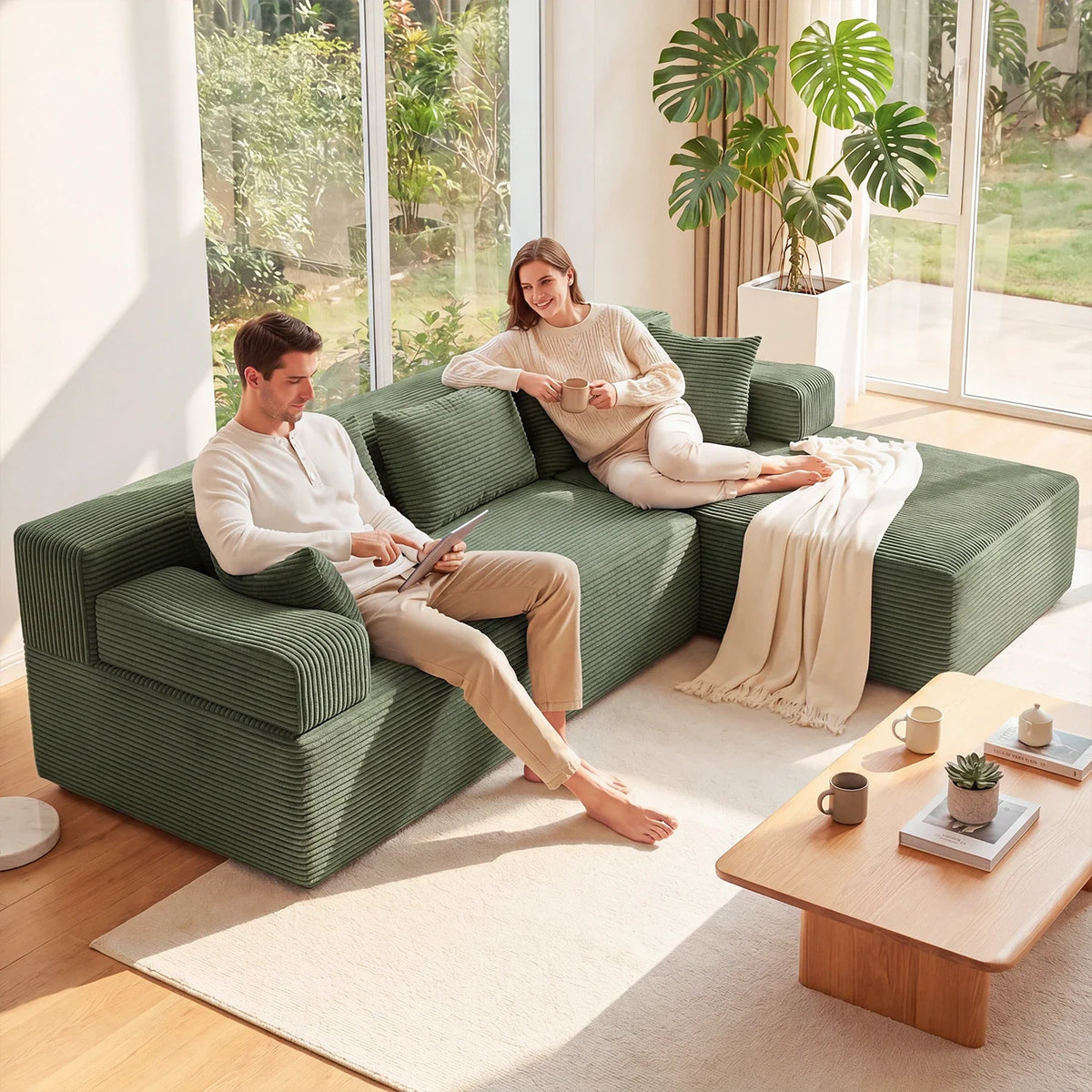
The supplied featured image is filed with Monvane’s L-Shaped Sectional Couch (Corduroy) archive and visibly shows two adults using the green sofa: one upright on the long run and one curled on the extended right side from the viewer’s perspective. It demonstrates two distinct posture zones, not product handedness, reversible construction or fit. Verify the current selected configuration on the named product page.
When a corner chaise is the wrong exchange
- No regular user wants the extended posture.
- The projection blocks the main route, balcony door or repeated service task.
- The preferred view makes the resident twist across the body.
- A chair and ottoman support unequal preferences with less permanent floor cost.
- The chaise steals the only useful table relationship from adjacent seats.
- The household needs genuine side-changing ability but the exact product is fixed.
Corner chaise lounge questions
Is a corner chaise the same as an L-shaped sectional?
No. A chaise is an extended leg-support seat; an L shape describes the overall plan. An L-shaped return may contain standard seats rather than a chaise.
Which side should the chaise be on?
Choose the side that passes entry, view, conversation, reach, exit and service tests. Confirm the seller’s orientation convention before ordering.
Does a corner chaise add a full seat?
Only if a repeatable posture works without conflicting with the adjacent user. Test usable capacity rather than counting the platform outline.
Can I put a chaise against a window?
Only when the exact height, sunlight/material guidance, curtain movement, outlet access and cleaning method all work for that window zone.
Is a reversible chaise always better?
No. Reversibility is valuable only when both states are verified, stable and likely to be used. A fixed state can be simpler when the room will not change.
Let the corner earn the chaise
Keep the corner chaise when its resident, posture and frequency are clear; both users can enter and exit; table and service access work; and no realistic alternative provides more value with less disruption. Keep the exchange ledger with the floor plan.
After the corner passes, compare current L layouts in Monvane’s L-Shaped Modular Couch collection and recheck the exact return orientation before preparing an order.