

Buying Guide
How to Choose a Cozy Couch That Fits the Way You Sit
A cozy couch is not simply the softest one. It is a seat whose depth, height, cushion response and adjustability fit the people, postures and session lengths in your home. Build a comfort brief, compare a known seat, run the ten-minute test and protect the household’s lowest score before buying.
On this page
A cozy couch is not automatically the softest or deepest couch. It is the one that lets the intended people hold their intended postures without constantly searching for a pillow, sliding forward or avoiding a difficult seat. Judge four separate jobs—posture, body fit, cushion feel and adjustability—then test the weakest one.
Fast decision: write down who uses the sofa, what they do there and how long a normal session lasts. Compare seat depth and height with a sofa you already like. Then sit naturally for ten minutes and give every regular user five fit scores. A zero is a redesign signal, not a number to average away.
Start with a comfort brief, not a softness adjective
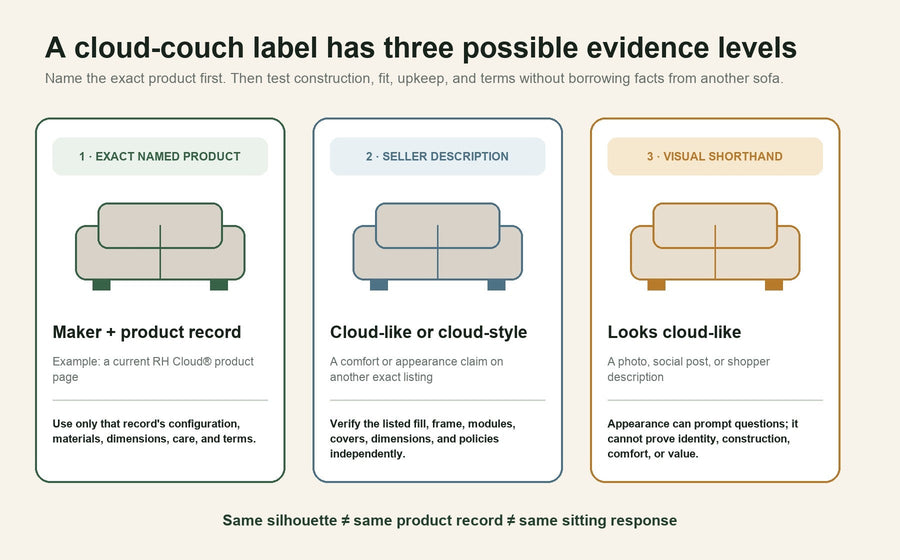
“Cozy,” “plush,” “cloud-like” and “supportive” describe impressions. They do not tell you whether a seat works for movie nights, upright conversation, reading, laptop use or getting up repeatedly. Before looking at products, complete this one-sentence brief:
We need a couch mainly for [activity], used by [people], for about [session length], with [upright / mixed / lounge] posture.
A household may have more than one answer. Name the hardest person or situation to fit: the shorter sitter who wants back contact, the taller sitter who wants thigh support, the family member who dislikes a low rise, or the reader who needs a stable arm. This prevents the most photogenic preference from becoming the only design requirement.
This guide evaluates comfort fit. It does not rank the best sofa overall, diagnose pain, prescribe a medical seat or compare every upholstery material and price tier. Those are separate decisions.
Comfort has four separate jobs

1. Posture: decide what the seat must make easy
Watch how people sit when they stop posing. Upright sitters tend to use the back and floor as reference points. Loungers may tuck a leg, turn sideways or use an ottoman. Mixed users change positions through a long session. There is no moral winner; there is only a match or mismatch between the sofa and the behavior.
2. Fit: check contact, not an isolated dimension
Seat depth matters because it changes where the back, thighs, knees and feet can settle. Seat height changes the entry and exit experience. Back-cushion thickness changes the usable depth, so two sofas with the same published seat depth can fit differently. Arm height and firmness also matter if someone actually leans on the arm or uses it while standing.
Research on seating in aged care provides a useful boundary warning, not a universal household rule: participants and experts often preferred higher chairs for easier exit, while seats that were too deep could prevent some residents from reaching the floor comfortably. The study’s population was aged-care residents, so use the result to justify personal testing—not to declare one dimension correct for everyone.
3. Feel: separate first-touch softness from deeper support
The first inch of compression produces the surface impression. The way the cushion pushes back farther into the sit affects whether the user feels held or keeps sinking. A seat can feel soft on top and still resist deeper compression; another can feel firm at first yet lack the response a heavier sitter expects. Test the full sitting period and position changes, not one hand press.
4. Control: count the ways the setup can change
Loose back pillows can shorten usable depth for one person and move away for another. An ottoman can turn an upright seat into a lounge seat. A modular arrangement may give different household members different positions. These controls have value only when you plan and test them; a pillow that is always in the way is clutter, not adjustability.
Match the seat to your dominant sitting mode
| Dominant mode | What to observe | Likely mismatch signal | Adjustment to test |
|---|---|---|---|
| Upright conversation or reading | Back reaches support while legs settle naturally; head does not have to chase the backrest | Sitter perches at the front or stacks several pillows | Thicker back pillow, a less-deep seat or a different back angle |
| Mixed everyday use | User can shift from upright to relaxed without rebuilding the whole sofa | Only one pose feels acceptable | Loose cushions, movable ottoman or separate seat positions |
| Lounging, curling up or movie night | Enough usable depth and width for the preferred pose; table remains reachable | Feet and knees crowd the front, or the room cannot hold the lounge footprint | Chaise or ottoman rather than making every seat extra deep |
| Frequent sit-to-stand | User can approach, sit and rise with the normal method they expect to use | Rocking, repeated attempts or reliance on an unstable pillow | Different seat height, firmer edge response or a usable arm |
If a medical condition, pain, weakness or recovery need controls the decision, take measurements and product details to a qualified clinician or occupational therapist. A retail guide cannot replace an individual assessment.
Measure a sofa you already trust
Generic “ideal” ranges hide differences in body size, cushion thickness and posture. Your most useful reference is often a seat that already works. Measure it in the exact configuration you use, then record why you like it.
- Measure usable seat depth. Measure from the front edge to the front of the back support—not automatically to the frame behind a loose cushion.
- Measure unoccupied seat height. Measure from the floor to the top of the seat at the main sitting point. Note whether the front edge compresses easily when you sit.
- Record back-cushion setup. Count any lumbar or throw pillow that is required for the fit. It is part of your real configuration.
- Describe the normal pose. Feet flat, legs tucked, sideways lounge, ottoman use and laptop posture are more useful than “comfortable.”
- Note the failure point. After how many minutes do you slide, add support, feel pressure or change seats?
When shopping online, compare the candidate with this reference. Confirm whether a listed depth is overall sofa depth or usable seat depth, and ask how the measurement treats loose cushions. If the seller cannot clarify, record that as uncertainty instead of filling the gap with a guess.
Read cushion specifications without fooling yourself
Foam language is one of the easiest places to confuse measurable properties. The Polyurethane Foam Association explains that density is mass per unit volume, while firmness is commonly measured through Indentation Force Deflection. It explicitly notes that firmness is independent of density. Its support factor is another measurement based on how the foam responds at deeper compression.
That means “high-density” does not, by itself, tell you whether a couch will feel soft or firm. A product page that gives density but not firmness has disclosed one useful property, not the entire comfort answer. Ask for the fill structure, whether the cushion is layered, what surrounds the foam, whether the back and seat use different materials, and which claims are based on tests rather than adjectives.
Then return to the body test. Construction data can explain an observation and help compare products; it cannot guarantee a subjective result for every sitter.
Run a ten-minute test in your real posture
A quick showroom bounce rewards immediate softness. A more useful test follows the activity named in your comfort brief. Use the same sequence for each candidate so the comparison is fair.
- Minute 0–1: enter normally. Do not arrange your body for the salesperson or photo. Notice whether you drop, brace or reach for an arm.
- Minute 1–3: find back contact. Keep your usual foot or leg position. If you need a pillow, add one and treat it as part of the configuration.
- Minute 3–7: do the real activity. Read, talk, hold a laptop or adopt a movie posture. Check table reach and whether your shoulders keep working to hold position.
- Minute 7–9: change pose twice. A cozy couch should not trap a mixed-position user in one acceptable spot.
- Minute 9–10: stand and sit again. Use the method you would use at home. Test any arm you expect to rely on.
- After the test: name one failure. “Too soft” is vague; “my back loses contact unless I add a six-inch pillow” is actionable.
For online-only shopping, recreate the listed depth and height against a wall or firm chair using folded blankets and cushions. This does not reproduce foam behavior, but it can expose a posture or dimension mismatch before purchase. Review the current return terms separately; do not assume a comfort preference automatically qualifies for a free return.
For a household, protect the lowest score

Have each regular user score back contact, leg and foot position, pressure points, position changes and sit-to-stand. Do not start with an average. A household average of eight can still hide one person’s zero—the reason that person later avoids the sofa.
First try a specific, repeatable adjustment: change the back pillow, move the ottoman, assign a different module or test another seat height. Score the adjusted setup again. If the zero remains in a frequent use case, reject the configuration. If the adjustment works but depends on one pillow, include that pillow in the budget, dimensions, storage and daily routine.
Worked example: interpret specs without declaring universal comfort
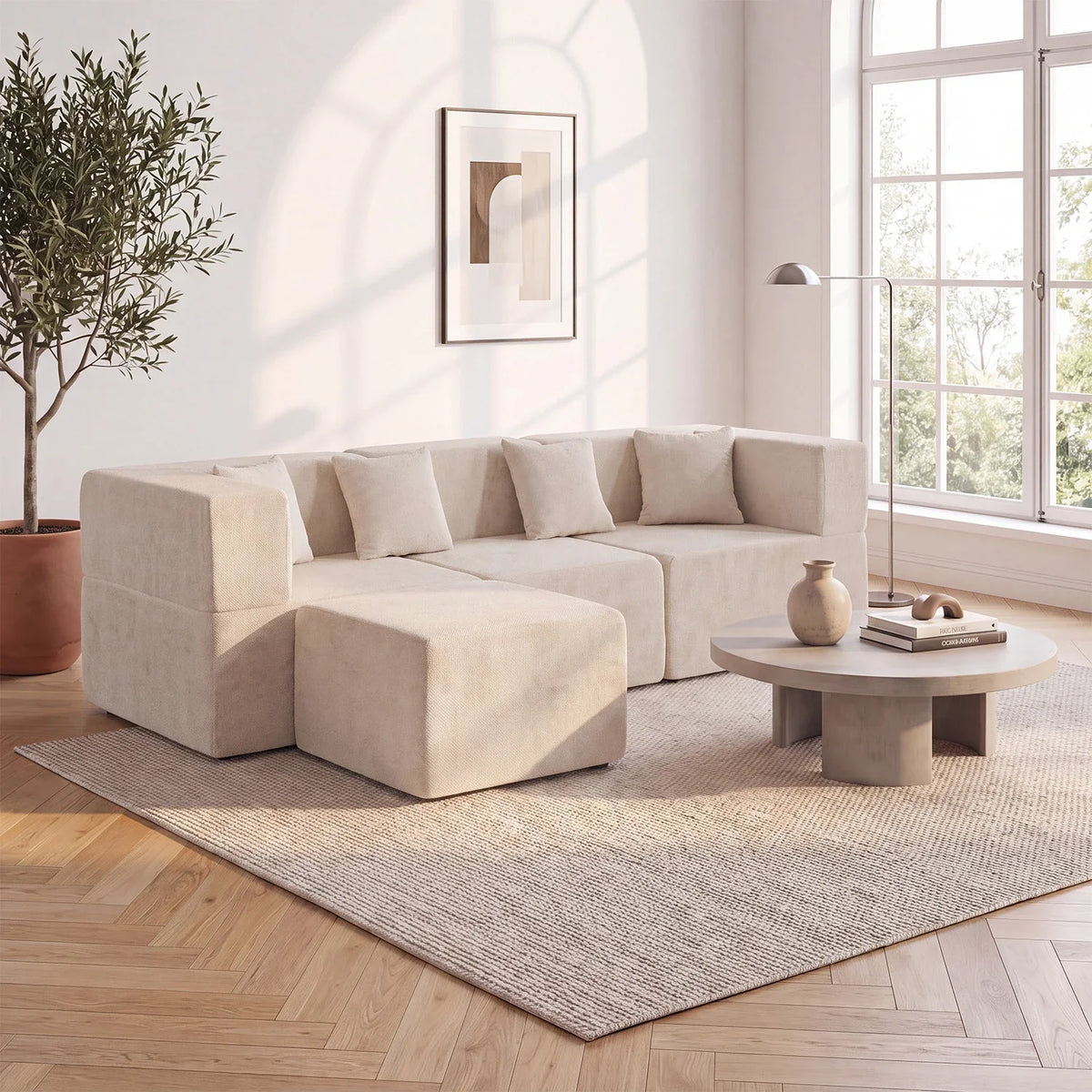
The current Monvane L-Shaped Modular Couch listing gives a 27.5-inch seat depth, 16.5-inch seat height and 30D foam identified as 1.87 lb/ft³. Those figures let a shopper build a comparison; they do not prove that every person will find the couch cozy.
A lounge-first household can compare the 27.5-inch depth with a familiar seat, then test whether loose pillows provide enough control for an upright sitter. Someone focused specifically on that measurement can use the narrower 27.5-inch deep-seat comfort guide. The current product page should still be rechecked for the selected material, configuration, care information and return terms before ordering.
Use the density as a construction fact, not a synonym for firmness. If the depth or height produces a zero in the household scorecard, the product is not rescued by a comfortable-looking photograph or a high average score.
Five reasons to reject a cozy-looking couch
- It fits a pose you rarely use. A curl-up seat may be wrong for a household that mostly talks, reads upright or stands frequently.
- The comfort depends on an unplanned pillow. If the pillow is required, specify its thickness and storage instead of treating it as decoration.
- Only the first minute feels good. Surface softness is not evidence for support through a full session.
- The lowest household score is ignored. A frequent user’s zero should trigger a new setup or a different sofa.
- The return plan is imaginary. Verify the current written policy, packaging expectations and costs that apply to the exact order.
Questions shoppers ask about cozy couches
Is a softer couch always cozier?
No. Softness describes surface feel, while comfort also depends on usable depth, height, back contact, deeper cushion response and the sitter’s activity. Test softness and support as different observations.
How can I choose a comfortable couch online?
Measure a sofa you already like, compare usable seat depth and height, recreate the candidate geometry with firm cushions, ask how measurements treat the back pillows, and verify return terms. Geometry testing cannot reproduce cushion feel, so keep that uncertainty visible.
Should everyone in the household test the sofa?
Every frequent user should test it or complete the at-home comparison. If that is impossible, collect their favorite-seat measurements and protect the person with the hardest fit rather than buying for an average body.
What cushion specification tells me firmness?
Density alone does not. Ask whether the seller provides a firmness measure such as IFD and how the full cushion is constructed. Even then, compare the complete seat because upholstery, layers and cushion geometry change the experience.
Can throw pillows fix a seat that is too deep?
A stable, correctly sized back pillow can reduce usable depth, but it becomes part of the required setup. If it moves constantly, blocks another user or still leaves a zero on the scorecard, choose a different configuration.
Make the decision reproducible
Keep the comfort brief, measurements and scorecard beside the product page. The purchase gate is simple: the dominant activity works, every frequent user avoids a zero, required adjustments are realistic, and current product and return details are verified. If the household profile is lounge-first and flexible modules are useful, compare the current Monvane modular couch collection with the same test. If not, let the evidence send you to a different seat.