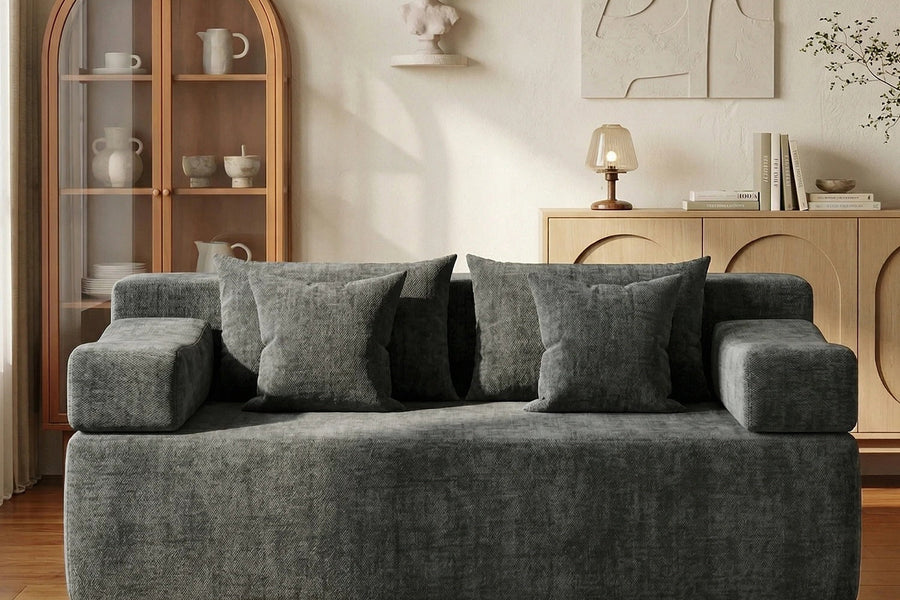


Couch Pillows
How to Decorate With Pillows on a Couch: A Daily-Use Layout
Protect the seats people use, choose a pattern from the couch shape, and build each pillow stack from rear anchor to optional front piece. Then keep only the layout that passes a sit, reach, parking, and reset test.

On this page
To decorate a couch with pillows, protect the seats people actually use, start at selected arms or corners, and build each stack from back to front. Place the deepest rear anchor first. Add a smaller bridge only if the seat stays usable. Finish with one optional focal pillow or sofa bolster pillow, then stop when another piece would block a required seat or make the arrangement harder to restore.
The right layout is not a fixed number of pillows per seat. It depends on the couch shape, who sits where, and what happens to each pillow during normal use. This six-step method gives every displayed pillow a position and a job: protect, map, layer, coordinate, edit, and reset.
Step 1: Protect the seats before styling
Remove every loose pillow and look at the full seat and back. Mark the places that must work without negotiation: a person's habitual corner, the center seat used for conversation, the chaise lane used for reclining, or the end where someone reaches a side table. Those are protected zones.
The placement sequence in this guide is Monvane editorial guidance, not a universal decorating rule. Its first rule is deliberately practical: build the arrangement around the seats, not over them. A guest-ready photograph can be fuller than the everyday state, but the daily layout should not require the household to clear the couch before sitting.
| Record | Question to answer | What it controls |
|---|---|---|
| Daily users | Who sits here, and do they use the same position? | How many positions must remain independent |
| Protected seats | Which seat or chaise lane should work immediately? | Where a stack cannot grow forward |
| Reach side | Where are the remote, drink, lamp, or side table? | Which arm or corner must stay easy to use |
| Parking place | Where can a guest-state pillow go without landing on the floor? | Whether an extra pillow can remain in the plan |
If two people use opposite ends every evening, protect both ends before adding symmetry. If one person uses the chaise and another uses the center, keep those paths open even when a catalog image suggests a denser arrangement.
Step 2: Match the pattern to the couch shape
The couch topology decides the starting points. The topology patterns are starting layouts; the household's occupied-seat test controls the final arrangement.
Straight couch
Begin at the two outer arms. One rear anchor at each end creates a frame without prescribing what belongs in the center. On a compact couch, those two anchors may be the complete daily layout. On a longer couch, a smaller piece can bridge one side or the center only when that position is not a protected seat.
Chaise or L-shaped couch
Keep the chaise length visually and physically open. Start at the non-chaise outer arm, then test one selected inside corner or the far chaise back as an optional second zone. Do not place a row of pillows down the chaise merely because its back edge is available; that edge may be the route a person uses to recline or turn.
U-shaped sectional
Distribute visual weight across the two outer arms and selected inner corners, but skip some back seams. Filling every seam can turn individual modules or seats into a continuous pillow wall. Protect the cross-couch conversation seats and any long lounging sections first, then use a bridge pillow only where a corner otherwise feels isolated.

These are placement patterns, not construction claims. “L-shaped,” “chaise,” and “U-shaped” describe the visible seat map here; they do not establish how a particular couch connects, reverses, or reconfigures.
Step 3: Build each stack from back to front
Work on one selected zone at a time. Do not scatter all the pillows across the couch and try to repair the arrangement afterward.
- Place the rear anchor. Set the deepest or visually largest piece against the back or arm at the chosen zone. Confirm that the adjacent protected seat still has a clear sitting surface.
- Add a bridge only when it earns the depth. A smaller square or lumbar can connect the anchor to another color, shape, or seating zone. It should leave enough of the anchor visible to keep the stack legible.
- Add one optional front piece. Use a smaller focal pillow or sofa bolster pillow only if it completes one position without spanning the places two users need independently.
- Stop and check the seat. If the front piece pushes the bridge into the sitting area, remove the front piece rather than compressing all three layers forward.
A bolster is a front-layer decision, not a substitute for mapping the seats. A long bolster can visually connect a solo reading corner, but laying it across two daily positions makes the users negotiate one shared object before sitting. The sofa-bolster placement is styling guidance, not medical or ergonomic advice.

Position comes before size; exact pillow dimensions remain a separate measurement decision. Once you know the exact back, corner, or front zone a pillow must occupy, measure that zone and make a full-size paper template. Use the measurement-first sofa pillow size guide for exact square and lumbar choices, insert compatibility, and template checks. The words “two-seat couch” or “sectional” are not enough to choose a pillow size.
Step 4: Give each visible layer one color job
How to style a sofa with pillows becomes easier when physical depth and color order agree. Let the rear layer relate to a large stable field. Let a smaller middle layer connect one existing room cue. Add contrast last, and only when the room needs it.
- Rear layer: repeat. Repeat the couch color, a large rug field, or another stable background so the biggest pillow does not start an unrelated palette.
- Middle layer: bridge. Touch one color, material, or line already visible nearby. The bridge can connect the couch to wood, metal, a rug, or art without copying any item exactly.
- Front layer: optional contrast. Use the smallest visible piece for a deliberate contrast only when another large pattern or bright field is not already leading the room.
Repeat, bridge, and contrast are editorial color jobs, not a universal palette formula. A patterned couch may need only repeat and bridge. A quiet solid couch may accept one contrast. If every layer introduces a new color and pattern, remove the front piece first and reassess before buying anything else.

Pattern scale can follow the same edit: let one layer carry the clearest pattern, keep the neighboring layer quieter, and leave enough visible surface for each to read. Do not add a second strong pattern merely to create a matched pair.
Step 5: Set the count from the removal burden
If you are asking how many pillows should be on a couch, start with the minimum pattern for its shape rather than a fixed pillows-per-seat formula. The useful count is the smallest arrangement that still makes the intended rhythm visible.
The layout counts are editorial starting points, not standards or product requirements. A practical daily starting state can be:
| Couch and routine | Start with | Add only when | Remove when |
|---|---|---|---|
| Compact straight couch used by two people | One rear anchor at each outer end | A small bridge can stay without narrowing either daily position | Either user must remove the same piece every time |
| Three-seat couch with one habitual corner | One two-layer stack away from the habitual corner plus one quiet outer anchor | The guest seat and reach side remain clear | The middle turns into permanent pillow parking |
| U-shaped couch used by a family | Outer anchors and one or two selected corner bridges | The added piece balances an empty zone without filling a required seat | Pillows migrate into a pile during every gathering |
Count the removal burden, not only the pillows. A piece that stays behind a user's back may have a stable daily role. A piece that always moves to a basket can belong to a deliberate guest state. A piece that repeatedly lands on the floor has failed either its position or its count test.
Three layouts worked from daily routines
The couch examples are hypothetical; their routines and results are not observed customer homes. They demonstrate how the same procedure changes when the protected zones change.
Two-seat daily couch for a couple
Inputs: both seats are used every evening, each person reaches a different side table, and no clean floor-level parking place is available. Layout: use one rear anchor at each outer corner. Test the couch without a middle pillow first. A small lumbar can enter a guest-ready state only if it has a defined basket or bench when both users sit. Stop: do not add a third daily piece merely to make the number odd.
Three-seat couch for one daily user and an occasional guest
Inputs: the daily user occupies the right corner, the left and center become a guest zone, and the remote lives on the right. Layout: keep the right reach side light. Build a rear anchor and smaller bridge at the left outer corner, then use one quiet rear anchor on the right only if it does not compete with the remote or arm. Recovery: if the left bridge is pushed into the center whenever a guest sits, move it to a guest-state parking place.
U-shaped sectional for family conversation
Inputs: two long sections and the center are occupied during gatherings, people face across the couch, and the two outer arms are not daily lounging positions. Layout: place tonal rear anchors at both outer arms and test one bridge at a selected inner corner. Leave at least one inner corner and several back seams unfilled. Stop: do not keep adding pillows until the U shape becomes a continuous decorated perimeter.
The current Monvane U-Shaped Sectional Couch (Chenille) page, checked August 18, 2026, associates the featured orange image with that exact product record. The image visibly shows several matching loose square pillows distributed along the back and open seat fields. That observation is a visual example only: recheck the current product page for the selected item, and never infer included accessories or specifications from staging.
Step 6: Test use, parking, and recovery
Do not finish by photographing the couch. Finish by using it.
- Sit. Each required user takes the normal position. If the couch must be cleared first, mark every displaced piece.
- Reach. Use the remote, side table, lamp, or drink position normally. Move any pillow that blocks the ordinary reach side.
- Park. Give every displaced guest-state pillow one clean temporary place. “On the floor for now” is not a parking plan.
- Reset. One person restores the arrangement without opening a reference photo. If the position is ambiguous, simplify the stack or record one repeatable rule such as “two layers at the left arm, one rear anchor at the right.”

Use three direct recoveries. Move a stack to a non-daily corner when its job is useful but its position fails. Remove a piece that repeatedly blocks a seat or lands on the floor. Define parking for a pillow that belongs only to the guest-ready state. If pillows slide or collapse, retest their position and shape before purchasing more.
The layout is complete when required seats remain open, every displayed pillow has one named job and position, removed pieces have a parking place, and one person can restore the same arrangement without guessing. Stop there. The finished couch should be ready to use, not merely ready to photograph.