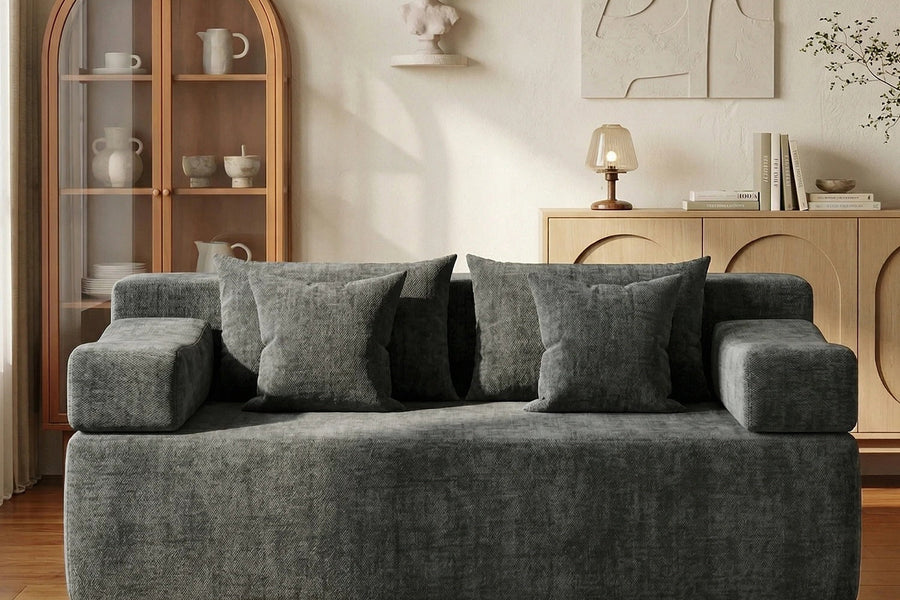


Color Palette
What Color Couch Should I Get? A Room-First Guide
Choose the couch color that fills one missing room job: quiet anchor, bridge, or focal point. Record the fixed fields, compare three exact upholstery samples, and approve the winner only after a matched day-and-evening test.
On this page
Choose the couch color that does one job your room still needs: quiet anchor, bridge, or focal point. A quiet anchor is the conditional winner when the room already has several strong fixed colors. A bridge color is better when the wall, floor, rug, and repeated finishes feel disconnected. A bright or patterned focal color belongs only in a comparatively quiet room that can give the couch visual priority.
If you are asking “What color couch should I get?”, do not begin with a color name. First record the surfaces that will stay, then compare three exact upholstery samples in the intended couch location under your normal day and evening light. Color approval does not replace room, delivery, material, care, comfort, or seller-policy checks.
Record the room before the couch
The couch is large; the walls, floor, rug, wood and metal already occupy the room with it. Make the expensive, slow-to-change surfaces vote before the couch does. This prevents a favorite online color from entering a room where it has no clear visual job.
Begin only after the exact couch has passed physical fit. Record its finished footprint and delivery route with the living-room couch measurement guide. Then make this five-field room record:
| Field | What to record | Why it matters to couch color |
|---|---|---|
| Wall behind or beside the couch | Physical paint chip or finish sample, not only a color name | It forms the largest adjoining vertical field and controls whether the couch outline stays distinct |
| Floor | Visible material and color at the couch position | It remains below the full couch and can make a near-neutral candidate disappear or separate |
| Largest rug | Main colors, pattern scale and how much of it stays visible | A strong rug may already own the focal-point job |
| Repeated wood or metal finish | A finish seen on at least several visible objects | A bridge color can connect repeated fields; one isolated accessory should not control the couch |
| Couch visual size | Compact, medium or room-dominant from the main approach | The more space the couch occupies, the more commitment its color carries |
Do not choose from a close-up alone. Stand at the room entrance and the main seated position. If the couch will dominate both views, require its color to perform the same job from both.

Give the couch one color job
Assign the couch one job before you assign it a color. The anchor, bridge, and focal-point framework is Monvane editorial guidance, not a universal color rule. It is useful because every candidate must solve the same stated room problem.
| Couch-color job | Choose it when | Candidate direction | Disqualifier |
|---|---|---|---|
| Quiet anchor | The room already has a strong rug, art, cabinetry or several fixed colors | Low-chroma neutral or near-neutral that remains distinct from wall and floor | It disappears into a neighboring fixed field or adds a new undertone conflict |
| Bridge | Two or more fixed fields feel separate but share a repeatable material or color cue | Muted color that visibly relates to at least two important fields | It matches one small accessory but has no relationship to the large room surfaces |
| Focal point | Walls, floor and rug are comparatively quiet and the room lacks one dominant field | Bright, saturated or multicolor upholstery the household intentionally wants to lead | Another large pattern or bright fixed field already competes for attention |
Choose one job only; if two rows seem equally necessary, simplify another large room field before buying the couch. A couch that must disappear and lead at the same time has no stable selection criterion.

Build a three-candidate shortlist
Compare three exact candidates, not three abstract color families. “Beige,” “green,” or “orange” is too broad for approval. Record the seller, exact product or SKU, upholstery, exact option label and whether a physical sample belongs to that exact material and color.
- Choose Candidate A for the quiet-anchor job. It should reduce competition without merging into the wall or floor.
- Choose Candidate B for the bridge job. Name the two important fixed fields it connects; do not count a single removable accessory.
- Choose Candidate C for the focal-point job. Remove or cover other optional focal items during the test so the couch receives a fair reading.
- Attach one disqualifier to each candidate. A disqualifier is observable: edges disappear, another large field competes, or the household rejects the full-room commitment.
Do not let three candidate colors hide three different products. Keep size, configuration, upholstery family, photography source and seller evidence as comparable as possible. If color forces a change of fabric or model, run the material and comfort decision again; the sofa-fabric evidence guide owns that separate risk.
| Candidate record | A · quiet anchor | B · bridge | C · focal point |
|---|---|---|---|
| Exact identity | Product, upholstery, option label | Product, upholstery, option label | Product, upholstery, option label |
| Fixed fields served | Fields it lets remain dominant | Two fields it connects | Quiet fields that support it |
| Exact sample | Received / requested / missing | Received / requested / missing | Received / requested / missing |
| Disqualifier | What makes it disappear or conflict | What breaks the two-field link | What creates a second focal fight |
Handle mushroom, bright, and multicolor options
Mushroom color couch
Mushroom is treated here as a shopping label; the exact physical sample controls the decision. Shortlist it as a quiet anchor only if the sample remains visibly separate from the wall and floor. Shortlist it as a bridge only if its exact sample connects two important fixed fields rather than merely echoing one cushion or vase.
Pause when the name is the only evidence. The word does not tell you whether the candidate will sit closer to your wall, floor, rug or none of them. If the exact sample makes the couch boundary disappear from the main approach, reject that candidate even if the name sounded safe online.
Bright color couch
A bright couch should solve a focal-point problem, not create a second one. It is a stronger conditional choice when the wall, floor and rug are quiet, the couch has a clear position from the room entrance, and the household intentionally accepts a large bright field rather than trying to hide it with neutral pillows.
If the room already has a strong patterned rug, large saturated art or colorful cabinetry, test whether a removable bright accent can do the job with less commitment. The couch should not win merely because it is the most exciting sample in isolation.
Multicolor couch
For a multicolor couch, count the pattern as the focal point before adding anything else. Lay out a sample large enough to show the repeat. Identify the background color, the most visible color from across the room and at least one color that has a real relationship to a fixed room field.
Reject the pattern when it competes with another dominant pattern or when its strongest color exists nowhere else in the fixed room and the household does not want a deliberate contrast. These color branches are editorial decision aids, not predictions of taste, resale value, or future trends.
Test the exact sample in two light states
Approve the material sample in the room, not the color name on a screen. The two-light test is an editorial comparison method; it does not calibrate color or guarantee a match. Its purpose is to give every candidate the same observable conditions.
- Place all exact samples where the couch will sit. Put them against the wall field and close enough to the floor and rug to read those relationships together.
- Use the normal daylight state. Do not switch on extra lamps only to rescue one candidate.
- Observe from the main approach and seated position. Record whether the couch outline remains legible and whether the intended anchor, bridge or focal job is clear.
- Repeat under normal evening light. Use the lamp settings the household ordinarily uses in that room.
- Keep the comparison matched. Keep the sample position, surrounding materials and lamp settings the same for every candidate.
- Issue one result. Pass only when the candidate keeps its assigned job in both states; pause when the exact sample or a decisive fixed element is missing; reject when the job changes or another large field begins to compete.

A small sample does not reproduce the visual scale of a full couch. Use the test to eliminate unstable candidates, then check seller sample terms, current product imagery and the return policy for the remaining exact selection. When no exact sample is available, keep the color decision provisional rather than upgrading a product photo into proof.
Read one current Monvane color example correctly
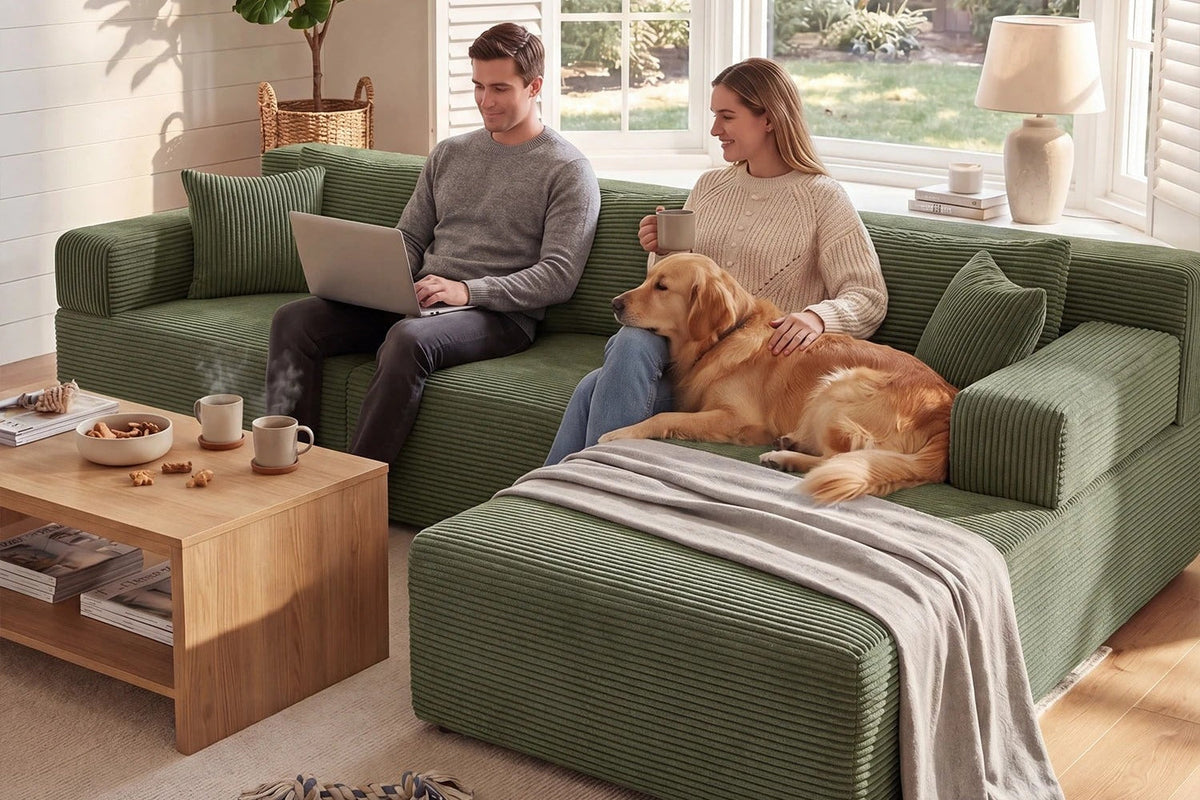
The current Monvane L-Shaped Sectional Couch (Corduroy) page, checked August 18, 2026, lists Green, Grey and Orange as its exact Color option labels. Those are product-specific names on that page, not three universal room roles. Recheck the selected variant and current page before purchase.
The option label identifies the selected variant; it does not finish the room-color decision. Green may behave as a bridge in one room and a focal point in another. Grey may act as a quiet anchor, or it may merge into a similarly valued wall and floor. Orange may be the intended focal field, or it may compete with a warm patterned rug. The room record and exact sample decide which description applies.
The styled image shows green as one large field beside warm wood, light neutrals and darker accents. It does not verify your wall paint, floor, lamp setting or physical sample. The styled product image is used only for visible relationships; it cannot guarantee how the fabric will appear in another room. Use it to understand the size of the commitment, not to approve an exact match.
Work one room from inputs to a decision
The worked room is hypothetical and its inputs and verdict are not observed customer results. Its declared inputs are warm white walls, honey-toned wood flooring, a rust-and-cream rug, black metal lighting, and medium daylight. Assume the couch already passes physical fit and the room has no other dominant pattern.
| Candidate | Assigned job | Matched observation | Example result |
|---|---|---|---|
| Mushroom | Quiet anchor | The assumed sample sits too close to the warm wall, floor and cream rug field | Pause and try a more distinct exact near-neutral sample |
| Muted green | Bridge | The sample remains separate while connecting the warm wood and rust field without duplicating either | Pass, subject to the exact two-light sample test |
| Warm orange | Focal point | The candidate becomes a second large warm field beside the already prominent rust rug | Reject unless the rug or focal-point plan changes |
Muted green wins this example because it bridges the existing warm surfaces without disappearing into them or becoming a second warm focal field. That verdict belongs only to the declared inputs. Replace the rust rug with a quiet solid rug, change the floor or test a different exact mushroom sample, and the result may change.

Make the final couch-color decision
A purchase-ready couch-color record should answer every line below without borrowing evidence from a different product, room or photograph:
- The exact couch has already passed room footprint and delivery-route checks.
- The wall, floor, largest rug, repeated finish and couch visual size are recorded.
- The couch has one declared job: quiet anchor, bridge or focal point.
- Three exact product and upholstery candidates were compared.
- An exact physical sample is attached to the selected option, or the decision remains paused.
- The candidate keeps its job in normal daylight and evening light from the main room views.
- The household accepts the full-couch commitment and no other large field creates a conflict.
Pass when all seven lines are complete. Pause when the exact sample, fixed-room evidence or second light state is missing. Reject a candidate when it cannot keep one useful color job without hiding the couch outline or starting a second focal fight.
If you already own a gray couch, move to the gray-sofa room-palette guide. If you already own a black couch, use the black-sofa living-room color guide. Those pages decorate around a fixed couch; this page decides the couch color before purchase.
The answer to “What color couch should I get?” is therefore conditional but concrete: choose the exact sampled color that fills the room's one missing visual job and keeps that job in both normal light states. Do not approve a mushroom label, a bright thumbnail or a multicolor pattern until the physical candidate passes beside the materials that will actually remain.