

L-Shaped Sectional
L-Shaped Modular Sectional Sofa: Give Both Sides a Job
An L-shaped modular sectional works when the long run, turn and return each have a defined job and the exact orientation preserves the entry route, focal-point view and table access. Mirror both plans before choosing a left- or right-facing label.
On this page
An L-shaped modular sectional is the right choice when its long run handles the primary seating job and its return adds a second useful function without blocking the room. Do not buy the shape from a left- or right-facing label alone. Draw the exact modules from above, mirror the return and test entry, focal-point and table routes in both plans.
Fast decision: write one job for the long run, one for the return and one for the turn. Place doors, focal point and table on a floor plan. Reject the orientation when the return interrupts the main path, creates unusable seats or makes the corner impossible to serve.
Assume modularity is already proven
This guide begins after you have the exact module inventory, supported configurations and connection method. It does not decide whether a seller’s “modular” claim is valid. That separate question belongs to the module-evidence audit.
Here, the product must pass a geometry test: what does each side of the L do, where do people face, and what does the projecting return cost the room? A fixed L and a modular L can share the same footprint; modularity matters only if the selected pieces support the plan you intend to use.
Break the L into three jobs

The long run: primary seating and focal point
The longest side usually holds the most regular seats. Decide whether those people watch a screen, face visitors, look toward a window or split attention between two focal points. Count usable sitting positions from seat widths and boundaries, not from a product name. A very wide arm, corner transition or pillow arrangement can change how many people sit naturally.
The return: lounge, seating or boundary
A chaise-style return usually directs legs forward. A seated return with back support can add inward- or forward-facing places. An ottoman-built return may move, but only if the exact piece is independently supported and the alternate configuration is documented. Choose one primary job; a return cannot be assumed to perform every one equally well.
The turn: the shared pressure point
The turn joins the two axes and often controls sightline, shoulder room and table access. Determine whether it is a dedicated corner seat, overlapping cushions, a chaise end or a meeting of separate modules. Ask who will actually choose that position and where their feet, drink and conversation partner will be.
Choose the L type from the return job
| L construction | Best starting job | Question before buying |
|---|---|---|
| Fixed chaise terminal | One dependable feet-up position | Is the handedness permanent, and does the projection clear the route? |
| Reversible chaise | A return that may switch ends | What physically moves, and are both final states fully supported? |
| Ottoman-built return | Flexible lounge or independent piece | Can the ottoman safely perform every planned role? |
| Corner-seat return | More upright seating around the turn | Do the return seats face the conversation or focal point? |
| Modular seat return | A longer L that may later shorten | Are exposed sides finished and approved after a module is removed? |
The “best” L is therefore conditional. A chaise may be efficient for one lounger and wasteful for three upright users. A seated return may support hosting and add unnecessary depth to a TV-only room.
Prove orientation from above

Seller conventions can describe handedness from the viewer’s perspective or the seated person’s perspective. Do not settle the order with words alone. Obtain or create a plan-view image of the exact selected configuration, mark the entry and focal point, then attach that image to the order record.
Mirror the plan. If one return sits beside the entry, simulate a person carrying bags through the door. If it faces a window, check curtain, vent and cleaning access. If it opens toward the room, test whether it defines the seating zone or divides people from the rest of the space.
Test three collisions
Route collision
Trace the normal path to every seat, door, cabinet and window. Include people already seated and the coffee table in the simulation. The return fails when users must repeatedly squeeze behind it, step over it or cross the viewing line.
Sightline collision
Sit on the long run, turn and return. Note head and eye direction rather than assuming every seat shares the same view. A corner can be valuable for conversation and weak for a screen. Keep the weaker view only when the household has another reason to use it.
Service collision
Map safe access to a table, outlet, reading light and a place to stand. A large coffee table may serve the long run while leaving the return isolated. A smaller or movable surface may improve access, but it also needs a parking location and must not become another route obstacle.
Count usable seats by routine
Write two occupied plans: ordinary evening and full expected gathering. Assign a person or role to each position. Mark where feet, elbows and bags go. If the corner is empty in both routines or the return works only when the table disappears, the advertised capacity does not describe your usable layout.
Do not force the maximum number of bodies into the plan. The practical capacity is the number of positions that satisfy your posture, sightline, access and personal-space expectations in that routine.
Use exact dimensions after the geometry passes
First decide which orientation and return job deserve the room. Then obtain the finished long-run and return dimensions for that exact configuration, plus individual module and package dimensions. Tape both axes, not just an outside rectangle. Monvane’s sectional measuring guide provides the detailed measurement workflow; this article supplies the geometry decision that should be measured.
Keep the future rank-35 dimension task distinct: measurement cannot rescue an L whose return has no job, even when the outside numbers fit.
A current Monvane L as a worked plan
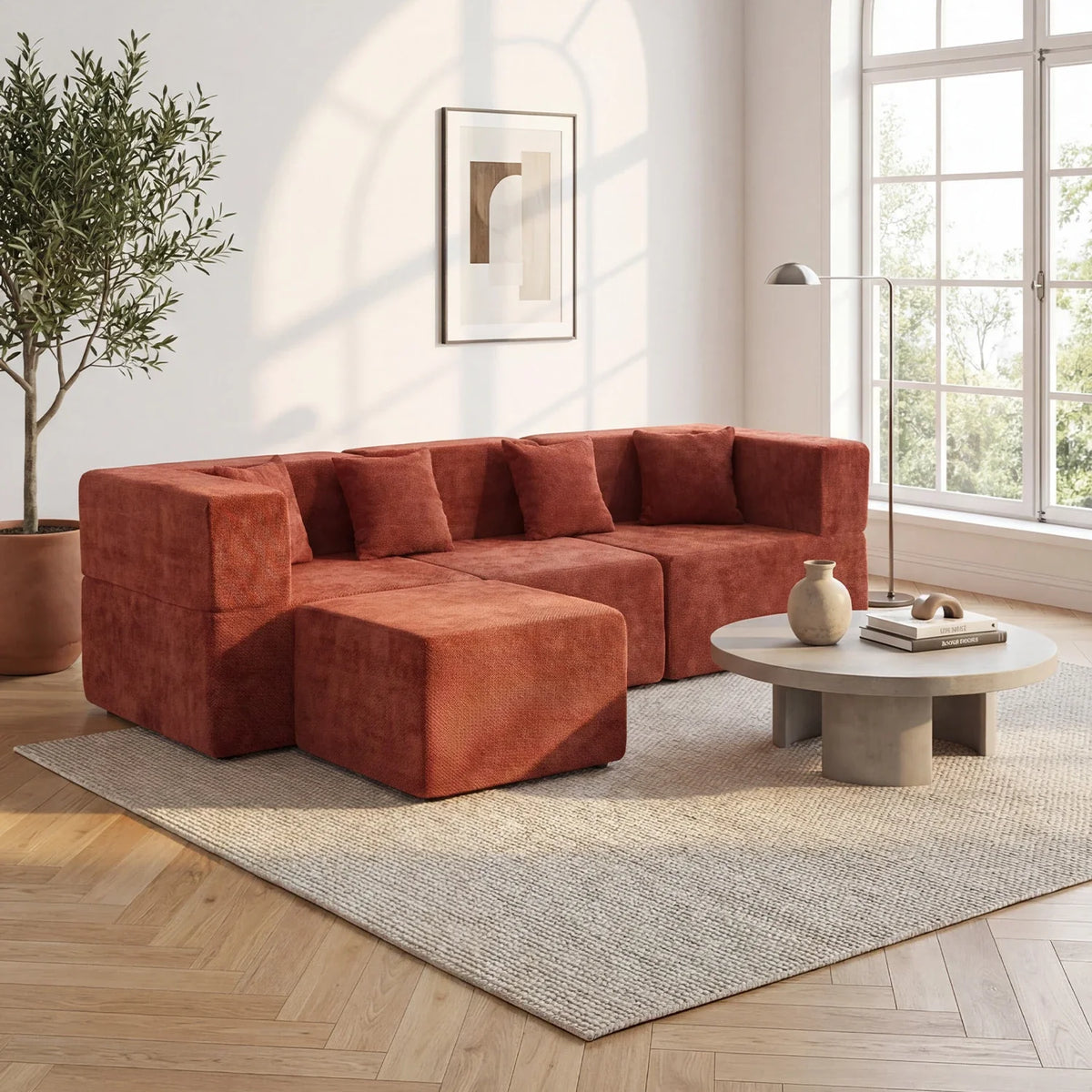
The supplied rust-red room image is filed under the L-Shaped Modular Couch product family and visibly shows a long sofa run, a turn and a forward upholstered piece. The current Monvane L-Shaped Modular Couch page lists a displayed overall size of 65 inches deep by 103 inches wide by 30 inches high, a 27.5-inch seat depth and two packages. It also offers Red among the colors and Chenille or Teddy Velvet in the material selector.
Those current facts support a candidate worksheet, not every arrangement visible or imaginable. Ask for the exact module map behind the selected material and color. On the supplied image, the forward piece clearly consumes the return zone; test whether its job is daily lounging, extra seating or a boundary, then draw the mirrored room plan before ordering.
When to choose another shape
- Straight sofa: the return has no recurring job and the room needs flexible side furniture.
- Loveseat plus chair: conversation needs two viewing directions but a permanent projection blocks circulation.
- U-shaped sectional: the room and gathering routine genuinely need two returns and inward-facing capacity.
- Smaller modular set: the L works only after removing a module or ottoman.
- Reversible chaise: orientation is likely to change and the exact reversible mechanism passes both plans.
If the sofa is already chosen, move to a post-purchase placement plan: select the focal point, preserve the main route, set table access and balance the surrounding furniture. Do not make this product-choice article compete with that separate room-arrangement task.
Questions about L-shaped modular sectionals
What is an L-shaped modular sectional?
It is a sectional made from identifiable units that form a long run and a projecting return. The exact pieces, connection method and supported alternate layouts must be verified for the product.
Which side should the return be on?
Choose the side that preserves the main entry route, supports the return’s job and keeps usable sightlines. Prove it with mirrored plan-view drawings instead of relying on a handedness label.
Is an L-shaped sofa good for a small room?
It can be when both axes fit, the return replaces another useful piece and circulation remains usable. It is inefficient when the projection has no routine job or requires furniture to be removed.
Can I put an L-shaped sectional in the middle of a room?
Yes, if finished backs and sides are suitable, both routes work, the long run or return defines a useful zone and outlets or vents remain accessible. Test the exact back view and module stability.
Can I reverse a modular L later?
Only when the exact module inventory, finished sides, connectors and approved configuration support the mirrored plan. “Modular” is not automatic proof of reversibility.
Approve the L with one annotated plan
Save the exact product option, module map, long-run job, return job, turn role, mirrored floor plans, occupied routine test, selected orientation and current specifications in one sheet. Attach the approved plan-view image to the order.
Only after every axis works should you compare current products in Monvane’s L-shaped modular couch collection. A successful L is not merely a sofa with a projection; it is a two-axis room plan in which both sides earn their floor area.