

Buying Guides
Reversible Sectional Sofa: Meaning, Limits, and Buying Checks
Decode what reversible changes, separate adjacent retail labels, and require one exact inventory to form two documented complete sectional states.
On this page
The practical meaning of a reversible sectional sofa is an exact sectional whose documented included parts support at least two complete orientations or arrangements. Its limits are product-specific: a chaise section may move, an ottoman and long cushion may trade sides, or compatible terminal pieces may change roles. Use three buying checks before checkout: identify what physically moves, confirm that the same selected inventory makes both states, and read the current setup instructions. If the second state exists only in a mirrored photo or a different left/right SKU, mark the claim unresolved.

What reversible sectional sofa actually means
Reversible describes a supported change between complete states; it does not identify the moving part by itself. A useful listing should let you answer four questions:
- What changes? Name the chaise, ottoman, cushion, arm, terminal section, or module group that changes position or role.
- What stays the same? Keep the exact size, material, variant, and included inventory constant.
- What are the two finished states? Each arrangement needs complete seating, intended support, and finished exposed sides.
- What authorizes the change? Use current plan drawings, parts information, and setup instructions for the selected version.
The label is not a universal engineering standard; the exact product page and instructions define the supported states. That boundary matters because two retailers can both use reversible while asking different pieces to move. It also keeps a category explanation from becoming an invented Monvane product promise.
Find the object that actually changes position
Do not ask only whether the sofa is reversible; ask what physically moves. Current first-party product pages show why. The current IKEA KIVIK 4-seat sectional page says its chaise section can be placed to the left or right and switched. For that exact product, the chaise section is the named moving object.
The current Article Sanders reversible sectional page describes a different architecture: the shopper changes the chaise side by shifting the ottoman and chaise cushion. Two listings can both say reversible while asking different pieces to move.
| Possible changed object | What the record must show | Reason to pause |
|---|---|---|
| Complete chaise section | Both end positions, compatible joins, arm or terminal logic, and current instructions | The second position is only implied by a flipped photograph |
| Ottoman plus chaise cushion | Where the ottoman moves, how the cushion is supported, and what covers the former position | The ottoman moves, but the long cushion or support deck does not |
| Terminal or modular sections | The exact modules, finished sides, connection rules, and supported completed plans | A module fits physically but leaves the wrong arm, connector, or exposed side |
These are recognition branches, not universal construction instructions. The physical change must come from the exact product record; a look-alike design cannot supply the missing mechanism.
Separate reversible from four look-alike claims
A flexible word is not a two-state product record. Decode the noun that each adjective modifies before comparing products.
| Listing language | What it can establish | What remains unproven |
|---|---|---|
| Reversible sectional | A claim that the selected sectional supports a named alternate state | Which component moves and how both states are completed |
| Modular | Identifiable sections participate in documented configurations | That the required mirror state is supported |
| Movable ottoman | One footrest can change location | That the seat platform and long cushion form a supported chaise on both ends |
| Reversible cushions | A cushion has two usable faces or can be flipped | That the sectional orientation changes |
| Left/right variants | The buyer can choose a handed arrangement at checkout | That one purchased set can switch after delivery |
The current Article Riley Left Sectional page demonstrates one especially easy misreading: its arrangement is labeled Left Arm Chaise Sectional, while a separate feature calls the loose back and seat cushions reversible. The second phrase describes the cushions, not a documented change in sectional orientation.
Modular answers how pieces relate; reversible answers whether a named second state is supported. A movable part or flexible arrangement can contribute to a reversible design, but only the exact second-state record completes that claim.
The claim decoder is Monvane editorial guidance for reading listings, not a substitute for the selected product's documentation. For a reversible sleeper sectional, verify orientation and bed conversion as two separate product claims.

Translate left and right into room language
Do not let left-facing or right-facing become the only orientation record. Seller viewpoints can differ, and a photo may be mirrored, cropped, or viewed from another angle. Pair the seller's exact plan drawing with stable room language:
- Save the selected variant and plan view. Keep the size, material, arms, return, and product identifier together.
- Mark the room side. Write “chaise beside the window” or “return nearest the entry” next to the drawing.
- Repeat for the second supported state. Do not create it by flipping the first image; use a second labeled product record.
- Resolve any mismatch before measuring. Ask the seller which included parts and current instructions produce each room-side description.
Write window side or entry side beside the seller's drawing. That wording survives a change in camera angle and gives support a precise question when the label and plan seem inconsistent.
Build one two-state product record
The strongest proof is not a label; it is a matched record for both states. Keep this record tied to one exact selection rather than mixing the parts list from one size with the photographs or instructions from another.
Record the selected product once
Start with the exact product name, variant or SKU, size, upholstery, color, included sections, cushions, ottoman, arms, hardware, and current instruction link. Save the check date. If the listing changes after the purchase decision, you can see which evidence supported the selected version.
Compare the two completed states
State A and State B must come from the same inventory. Complete a row for both states rather than giving the stronger state all the evidence.
| Field | State A | State B | Stop condition |
|---|---|---|---|
| Inventory | Every included piece has a named job | The same pieces have named jobs | An extra, missing, or unexplained spare is required |
| Support | Seat and chaise surfaces use documented support | The alternate surfaces use documented support | A cushion bridges an undocumented gap |
| Exposed finish | Visible sides are intended to show | Newly visible sides are intended to show | A raw panel, unused connector, or wrong arm faces the room |
| Usable seating | The completed plan preserves its documented seats | The completed plan preserves its documented seats | The second state is a compromise the listing does not disclose |
| Instructions | Current setup record matches | Current change record matches | The change requires force, hardware, or a sequence the record does not describe |
The two-state record checks purchase evidence only; it does not authorize detaching, reconnecting or moving an exact sectional. If physical connector or release details are missing, stop and obtain the model-specific instructions or written support answer.


Keep the current Monvane claim inside its evidence
The current Monvane L-Shaped Sectional Couch page says its sections are flexible, its modules can be rearranged, and the modules can connect or separate without tools. Those are useful current product facts. The same page does not explicitly name a reversible mechanism or present the same exact inventory in two labeled complete states.
Flexible configuration is verified; reversible remains a separate question. That is not a negative verdict on the product. It means a shopper should preserve the current wording and ask Monvane support for the exact module map, both intended plans, and the applicable setup instructions before treating the selected version as reversible.
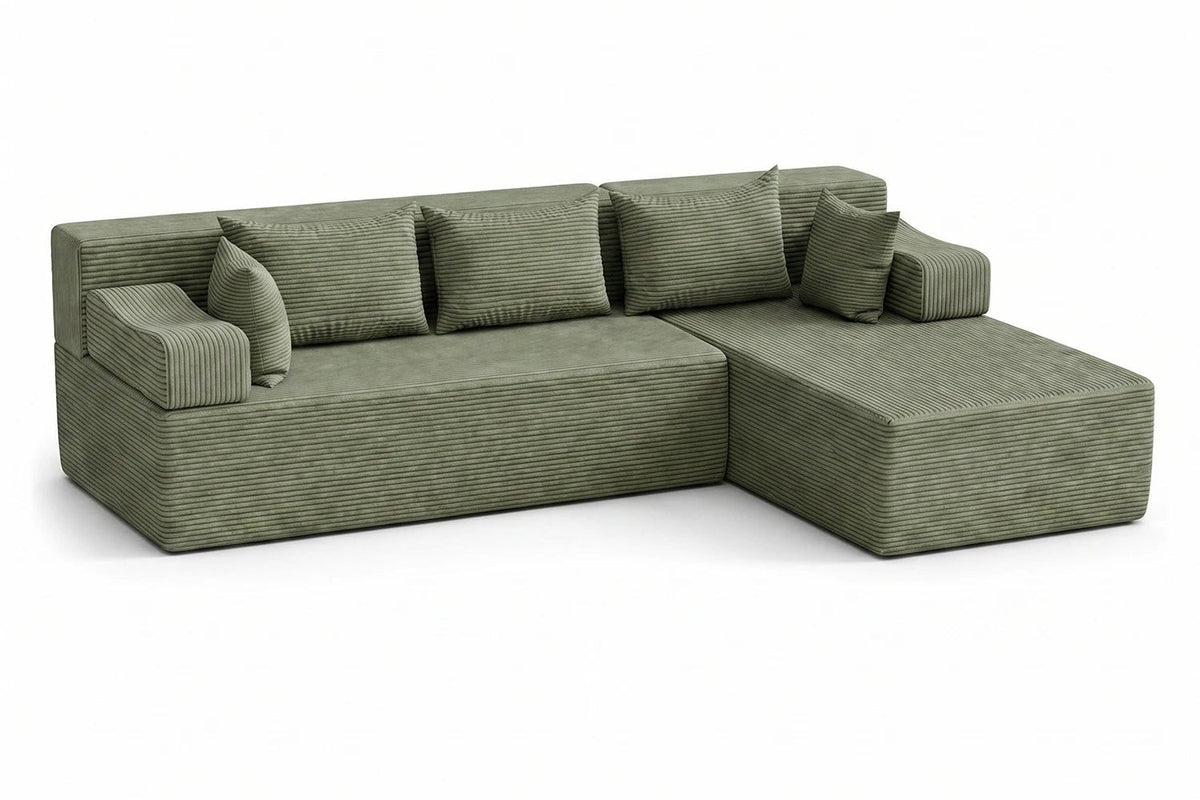
Do not use the featured photograph to fill that evidence gap. It shows one current green corduroy arrangement, not the underside, connector geometry, full inventory, or a second supported state. The current page also contains conflicting dimension blocks, so this guide does not repeat those measurements; use the final confirmed product record when moving on to room fit.
Decide whether the second state has real value
A supported second state is useful only when it has a realistic job. Name that job before treating reversibility as a buying advantage.
| Expected use | What to verify | When the feature adds little value |
|---|---|---|
| A planned move | Both exact footprints are plausible for likely future rooms and every piece travels with the set | The alternate state still fails the likely doorway, room, or return constraint |
| Periodic room changes | The approved change is practical for the household and all parts have a defined role | The switch requires undocumented handling or storage for an unused part |
| One permanent room orientation | The primary state fits better than available fixed options on the criteria that matter | No realistic second-state use can be named |
| Reversible sleeper sectional | Both orientation states plus the separate open-bed mechanism and clearance | Either claim lacks exact current evidence |
This value test is an editorial buying recommendation; it does not predict durability, resale value or switching effort. Once the product states pass, test each exact footprint in the room. The L-shaped sectional room-fit guide owns the detailed return, route, door, and floor-tape work.
Make the purchase decision from two complete states
End with one of three results:
- Pass: the exact selected inventory creates two documented complete states, the current instructions cover the change, and at least one state fits the present room.
- Unresolved: the listing uses reversible or flexible language, but the changed object, second plan, support, finished sides, inventory, or instructions remain incomplete.
- Not reversible for this decision: the evidence shows only a fixed handed variant, cushion flipping, a loose ottoman, or another change that does not produce the required second sectional state.
Buy the flexibility only after the product claim and at least one room plan both pass. If the evidence conflicts, pause checkout and ask for a written answer tied to the exact variant. If both product states are proven, save the two-state record with the order and use only the maker's current instructions for any later change.
A reversible sectional is therefore not identified by a silhouette or one marketing word. It is identified by a named moving object, one exact included inventory, two complete supported states, and current documentation. That record turns reversibility from a vague promise into a practical buying choice.