

How-To Guides
How to Float a Couch in the Middle of a Room
How far to pull a couch off the wall, how to keep a floating couch from sliding, how to style the back, and the Float Zone formula, worked with official MONVANE dimensions and clearances.
On this page
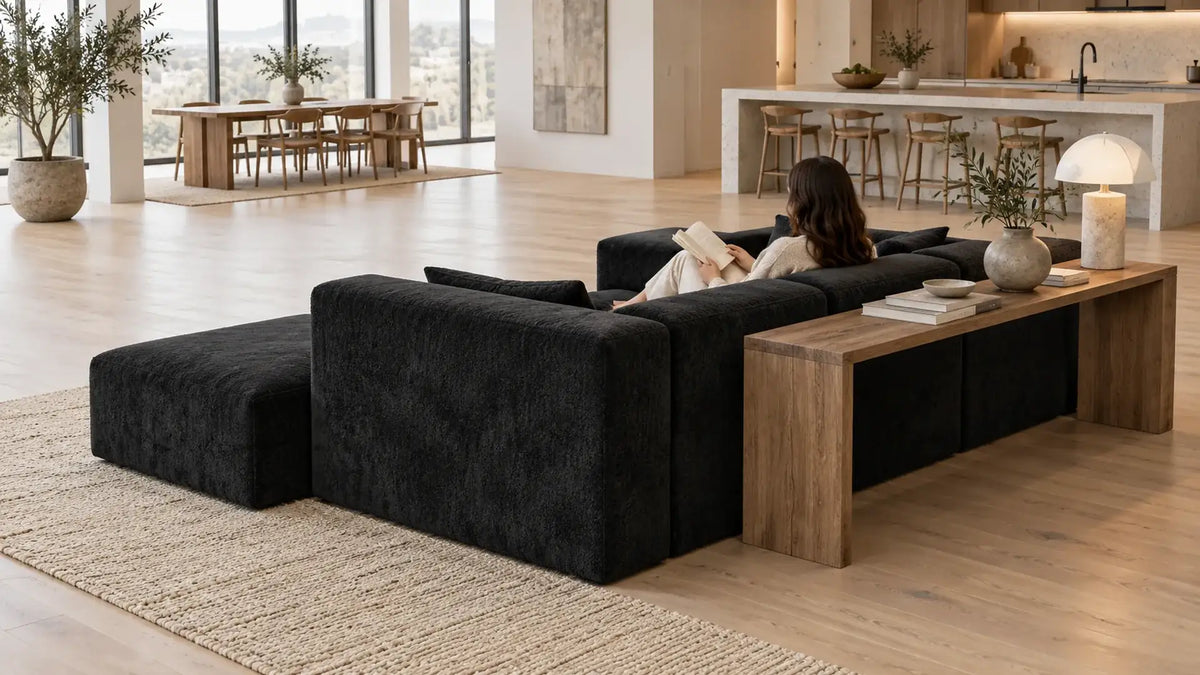
To float a couch in the middle of a room, pull it off the wall far enough for a 30-inch walkway behind it, set every base on one rug so it stays put, and keep 16 to 18 inches between the seat and the coffee table. If nobody walks behind it, the gap can be smaller, but a floated couch reads best when its back is finished with a console table or a clear path.
Before you start
MONVANE's Sofa Size Guide recommends main walkways of at least 30 inches, a 16 to 18 inch coffee table gap and 2 to 6 inches of breathing room when a sofa sits against a wall. Get your couch's depth from its product page: the Loveseat Sofa (2 Seater) is 37.4 inches deep, the L-Shaped Modular Couch 65 inches.
"Floating" a couch does not mean lifting it. It means pulling the couch away from the wall so it stands in the room. These MONVANE couches sit flat on the floor without legs, so the rug and the walkway do the work.
Floating a couch means placing it away from the walls, usually to split an open-plan room, face a fireplace or shorten the distance to the TV. It makes a room feel more deliberate, but it uses floor on every side of the couch, so it takes planning.
How far should you float a couch from the wall?
Float a couch at least 30 inches from the wall if people will walk behind it, the Size Guide's minimum main walkway; if nobody walks behind it, 2 to 6 inches or a console table's depth is enough. Planning for a wheelchair or walker? The U.S. Access Board chapter on accessible routes uses 36 inches of continuous clear width and allows 32 inches only at short pinch points of up to 24 inches, such as a doorway; it governs public facilities, not homes, but it is a sensible target for the path behind a floated couch.
| MONVANE couch | Depth (product page / Size Guide) | Floated with a 30-inch path behind |
|---|---|---|
| Loveseat Sofa (2 Seater) | 37.4-inch D × 75-inch W | 30 + 37.4 = 67.4 inches from the wall to the seat front |
| Loveseat Sofa (Chenille) | 43.3-inch D | 30 + 43.3 = 73.3 inches |
| L-Shaped Modular Couch | 65-inch D × 103-inch W | 30 + 65 = 95 inches |
| Cushioned Modular Sofa (4 Seats) | 69.3-inch D × 106-inch W | 30 + 69.3 = 99.3 inches |

The Float Zone
Float Zone = path behind + couch depth + table gap + table depth + path in front. It is the strip of floor, wall to wall, a floated couch really uses. If your room is shorter than the Float Zone, put the couch's back to a wall instead.
With a walkway behind the couch
Worked example 1 – Loveseat Sofa (2 Seater) with a 24-inch-deep coffee table. 30 + 37.4 + 18 + 24 + 30 = 139.4 inches, about 11 feet 7 inches.
Backed by a console table
Worked example 2 – L-Shaped Modular Couch, no path behind (console table 12 inches deep). 12 + 65 + 16 + 24 + 30 = 147 inches, about 12 feet 3 inches.
In a studio with no coffee table
Worked example 3 – a sofa bed in a studio, no table. Use the formula 30 + couch depth + 30. For the 43.3-inch-deep Loveseat Sofa (Chenille), that is 30 + 43.3 + 30 = 103.3 inches, about 8 feet 7 inches. If you use a fold-out sleeper such as the Oversized Sofa Bed (86.6 inches unfolded), run the same formula with its open length: 30 + 86.6 + 30 = 146.6 inches (about 12 feet 3 inches). On a floor-lounger couch such as the Convertible Loveseat, leave open floor space in front of the fixed U-shaped base when lifting its removable top seat cushion onto the floor (keeping the anti-slip grip bottom down).
The 30-inch paths and the 16 to 18 inch table gap come from the Size Guide; table and console depths are examples, so use your own.
How do you keep a floating couch from sliding?
Keep a floating couch from sliding by putting every base on one large rug with a rug pad, and pushing modules tight together; with no wall behind it, the rug does the wall's job.
MONVANE modular couches such as the L-Shaped Modular sit directly on the floor with no legs, on a non-slip base, and the Convertible Loveseat lists "a textured anti-slip grip bottom." A base that is half on a rug and half off is the most common reason a floated couch creeps. A customer review of the U-Shaped Modular Couch published on the product page (Megan K., March 11, 2026) says that with a 6-year-old "who loves roughing around," it "barely moves." For module-by-module steps, see how to keep a sectional from separating.
- Choose a rug big enough that every base sits fully on it.
- Lay a rug pad under it on hard floors.
- Set the modules on the rug and push them tight together.
- Sit on each end and check nothing shifts.

How do you style the back of a floating couch?
Finish the back of a floated couch with a console table slightly lower than the couch back, such as under the 30-inch height of the L-Shaped Modular Couch, or leave a clean 30-inch path with a runner.
- Console table. Keep it a little lower than the couch back so it reads as part of the couch. Put lamps here, not on the floor behind it.
- Cords. Run lamp cords along the floor in a cord cover, never under a rug or across the path.
- A runner. If people walk behind, a runner marks the path.

Which rooms are best for floating a couch?
Float a couch in open-plan rooms, long narrow living rooms that need a divider, and rooms where the TV or fireplace sits across from a wall of windows; skip it in rooms shorter than the Float Zone. If the couch will face a fireplace or a space heater, the U.S. Fire Administration's heating fire safety page says to keep anything that can burn at least 3 feet from heat sources.
- Open plan. The back of the couch marks where the living area ends and the kitchen or dining area begins. See how to keep kitchen and living room flow.
- Long rooms. Floating the couch creates 2 zones instead of a bowling alley.
- Small rooms. The Size Guide suggests keeping one long walkway open; a loveseat floated a short way off the wall can do that.

Which MONVANE couches float best
Compact loveseats under 40 inches deep, like the 37.4-inch-deep Loveseat Sofa (2 Seater), float most easily; modular couches float well if they sit on one rug, because each module can be pushed tight to the next.
All layouts are in the modular couch collection; for room sizes, the Sofa Size Guide. If anything arrives damaged, contact MONVANE Support with your order number and photos; the product FAQ lists a 2-year limited warranty plus one additional year after registration. This guide covers floating one couch; for arranging a sofa with a loveseat, see how to arrange a sofa and loveseat.
When floating is not the right choice
The room is too narrow for a walkway behind
If pulling the couch out leaves only a squeeze behind it, keep it against the wall and float the coffee table instead.
Cords would have to cross the walkway
Run lamp cords in a cord cover, never under a rug; if that is not possible, choose a wall position near an outlet.
Questions about floating a couch
These answers cover what people ask before they pull the couch off the wall.
Does a floating couch make a small room look bigger?
It can, if the room is longer than the Float Zone, because light and a path run behind it. In a room shorter than that, floating takes away walking space, and a couch 2 to 6 inches off the wall works better.
Can you float a sectional?
Yes. Put every base on one large rug, push the modules tight, and leave a 30-inch path on any side people walk past. An L-shape often floats with its short side used as a room divider.
What goes behind a floating couch?
A console table slightly lower than the couch back, a runner if it is a path, or nothing but floor. Keep cords in a cord cover along the floor, never under a rug.
Do you need a rug under a floating couch?
On hard floors, yes: it is what keeps the couch from creeping with no wall behind it. Choose one big enough for every base to sit fully on it, with a rug pad underneath.
How do I float a couch that faces the TV?
Measure from the TV wall: path in front, coffee table, 16 to 18 inch gap, couch depth, then the path or console behind. If that adds up to more than the room, move the TV wall or choose a shallower couch.
Sources and scope
- MONVANE Sofa Size Guide: 30-inch walkways, 16 to 18 inch coffee table gap, 2 to 6 inch wall gap, small-room guidance, and dimensions for the Loveseat Sofa (2 Seater), L-Shaped Modular Couch and Cushioned Modular Sofa (4 Seats). Checked October 20, 2026.
- MONVANE product pages: Convertible Loveseat: anti-slip grip bottom; Loveseat Sofa (Chenille): 43.3-inch overall depth; L-Shaped Modular Couch 65 × 103 × 30 inches; non-slip base. Checked October 20, 2026.
- Customer review of the U-Shaped Modular Couch (Megan K.) as published on MONVANE product pages, checked October 16, 2026.
- The Float Zone combines Size Guide figures with example table depths; it is our own routine, not a MONVANE instruction.
- Images: AI-generated illustrations based on the named product photos.
- Borrowed from public-building rules: 36-inch clear width with 32-inch pinch points: U.S. Access Board, Guide to the ADA Standards, Chapter 4: Accessible Routes (access-board.gov), checked October 23, 2026.
- Keeping anything that can burn 3 feet from heat sources: U.S. Fire Administration, Heating Fire Safety (usfa.fema.gov), checked October 23, 2026.